It may be exciting for you to join engineering college, but it could also seem challenging because there are many things that engineering students need to know.
But does joining the college mean that they should know everything right from day one?
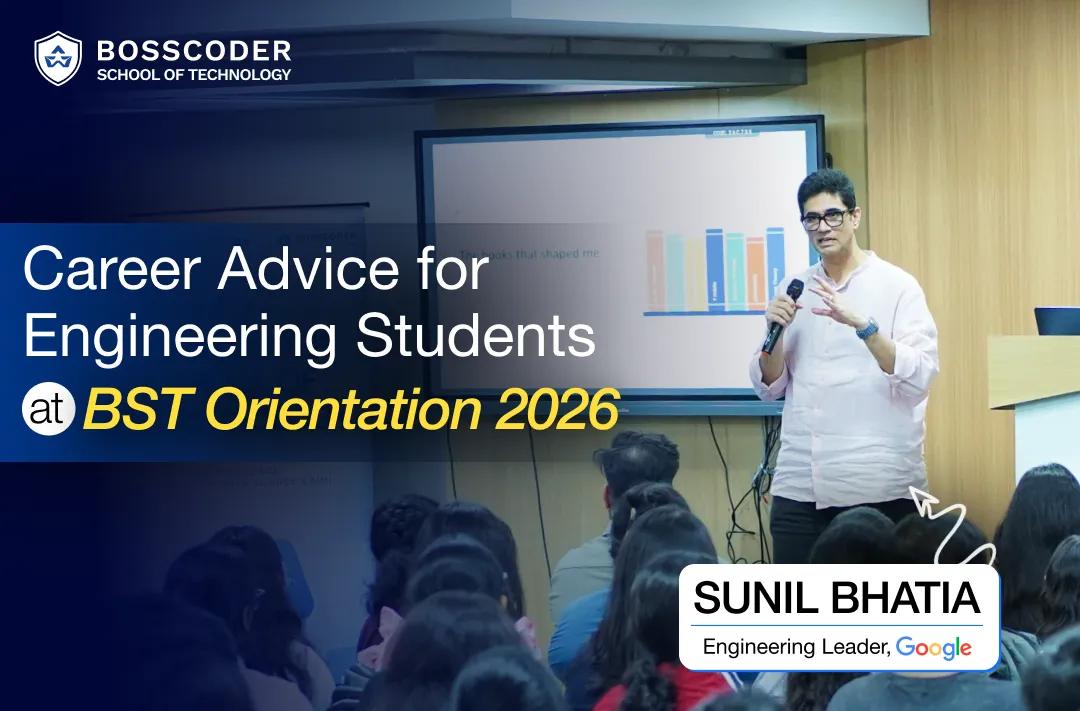
No, they don’t have to according to Sunil Bhatia, the Engineering Leader at Google.
He made a speech at the Orientation Week of Bosscoder School of Technology (BST) under the title “Everything Can Be Figured Out - A Talk for Future Engineers” with 26 years of experience in building software for Yahoo, Amazon, Stripe, Adobe, and Google. He gave career tips to engineering students and talked about how the right mindset is required for growing as a future engineer.
The main point of his speech was clear:
You don’t need to have the whole map. You only need to start.
1. Start With the End in Mind
The engineering career is not always predictable for everyone.
The first point made by Sunil Bhatia was:
"Begin with the end in mind but be flexible."
The engineering student needs a direction. One needs to think about what type of engineer one wants to become and what problems one wants to solve.
However, you do not need to plan every step of your career.
There will come a point when your interests will change after you will gain knowledge. You might get excited about some other technology, or maybe some other field altogether.
The key here is to have a direction in mind yet be flexible at the same time.
2. Make the Most of Your Engineering Education
Having an opportunity to get education in a good educational setting is just the start.
Sunil Bhatia advised students to “Respect the opportunity.”
For Bosscoder School of Technology’s freshmen who started their B.Tech journey, it involves getting the maximum benefit from the surrounding educational setting.
Students can:
- Learn from their faculty and other experienced engineers.
- Work on projects with other students.
- Try out new technologies.
- Ask questions.
- Experiment with different ideas.
- Make mistakes and learn from them.
The next four years of their life shouldn’t just become the time during which they finish a degree but the time when they build up their engineering foundations and develop their skills for an entire career in engineering.
3. Learn The Why, Not Only The What
One of the biggest differences between memorizing a concept and understanding it is knowing why it works.
One of the most important concepts discussed during the session was "Depth Over Surface."
The message was:
Know the "why," not the "what."
As an example, when learning AVL and Red-Black trees, it is not enough for students to just memorize the concepts or the functions. Rather, a better question that they may ask themselves would be:
Why does search stay fast as data grows?
Such an approach will help students develop a greater understanding of the concepts rather than memorize them only for exams.
From the perspective of future engineers, this can help build a solid foundation in technical concepts.
4. Learn by Building Real Projects
Documentation and tutorials may assist the students to begin learning, however making something on their own can advance the process greatly.
As Sunil Bhatia stated:
“Read real source. Then rebuild a piece.”
The students should select an open source project that inspires them, learn how it is made, and rebuild one module from scratch.
Learning becomes more active and involves solving problems.
One does not just study how software functions, one tries to make it function.
It is hard and challenging task indeed, but it may uncover any weaknesses in your knowledge and teach you more practical engineering skills.
5. Go Beyond the Code
It’s true that technical knowledge is essential, but engineering students might benefit from going beyond the code.
Sunil's message was simple:
“Read. Read. Read.”
Among other things that were suggested during the presentation, the following books and topics have inspired him:
- CLRS
- Clean Coder
- The Pragmatic Programmer
- The 7 Habits of Highly Effective People
- Systems Thinking
- Economics
- Game Theory
The larger idea was to read across code, craft, and life.
Various topics will offer unique perspectives and ways of thinking, which could be helpful for engineers in solving problems.
6. Build Your Professional Portfolio in Public
While students may concentrate very much on grades, courses, and certificates,
their work will have much more value if others can see what you make.
Sunil advised the students to network openly.
The strategy was quite simple:
- LinkedIn – so that others could find you
- Blog – so that you could start to think and express yourself
- GitHub – so that you could showcase what you are capable of making
This way, students of Bosscoder School of Technology can make a portfolio of their own.
Instead of claiming that you know something, you can prove this with projects, code, text, and solving problems.
7. Do Not Wait For a Mentor
While mentoring can prove useful, students should not necessarily wait for someone to become their mentor.
The session offered a different approach:
Follow → Build → Share
Follow those people whose work inspires you. Create something out of what they create. And then share what you created.
Once you continuously create and share, it’s likely that those people who inspire you will come across your work someday.
The key takeaway is clear: start generating value before expecting guidance from others.
8. AI as a Tool, Not a Crutch
AI is becoming an integral aspect of technology/software development for today’s engineering students.
Sunil Bhatia advice was balanced:
"Do not fear AI - and do not become its slave."
AI may facilitate the process of working and learning. However, students must not let AI take away their capacity to think.
This aspect of AI was reflected in:
"You hold the wheel."
Even future engineers have to know what the problem is, analyze the output, make decisions, and understand the system itself.
AI will accelerate your work. However, you will have to know where you are going yourself.
9. Build What You Don’t Know
It’s nice to work on what you already know.
But growth usually takes place when you work on something new. This was highlighted by the phrase “Range” in the presentation.
The idea was:
“Feel what you know. Build what you don’t.”
The students are advised to learn about challenging fields such as bit-wise techniques, rasterization, and collision detection through KD-tree.
There is no need for knowing all that before undertaking the project.
Sometimes, the way of learning is by building something which is unknown.
10. Invest in Yourself Through Practical Experience
It is not necessary that learning involves spending money on expensive things.
Sometimes, building and shipping a project can provide valuable experience.
The lecture gave a practical example for the same:
- Purchase a domain.
- Host a server.
- Develop an application.
- Integrate the application through your own API.
Money spent is not the aim.Experiencing the whole process by yourself is the target. There is a difference between knowing something and implementing it practically.
11. Teach What You Learn
A simple method for testing your knowledge is by explaining a concept to someone else.
Teaching was discussed as a method to achieve deeper learning in the presented lecture.
In the case of engineering students, teaching is not necessarily about giving lectures in front of class.
It can be about:
- Explaining a concept to a friend
- Creating a technical blog
- Sharing the things you have learned
- Assisting a person in solving some problem
Thus, when you teach others, you reinforce your knowledge at the same time.
12. Learn From Failure and Keep Going
Failure is a part of engineering discipline.
Projects may fail. Bugs can take hours to be fixed. Sometimes technical terms need more than one attempt to be understood.
The message by Sunil Bhatia is the following:
"It's ok to fail. Never ok to quit."
Failure may become part of the learning process, and not the indication that you are not capable of doing something.
For engineering students, developing the skill to move on in spite of difficulties can be as important as learning technical aspects.
13. Remember the Power of “Yet”
In addition to the growth mindset by Carol Dweck, another interesting factor discussed in the session is the following:
Yet.
The difference between the two phrases:
“I can't do this.” And “I can't do this… yet.”
Is quite powerful, turning an absolute inability into a limitation that might be overcome eventually.
For the students starting their engineering career, this approach may make even hard topics and technologies look a little more manageable.
You don’t have to know everything today. You have to continue learning.
14. Make Sure to Learn About Money
While engineering education mostly deals with technical skills, there are other things the session made students aware of, such as:
“Learn about money before you earn it.”
It means gaining the economic literacy and skills in terms of compound interest and money management at an early stage.
In general, this point implies that while developing a career, it’s also necessary to learn about the environment outside of your field.
Lessons for Engineering Students at BST
This session at Bosscoder School of Technology is not about discovering the ultimate career path.
It is about cultivating the mentality that will drive the process of continuous development.
What students who just started B.Tech should remember is the following:
- Start with a direction.
- Understand things deeply.
- Build real projects.
- Read outside the coding field.
- Share your work.
- Tackle new challenges.
- Utilize AI properly.
- Learn from failure.
- Teach others.
- Keep moving forward.
Your first year of study does not have to be the same as your final year.
Learning, changing your mind and experimenting is totally fine.
Frequently Asked Questions
Q1. What career advice did Sunil Bhatia share with engineering students at Bosscoder School of Technology?
According to Sunil Bhatia, engineering students must start with direction, learn thoroughly, create real projects, share what they have created, apply AI intelligently, take lessons from mistakes, and develop their skills continuously. The key point that he highlighted is to "just start."
Q2. What do engineering students need to do while studying B.Tech?
There are certain things that engineering students must focus on while pursuing B.Tech such as learning basics, concept learning, creating real projects, trying new technologies, reading beyond coding, and experimenting.
Q3. What did Sunil Bhatia say about the use of AI by engineering students?
Sunil Bhatia encouraged students not to afraid of AI and not rely on it. He also said that it could help speed up the process but students still have to think, ask questions, understand, and make their own decision.
Q4. How can engineering students create a successful career and professional profile?
Students can create their professional profile by getting involved in actual projects, participating in open source projects, publishing their work on LinkedIn or blogs, and showcasing their projects on GitHub.