A certificate lists what you studied. A GitHub repo shows what you built. For engineers with 2–8 years of experience moving into AI/ML, the right AI ML projects for portfolio reviews are what turn a resume into an interview.
This guide covers the projects inside the Bosscoder AI & ML Program: what each one builds, how to measure it, and how to present it. Fourteen of the program’s 15+ projects are listed, each scoped at about six hours.
Short Answer
Short answer: The Bosscoder AI & ML program includes 15+ portfolio-ready projects across eight phases. They run from churn analytics and recommenders to RAG assistants, LangGraph agents, and a FastAPI-to-AWS deployment. Together they cover the four target roles: Data Scientist, AI/ML Engineer, GenAI/LLM Engineer, and MLOps/AI Platform Engineer.
Where to Start: Quick Picks by Goal
- Only three projects? Build the RAG assistant, the LangGraph agent, and the FastAPI-to-AWS API. They show GenAI, agents, and deployment.
- Targeting Data Scientist roles? Lead with churn analytics, credit risk, and bank churn prediction.
- Targeting MLOps roles? Lead with the inference API and the retraining pipeline.
- New to ML? The program starts with foundations, so begin with the sales intelligence project.
What Recruiters Look for in an AI & ML Portfolio
Recruiters and hiring managers scan repos quickly. Four signals decide whether they keep reading:
- A real-world problem: churn, credit risk, support automation.
- Deployment: a model behind an API beats a notebook.
- Documentation: a README with decisions and trade-offs.
- Measurable results: metrics and a baseline to compare against.
Each project below is built around a business-style problem, so these signals come naturally. A certificate cannot show any of these. A repo with a clear README, a live demo, and an honest evaluation can.
How the Program’s Projects Are Organized
The projects below follow the curriculum order, in three groups:
- ML foundations (8 projects): analytics, statistics, classical ML, computer vision, and NLP.
- GenAI and agents (4 projects): prompting, RAG, and agent systems.
- Production and MLOps (2 projects): deployment, versioning, and retraining.
How to Choose Which Projects to Feature
You will build many projects, but not everyone belongs on your resume. Choose which to feature with three questions:
- Does it match the role you want? Data Scientist, AI/ML Engineer, GenAI/LLM Engineer, and MLOps/AI Platform Engineer roles each need different proof.
- Can you finish it end to end? A finished project beats an abandoned ambitious one.
- Can you explain it in two minutes? If not, interviews will be hard.
AI & ML Projects for Portfolio: The 14 Projects You Build
E-Commerce Sales Intelligence
You clean raw e-commerce transaction data with Pandas. You explore it with Seaborn charts to find sales trends, top products, and seasonality. The output is a set of business insights and recommendations.
Question: What do raw sales records reveal?
Stack: Pandas, Seaborn
Build: You clean raw e-commerce transaction data, then analyze it for sales trends and actionable business insights.
Measure: Report three insights, each backed by a chart.
Why it counts: Shows you can turn messy data into business decisions.
Resume bullet: Analyzed [n] transactions in Python and surfaced [x] insights on sales trends.
Customer Churn & Retention Analytics
You analyze customer behavior to see who leaves and why. Hypothesis tests (SciPy/statsmodels) show which factors really drive churn. You turn the findings into a data-backed retention strategy.
Question: Why do customers leave?
Stack: Pandas, SciPy/statsmodels
Build: You analyze customer behavior and use hypothesis testing to identify churn drivers. Then you develop a data-driven retention strategy.
Measure: Report test results and effect sizes for each driver.
Why it counts: Shows statistical rigor, not just model fitting.
Resume bullet: Identified [x] churn drivers using hypothesis testing and proposed a retention strategy.
Credit Risk Analytics & Loan Default Simulator
You convert customer data into numerical features and probability distributions. These feed a statistical model of how likely each borrower is to default. The result is a loan default risk scoring system.
Question: How likely is a borrower to default?
Stack: NumPy, SciPy
Build: You turn customer data into numerical features and probability distributions. You then build a statistically grounded default risk scoring system.
Measure: Explain the score in plain language.
Why it counts: Shows probability and risk thinking.
Resume bullet: Built a loan default risk scoring system with [method] and validated it on [n] records.
Portfolio Optimization & Investment Strategy
You use linear algebra and optimization (NumPy, SciPy) on asset return data. The goal is to find the mix of investments that balances risk against return. The output is an optimized portfolio and an investment strategy.
Question: How do you balance risk and return?
Stack: NumPy, SciPy, Pandas
Build: You apply linear algebra and optimization techniques to an investment portfolio. The goal is balancing risk against return.
Measure: Compare your allocation with a simple equal-weight baseline.
Why it counts: Shows applied math, not just library calls.
Resume bullet: Optimized a portfolio using [method], improving [metric] from [x] to [y].
Bank Customer Churn Prediction & Retention System
You build and tune classification and ensemble models (XGBoost/LightGBM) to predict which bank customers will leave. SHAP shows why each prediction was made. Those explanations guide retention decisions.
Question: Which bank customers will leave?
Stack: Scikit-learn, XGBoost/LightGBM, SHAP
Build: You build and tune classification and ensemble models to predict churn. SHAP then explains the factors behind each prediction.
Measure: Report precision-recall at your chosen threshold, plus SHAP drivers.
Why it counts: Explainability is what retention teams need to act.
Resume bullet: Built a churn model ([metric] [x]) with SHAP explanations for retention decisions.
E-Commerce Recommendation & Customer Intelligence System
You segment customers with clustering and use PCA/UMAP to reduce and visualize the data. You build a recommender for products. Isolation Forest flags unusual or suspicious behavior.
Question: How do you segment customers and recommend products?
Stack: Scikit-learn, PCA/UMAP, Isolation Forest
Build: You build a segmentation, recommendation, and anomaly-detection system using clustering and dimensionality reduction.
Measure: Name each segment and suggest one action per segment.
Why it counts: Shows unsupervised learning tied to business action.
Resume bullet: Built a customer intelligence system with clustering, recommendations, and anomaly detection.
Medical Image Intelligence System
You train a CNN with transfer learning to classify chest X-rays. YOLOv8 object detection then localizes the findings in the image. The system both labels and points to abnormalities.
Question: How do you detect findings in medical images?
Stack: PyTorch, Torchvision, YOLOv8
Build: You build a CNN-based system using transfer learning and object detection. It classifies and localizes findings on chest X-rays.
Measure: Show predictions with bounding boxes and a confusion matrix.
Why it counts: Shows transfer learning and detection, core computer vision skills.
Resume bullet: Built a CNN and YOLOv8 system for chest X-ray classification and localization.
Customer Support AI Agent
You build an NLP pipeline that starts with TF-IDF and moves up to transformers. It powers semantic search, question answering, and summarization. Together these let a support agent find and give answers quickly.
Question: How can support teams find answers faster?
Stack: Hugging-Face Transformers, PyTorch
Build: You build an NLP pipeline that progresses from TF-IDF to transformers. It powers semantic search, QA, and summarization.
Measure: Compare TF-IDF and transformers on the same test queries.
Why it counts: Shows NLP depth and model trade-offs.
Resume bullet: Built an NLP support pipeline from TF-IDF to transformers for search, Q&A, and summaries.
LLM Prompt Engineering & Structured Output Playground
You build a Streamlit app that compares prompting strategies and models side by side. You then add schema-validated structured output with Pydantic and function calling. It’s a tool for testing what prompts work best.
Question: Which prompting strategy works best?
Stack: Pydantic, tiktoken, Claude/GPT
Build: You build a Stream-lit playground comparing prompting strategies and models side by side. Then you add schema-validated structured output and function calling.
Measure: Record side-by-side outputs for the same prompts.
Why it counts: Shows prompting discipline and reliable structured output.
Resume bullet: Built an LLM playground comparing prompting strategies, with schema-validated output.
RAG Knowledge Assistant Over Your Own PDFs
You build a “chat with your documents” assistant that gives cited answers from your PDFs. You upgrade it with hybrid search, HyDE, and reranking. RAGAS measures how much each upgrade improves quality.
Question: Can people trust answers from their documents?
Stack: LangChain, ChromaDB, RAGAS
Build: You build a RAG chatbot that gives cited answers over your PDFs. Then you add hybrid search, HyDE, and reranking.
Measure: Report RAGAS scores before and after each upgrade.
Why it counts: Shows you measure answer quality.
Resume bullet: Built a cited RAG chatbot; raised [metric] from [x] to [y] using reranking.
ReAct Research Agent Rebuilt in LangGraph
You build a research agent that plans, searches the web, and writes a cited brief. First you write the ReAct loop by hand. Then you rebuild it in LangGraph with state and routing, and trace it with LangSmith.
Question: How does an agent plan and cite research?
Stack: LangGraph, Tavily, LangSmith
Build: You build an agent that plans, searches, and writes a cited brief. First a hand-written ReAct loop, then LangGraph with state and routing.
Measure: Include a LangSmith trace of one full run.
Why it counts: Shows debuggable agent design.
Resume bullet: Built a research agent in LangGraph with state, routing, and LangSmith tracing.
Multi-Agent Support Desk with Memory & MCP
You build a crew of cooperating agents (CrewAI) that handle customer support. They keep persistent memory in ChromaDB. They also connect to real systems through a Model Context Protocol server you build yourself.
Question: Can several agents handle support with shared memory?
Stack: CrewAI, MCP (Fast MCP), ChromaDB
Build: You build a multi-agent support crew with persistent memory. It connects to real systems through a self-built MCP server.
Measure: Document each agent’s role and tools.
Why it counts: Shows multi-agent orchestration and MCP.
Resume bullet: Built a multi-agent support desk with persistent memory and a custom MCP server.
Production Inference API: FastAPI to Docker to AWS
You wrap a trained model in a typed FastAPI service. You package it with Docker, automate testing and deployment with GitHub Actions, and deploy it live on AWS. It supports both real-time and batch predictions.
Question: How do you ship a model to production?
Stack: FastAPI, Docker, GitHub Actions, AWS
Build: You ship a trained model as a typed FastAPI service. It adds Docker, CI/CD, and a live AWS deployment.
Measure: Show real-time and batch inference with a sample request.
Why it counts: Shows you can move beyond notebooks.
Resume bullet: Deployed a model on AWS via FastAPI, Docker, and CI/CD.
Experiment Tracking, Versioning & Automated Retraining
You build the MLOps backbone for a model. It uses MLflow for experiment tracking, DVC for data and model versioning, and a feature store. Evidently detects drift and triggers automatic retraining.
Question: How do you keep models reproducible?
Stack: MLflow, DVC, Evidently
Build: You build the MLOps backbone for a model: experiment tracking, dataset and model versioning, and a feature store. Drift triggers automated retraining.
Measure: Show a drift alert triggering a retraining run.
Why it counts: Shows you can run models after launch.
Resume bullet: Built an MLOps pipeline with MLflow, DVC, and drift-triggered retraining.
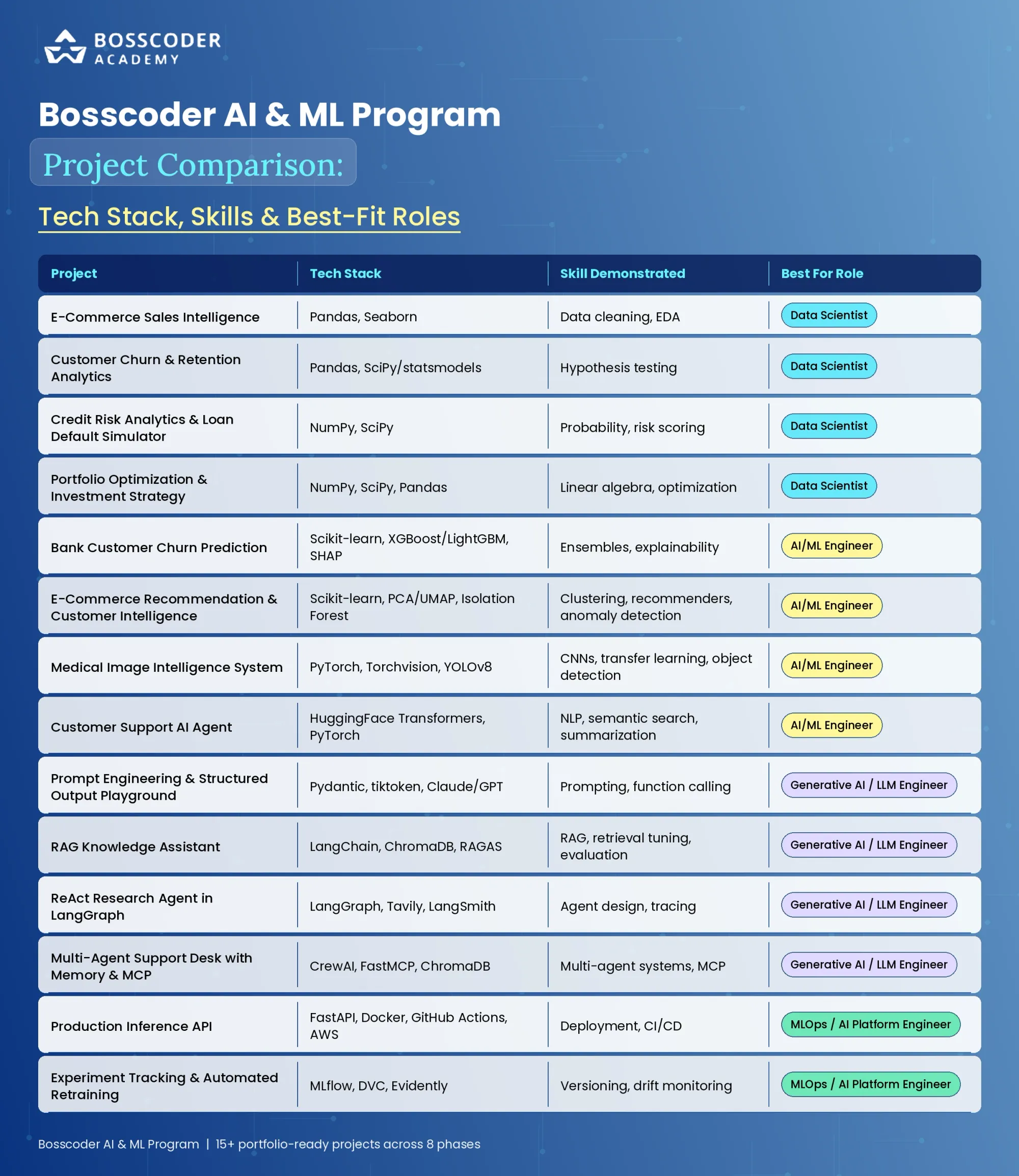
Project Comparison Table
The table below maps each project to its stack, skill, and best-fit role. The role mapping is a guide, not a promise.
Mentorship and Code Reviews
Projects improve fastest when an experienced reviewer reads them. Bosscoder pairs live learning with one-on-one mentorship, so feedback fits your background.
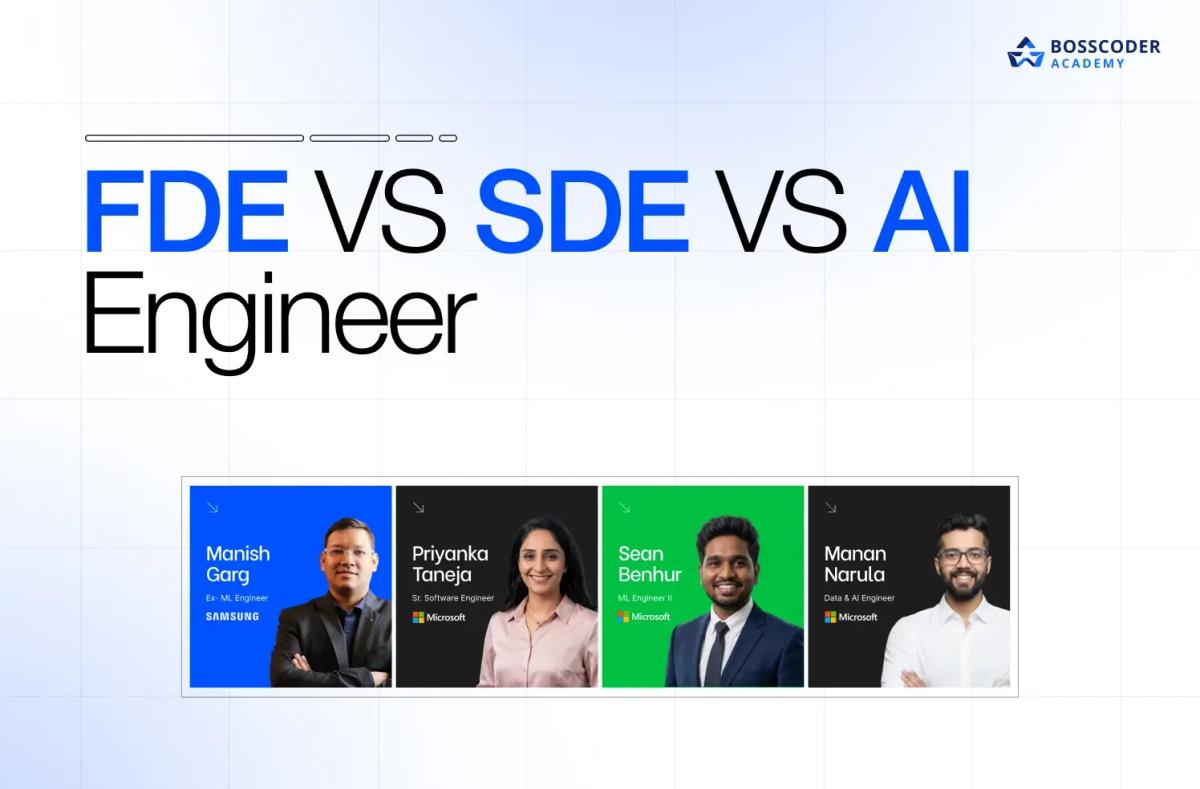
Listed mentors include
The optional Module 8 adds resume, LinkedIn, and GitHub review, plus mock interviews.
How to Showcase These Projects
Finishing is half the work. Presenting is the other half. A README that gets read has six parts:
- The question and the answer, in one sentence.
- Data source and setup steps.
- Method in five bullets, baseline first.
- One chart and one headline number.
- Limits: what the model cannot tell you.
- A live demo or recorded walkthrough.
For a RAG chatbot project, let reviewers ask it a question. Build your AI engineer portfolio around the three to five projects closest to your target role.
In interviews, prepare the trade-offs: why this model, why this metric, what failed. On your resume, lead with the outcome and the stack.
What Separates a Great Portfolio from a Good One
Most weak portfolios share the same few problems:
- No baseline. Without a simple comparison, nobody can tell if your model helps.
- Wrong metric. Accuracy misleads on imbalanced problems like churn or fraud.
- Data leakage. Split your data before preprocessing, not after.
- Demo-only GenAI. A chatbot without evaluation shows API use, not engineering.
- Overbuilt solutions. A transformer for a problem logistic regression solves raises questions about judgment.
- No README. A notebook with no context is invisible.
Avoid these and your three best projects will outperform a long list of thin ones.
Who This Program Is For
The Bosscoder Academy AI & ML Program suits engineers, developers, and data professionals moving into AI, ML, or GenAI roles. Basic Python is recommended; prior ML experience is not required.
It is built for working professionals who want machine learning projects tied to live learning over nine months.
Conclusion
The strongest AI ML projects for portfolio reviews are the ones you can run, measure, and explain. The Bosscoder AI ML Program gives you 15+ of them, from churn models to RAG, agents, and MLOps pipelines.
Frequently Asked Questions (FAQs)
Q1. What AI ML projects will I build in the Bosscoder program?
The program lists 15+ portfolio-ready projects across eight phases, including churn prediction, a recommender system, a RAG assistant, LangGraph and CrewAI agents, a FastAPI-to-AWS inference API, and an MLflow retraining pipeline.
Q2. Do the projects include real deployment?
Yes. You build a fully deployed AI application. One project ships a typed FastAPI service with Docker, CI/CD, and a live AWS deployment for real-time and batch inference. Another adds drift-triggered automated retraining.
Q3. Do I need ML experience to build these projects?
No prior ML experience is required. The program starts with foundations and progressively builds toward advanced AI systems and GenAI applications. Basic Python knowledge is recommended, and Module 1 refreshes Python, NumPy, and Pandas.
Q4. Which roles do these projects prepare me for?
The program prepares learners for AI/ML Engineer, Data Scientist, Generative AI/LLM Engineer, and MLOps/AI Platform Engineer roles. Match your project mix to the role you want: RAG and agent projects suit GenAI roles, while deployment and retraining projects suit MLOps.