The tech interview process is changing, with companies using AI-based development tools, advanced engineering methodologies, and coding tests. Preparing for a software engineer job in 2027 entails more than solving Data Structures and Algorithms (DSA) problems. Companies also test the candidate's ability to design scalable applications, debugging, system knowledge, and AI tools usage.
The traditional tech interview rounds such as DSA, Low-Level Design (LLD), and High-Level Design (HLD) are still important. But AI-based coding tests have become a new method of evaluating the software engineer's skill set.
Be it an entry-level Software Development Engineer (SDE) role or experienced ones in product-based companies, knowing about the interview process will help you in your preparation.
Let us see the major interview rounds, some questions from recent interviews, and ways of preparing for software engineering interviews in 2027.
What Is the Process of the Tech Interview?
A tech interview process is an assessment procedure that companies use to test the programming skills of their candidates, problem-solving skills, and the basic knowledge of the engineer.
As far as the assessment for software engineering jobs, companies typically test:
- Programming fundamentals concepts and skills
- Data Structures and Algorithms
- System Design, both Low-level and High-level
- Core computer Science concepts
- Development and debugging abilities
- AI-assisted development and code analysis
- Communication and behavioral skills
It depends on the specific company and position how many rounds are going to be.
Tech Interview Process in 2027: Major Rounds and Actual Questions
1. CV Screening and Recruiter Discussion
The first phase is normally the CV screening. Recruiters will assess your technical experience, projects, past responsibilities, and fit to the job description.
For experienced developers, the company might expect you to have some experience working on production systems, scalable systems, backend/ frontend technologies, and any measurable project achievements.
In case your CV got selected, you may need to have an initial recruiter discussion regarding your experience, career aspirations, notice period, and salary expectations.
Examples of questions:
- Take me through your current project and your role.
- Describe the most challenging technical problem that you've solved.
- Why are you looking for a job change?
- What programming languages and technologies do you work with?
Tip for preparation: Be ready to give a good project explanation.
2. Online Assessment or Coding Round of DSA
The next step is the online assessment interview/coding round where your ability of problem solving approach, coding and knowledge of time & space complexity is tested.
You need to study arrays, strings, hashing, binary search, linked lists, stacks, queues, trees, graphs, recursion & dynamic programming.
Examples of coding interview questions:
Some examples are based on publicly disclosed experiences of candidates who have appeared for interviews.
Example 1: Meeting Rooms II
Given an array of intervals representing the start and end time of the meetings. Find out the minimum number of meeting rooms required to hold these meetings.
This is the test of sorting, priority queues & interval type of problems.
Example 2: Search in Rotated Sorted Array
Given a sorted array which is rotated around some random point, find the index of the target element. If element is not found return -1.
This is the test of binary search and identifying the sorted part of array.
Question 3: Shortest Path in Graph
Find the shortest path between two vertices in a graph.
Graph traversal and shortest-path algorithm are tested in this question.
The previous two questions have previously been asked by Microsoft and Amazon companies in their respective interviews.
Preparation Tip: Learn approaches to problem solving rather than solutions, always mention edge case scenarios and complexities involved.
To understand how DSA, System Design, Full Stack Development, and GenAI fit into modern engineering preparation, explore the Software Engineering with Applied GenAI curriculum
3. Core Computer Science Fundamentals
Product-based companies test your knowledge about some essential Computer Science concepts through technical interviews.
Essential topics are:
- Operating Systems: Processes, threads, deadlocks, memory management, and CPU scheduling.
- DBMS: SQL queries, indexing, normalization, transactions, and ACID properties.
- Computer Networks: HTTP, TCP/IP, DNS, REST APIs, and network protocols.
- Object-Oriented Programming: Encapsulation, inheritance, polymorphism, abstraction, and SOLID principles.
Example interview questions:
- What will happen when typing google.com in the web browser and clicking Enter?
- How would you detect and fix a deadlock problem in a multi-threaded program?
- Explain what is the difference between clustered and non-clustered indexes?
- How would you fetch the second highest salary value from the Employee table in SQL?
- What will happen if two transaction attempts to update the same row of a database at once?
- How does HashMap manage hash collisions in Java?
Interview tip: Pay special attention to practical aspects of the answer. The interviewer may ask follow-up questions to check if you can utilize the theory in engineering practice.
4. System Design Interview: LLD and HLD
System Design is especially important for mid-level and senior software engineering roles. It tests whether the candidate can design scalable applications and systems.
System Design usually consists of two kinds of interviews.
Low-Level Design (LLD)
LLD concentrates on classes, objects, design patterns, relationships, and application-level architecture.
Interview questions:
- Design a multi-level Parking Lot system.
- Design a Snake and Food game.
- Design an Elevator system.
- Design a Library Management System.
For instance, during a Parking Lot design interview, you have to make classes such as Vehicle, ParkingSlot, Floor, Ticket, and ParkingLot. The interviewer will ask about your design of different kinds of vehicles and parking strategies.
If you want to understand how structured DSA and System Design preparation helps in technical interviews, read Vishwas Shukla's learning experience
High-Level Design (HLD)
HLD concentrates on distributed systems, scalability, databases, caching, and communication between services.
Interview questions:
- Design a notification service.
- Design a URL shortener, for example, Bitly.
- Design WhatsApp.
- Design a video streaming website, for example, Netflix.
- Design a scalable ride-booking service, for example, Uber.
For example, when designing a notification service, you might need to clarify how notifications get queued, processed, retried, and delivered through various channels.
Such cases are typical of problems that come up in system design, such as those mentioned in recent Microsoft interviews.
Tip: Practice explaining architecture diagrams, API design, database selection, scalability, reliability, and trade-offs.
5. AI-Assisted Coding Interview: A New Trend in 2027
A new trend in software engineering interviews is the increasing relevance of AI-assisted coding.
Historically, candidates were supposed to solve coding challenges on their own. Now, engineers use AI solutions such as GitHub Copilot and Gemini to create code, debug apps, and speed up development.
And it influences how interviewers test coding skills.
According to Business Insider in October 2026, Google introduced pilot changes to its software engineering interviews. For some candidates, Google may use Gemini as a coding assistant. And there is a new code comprehension challenge testing AI fluency and prompt engineering.
This is still an evolving and company-specific process, not a regular interview round at all companies.
Examples of AI-assisted interview tasks:
- Given a codebase, you need to implement a new API endpoint using an AI coding assistant.
- An AI coding tool creates a function with incorrect results in certain edge cases. You need to find and fix the problem.
- You review an AI-created code and find potential security vulnerabilities.
- Debug a failed test case using AI and describe the underlying reasons for failure.
- Refactor an already existing piece of code by improving its performance and checking validity of the generated code.
These problems represent only examples of the practice cases, not genuine questions of Google’s interview process.
It is important for candidates to know such concepts as prompt engineering, code review, debugging, testing, and limitations of AI-produced solutions.
The key goal here is not using AI itself, but showing that you are able to analyze it.
6. Managerial and HR Interview
The last round usually includes communication skills, professional experience, teamwork, and cultural fit.
For more experienced applicants, the interviewer may ask about past projects, technical decisions, team participation, and management skills.
Example of behavioral questions:
- Tell me about a time when you disagreed with your team regarding a technical decision.
- Talk about the problem you solved during production and how you solved it.
- Tell me about a project when you had to work on a tight schedule.
- What would you do if your technical approach was not accepted by your manager?
- Tell me about the situation when you took responsibility for something that was not in your duties.
Answer all questions using the STAR technique (Situation, Task, Action, Result).
How to Prepare for Tech Interviews in 2027
A proper preparation process will allow you to study traditional engineering basics and AI-related skills.
| Preparation topic | Topics to study |
|---|---|
| DSA | Arrays, Trees, Graphs, DP, and problem solving techniques |
| System Design | LLD, HLD, APIs, caching, and distributed systems |
| CS Fundamentals | OS, DBMS, OOP, and Computer Networks |
| Development | Full Stack projects, debugging, and code quality |
| AI Tools | Prompting, code review, testing, and validation |
| Mock Interviews | Live coding, system design, and behavioral rounds |
Stick to a consistent studying schedule, solve coding questions and take part in mock interviews.
For a more structured learning pathway, check out our Software Engineering and Applied GenAI courses, including programming fundamentals, DSA, System Design, Full Stack Development, and Applied GenAI .
Solving coding problems is only one part of interview preparation. Learn how mock interviews helped Abhishek improve his problem-solving approach and crack Oracle SDE 3
Bosscoder Academy Can Help You To Prepare
The preparation of the interview at product-based companies demands fundamentals, development experience, and guidance.
Bosscoder Academy Software Engineering Course is built to help working professionals prepare their fundamentals of DSA, System Design, Full Stack Development, and AI.
It also has structured learning, live learning sessions, mentorship, projects, mock interviews, and job placements.
The syllabus includes Applied GenAI, which is beneficial for software engineers to learn how to use AI in software.
With structured learning and experience, professionals can prepare themselves technologically to take up the software engineering position at product-based companies.
Conclusion
As we have seen, the 2027 tech interview process is evolving and becoming more complete. DSA, coding fundamentals, System Design, and Computer Science continue to be relevant, while AI-powered coding is bringing about new ways to assess the engineer.
Do not consider AI as a substitute for technical fundamentals and instead aim to be good problem-solvers who can code well and design systems that run efficiently.
With the help of regular training, practical experience, and mock interviews, you can get prepared for the next software engineering interview.
Looking for inspiration while preparing for your next career move? Read how Sourabh transitioned from Samsung to Microsoft as a Software Engineer.
Frequently Asked Questions (FAQs)
Q1. What are the main rounds in a tech interview process in 2027?
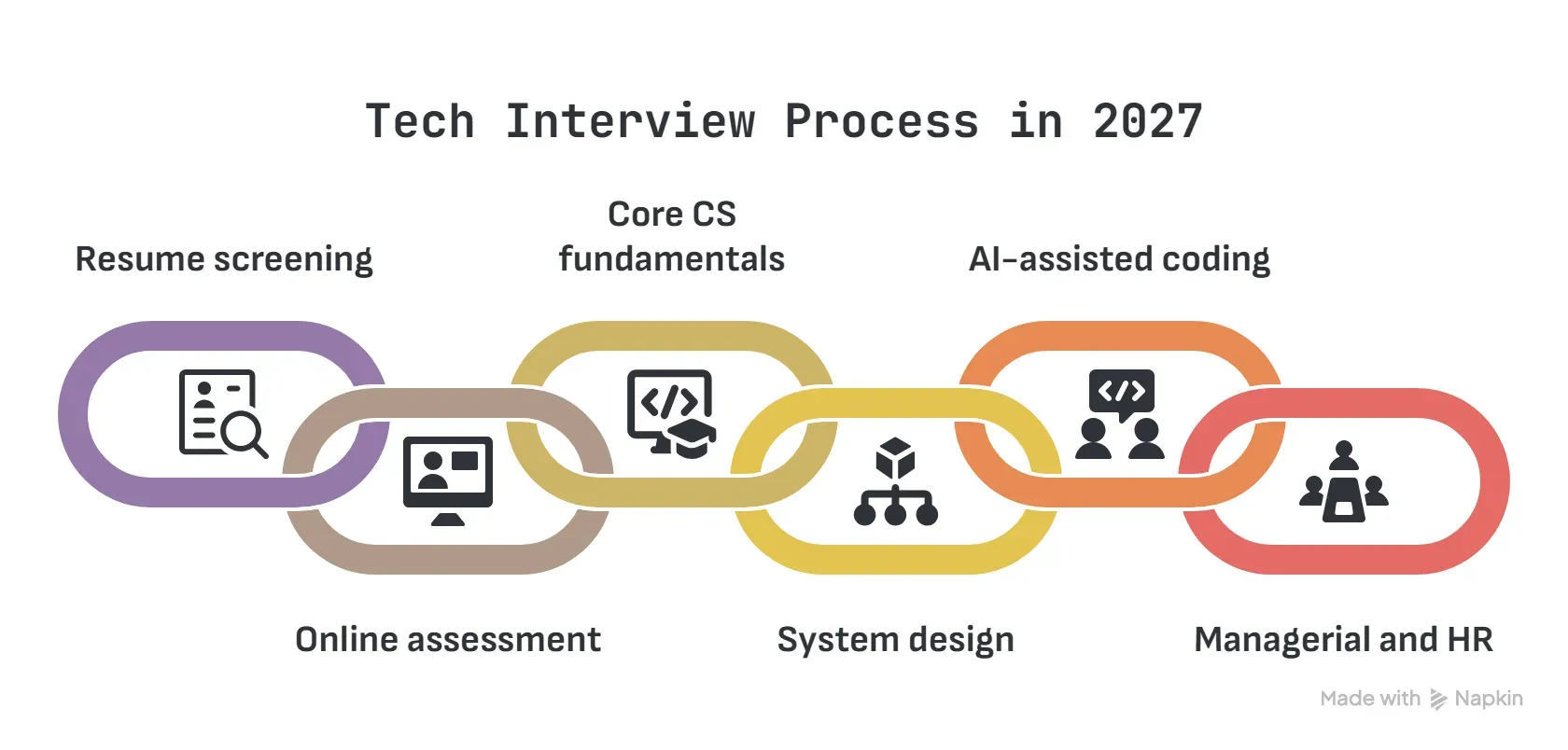
They include resume screening, online assessment, DSA and coding interviews, CS fundamentals, System Design, AI-assisted coding assessment if any, and discussion with managers/HR.
Q2. Is DSA still relevant for software engineering interviews in 2027?
Yes. It will still be used to assess one's problem solving, logic, and coding skills. AI development doesn't render the knowledge of algorithms redundant.
Q3. What is AI-assisted coding interview?
It assesses one's ability to develop using AI coding tools, read, debug, and revise code. It might differ between organizations.
Q4. Is System Design required for every software engineering interview?
Not always. The system design round is more common for middle and senior levels and some companies include design questions for freshers.
Q5. How much time is required to prepare for an interview in software engineering?
It depends on your current knowledge and skills and the company you want to join. You can adopt a well-designed preparation strategy that includes DSA, System Design, CS concepts, development, and mock interviews.