Companies no longer want engineers who only know one slice of AI. They want people who can build classical ML systems, ship GenAI features, and run both in production. The Bosscoder Academy AI & ML Engineer Program is built around that combination: a 9-month, live, mentor-led program that takes you from Python and statistics to RAG, agents, and MLOps.
If you’re wondering whether you qualify, this guide covers who the program is for, how much experience you need, what the learning path looks like, and the roles it prepares you for.
Who Is the Program For?
The Bosscoder Academy AI & ML Engineer Program is designed for:
- Software engineers who want to move into AI and machine learning
- Backend and full-stack developers interested in building AI-powered products
- Data professionals who want to expand into modern AI engineering
- Working professionals planning a career switch into AI
- Developers curious about LLMs and agentic AI
There is no fixed degree requirement and no restriction on engineering branch. The one recommended prerequisite is basic Python knowledge. If you can read and write simple Python, you can follow the program from day one.
Admission is simple. You fill in an application, speak with a counsellor about your background and goals, confirm your seat, and move into onboarding.
Do You Need Prior ML or AI Experience?
No. The program starts with fundamentals and builds step by step toward advanced AI systems.
Module 1:
Python for Data & AI covers advanced Python and OOP, NumPy, Pandas, SQL, Git, exploratory data analysis, visualization, and data cleaning pipelines. It gives everyone the same programming base before ML begins.
Module 2:
Math & Statistics for ML teaches the concepts behind the models: probability, Bayes’ theorem, distributions, the Central Limit Theorem, hypothesis testing, A/B testing, linear algebra, and optimization. You learn why algorithms work, not just how to call them.
Only after these two modules does the program move into machine learning. That’s why learners from non-ML backgrounds can join and keep up.
Backgrounds Our Learners Come From
Bosscoder learners don’t share a single profile. Recent AI/ML program stories include:
- Soham Bhattacharyya moved from TCS to Accenture as an AI/ML Engineer.
- Rashi Mathur moved from Neosoft Technology to PwC as an AI/ML Engineer.
- Surya Kumar moved from HCL Tech to LTIMindtree as a Data Scientist.
- Alok Jain moved from WSP Global to Agivant Technologies.
- Mansi Bansal moved from Honeywell to PwC.
- Padmanabh Manikandan went from Data Scientist to ML Engineer at Maxhome.ai.
- Bhargava moved from a TCS analyst role to an ML Software Engineer role.
- Akshay Darade started as a fresher and became a Data Scientist at NTT Data.
- Shivam made the switch from 12 years in IT to AI.
The common thread is a willingness to learn consistently, practise on real projects, and prepare seriously for interviews.
How the 9 Months Are Structured
The Bosscoder Academy AI & ML Engineer program runs across eight modules, each building on the last.
Module 1
Python for Data & AI. Python for engineering, data wrangling, EDA, and feature engineering basics.
Module 2
Math & Statistics for ML. Probability, inference and experimentation, linear algebra, and gradient descent variants.
Module 3
Machine Learning Systems. Regression, trees and ensembles, SVM, clustering, PCA and UMAP, recommender systems, anomaly detection for fraud and risk, imbalanced data, hyperparameter tuning with Optuna, SHAP and LIME explainability, and time series forecasting.
Module 4
Deep Learning & Transformers. Neural networks, backpropagation, CNNs, transfer learning, YOLOv8 object detection, RNNs and LSTMs, attention and transformers, and HuggingFace, in both PyTorch and TensorFlow.
Module 5
Generative AI Engineering. LLM APIs, prompt engineering, function calling and structured output, embeddings, vector databases, RAG and advanced RAG (hybrid search, reranking, RAGAS evaluation), fine-tuning with LoRA and QLoRA, alignment concepts, and local LLMs with Ollama.
Module 6
Agentic AI Systems. LangGraph, CrewAI, and AutoGen, ReAct and planning patterns, agentic RAG, short- and long-term memory, multi-agent orchestration, Model Context Protocol (MCP), agent evaluation, guardrails, and hallucination handling.
Module 7
Production AI & MLOps. FastAPI, Docker, CI/CD, AWS deployment, batch versus real-time inference, MLflow, data and model versioning, feature stores, drift monitoring, LLMOps, and LangSmith tracing.
Module 8
AI System Design & Career Preparation (optional). ML system design, DSA, mock interviews, and resume, LinkedIn, and GitHub reviews for AI/ML roles.
The path runs from “I can analyse data” to “I can deploy, monitor, and improve an AI system in production,” which is where many courses stop short.
Projects You’ll Build
The Bosscoder Academy AI & ML Engineering Program includes 15+ portfolio-ready projects, each scoped at about six hours, designed to mirror real industry work.
Foundations
- E-Commerce Sales Intelligence
- Customer Churn & Retention Analytics
- Credit Risk Analytics & Loan Default Simulator
- Portfolio Optimization Strategy
Machine learning and deep learning
- Bank Churn Prediction System, with SHAP explainability
- E-Commerce Recommender, with segmentation and anomaly detection
- Medical Image Intelligence System, a CNN and YOLOv8 chest X-ray project
- Customer Support AI Agent, an NLP pipeline from TF-IDF to transformers
GenAI and agents
- PromptForge, a prompt playground with structured output
- DocuMind, a RAG assistant that chats with your PDFs
- ResearchPilot, a ReAct research agent built by hand and then in LangGraph
- DeskMate, a multi-agent support desk with persistent memory and an MCP server
Production
- ServeML, a model served through FastAPI, Docker, CI/CD, and a live AWS deployment
- TrackML, an MLOps platform with experiment tracking, versioning, and drift-triggered retraining
These projects give you something concrete to show. In interviews, a deployed system you built and can explain end to end carries more weight than a list of completed topics.
How You Learn: Live Classes, Mentors, and Certification
Live, structured learning
Classes are live, with assignments and projects built into the curriculum. The roadmap was designed with ML and AI engineers from top product companies to cut the noise and keep learners focused.
1:1 Mentorship
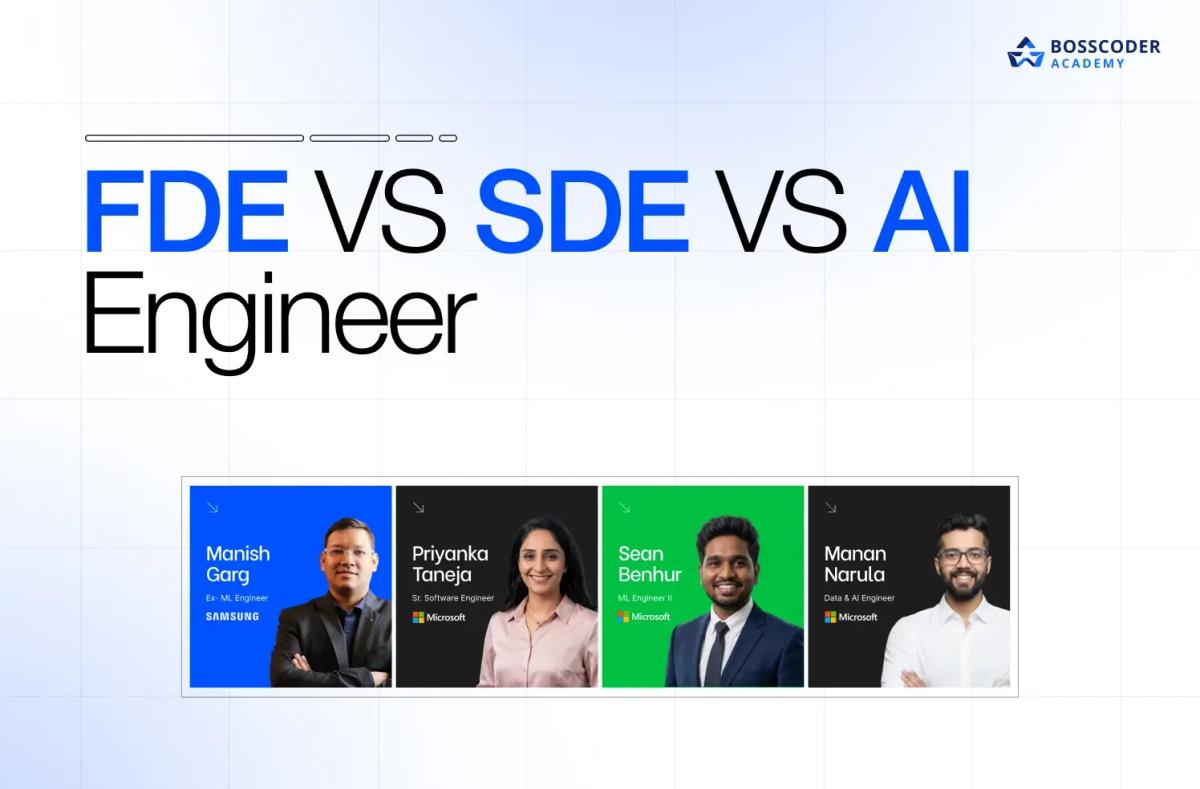
Every learner comes from a different background, so personal guidance from senior AI and ML engineers is part of the program. Instructors and mentors include:
- Manish Garg, co-founder of Bosscoder and former Samsung ML engineer
- Syed Mohammad Ali, Senior Data & Applied Scientist at Microsoft
- Anik Dutta, ML Engineer at RELX
- Sean Benhur, ML Engineer at Comcast
- Chinmay Jain, Data Scientist II at Microsoft
Certification
Learners receive an industry-recognised AI & ML certification with NASSCOM certification.
Career Paths After the Program
The Bosscoder Academy AI & ML Engineer program prepares you for the following roles:
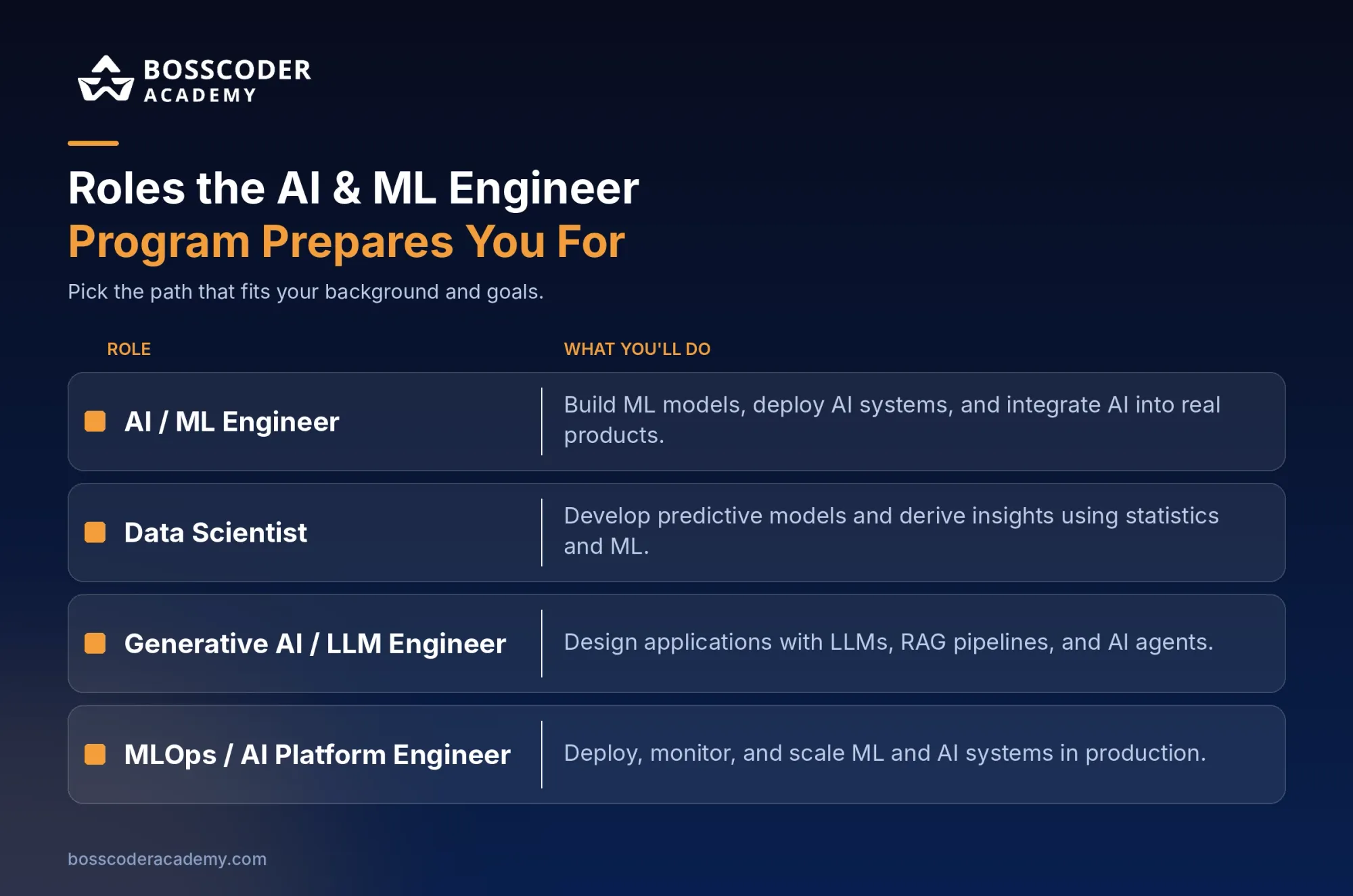
Your starting point shapes your best-fit role. Backend developers often find AI engineering and MLOps a natural step, since FastAPI, Docker, and cloud deployment build on skills they already use. Analysts and data professionals often lean toward data science and applied ML. Developers drawn to LLMs can focus on the GenAI and agentic modules.
The demand backs this up. NASSCOM projects over 1.5 million data and AI job openings in India by 2026, and Bosscoder graduates now work in AI and data roles at companies such as Amazon, Zomato, Swiss, Deloitte, Fractal, and Razorpay.
Placement Support
Skills are one half of a career switch. The other half is getting in front of the right employers. Bosscoder’s placement system has three parts:
Profile building
Resume reviews, LinkedIn optimization, curated roles that fit your profile, and application guidance.
Referrals
Access to an alumni network across product companies, referrals from mentors and instructors for high-performing learners, and real-time sharing of hiring opportunities.
Company tie-ups
400+ hiring partnerships across tech companies.
Interview preparation runs alongside, including mock interviews for both technical and behavioural rounds, and salary negotiation guidance in Module 8.
Across Bosscoder programs, the independently assessed outcomes (by B2K Analytics) show a 91% placement percentage, a 104% average salary hike, a 99 LPA highest package, and a 233% highest hike. More than 2,200 careers have been transformed through Bosscoder, and the full placement report is available to download.
Is This Program Right for You?
The program fits you well if:
- You’re a developer, analyst, or IT professional who wants to move into AI, ML, GenAI, or MLOps.
- You have, or can quickly pick up, basic Python.
- You want live classes, mentorship, and accountability rather than scattered recorded content.
- You’re ready to build projects, deploy them, and prepare seriously for interviews.
If you’re brand new to programming, spend a few weeks on Python basics before the start date. A little preparation will make Module 1 smoother and free up more of your time for the machine learning that follows.
Frequently Asked Questions (FAQs)
Q1. Who can join the Bosscoder AI & ML program?
Engineers, developers, data professionals, and working professionals who want to move into AI, ML, and GenAI roles. Basic Python is recommended.
Q2. Do I need prior machine learning experience?
No. The program begins with Python, math, and statistics, then builds up to machine learning, deep learning, GenAI, agents, and MLOps.
Q3. How long is the program?
Nine months, across eight modules, with live classes and 15+ projects. The final module on system design and career preparation is optional.
Q4. What roles can I target after completing it?
AI/ML Engineer, Data Scientist, Generative AI / LLM Engineer, and MLOps / AI Platform Engineer, depending on your background and experience.
Q5. Is placement support included?
Yes. There is 100% Placement Assistance It covers profile building, referrals, interview preparation, and access to 400+ hiring partnerships.