Introduction
You built a chatbot over your company's documents. On your laptop, it answers perfectly. Then someone asks for it on the internal portal, behind SSO, with real customer data, and suddenly nothing is simple. Who approves the data access? What happens when the API rate-limits you at 2 a.m.?
That gap between "it works for me" and "it works for everyone" is what our Forward Deployed AI Engineer course is built around. And you prove you can close it the way that counts: by building 14 real-world projects and a fully deployed capstone.
Want to understand how to move from learning AI concepts to building production-ready applications? Explore our AI Engineer Roadmap 2026: LLMs, RAG & Agents to discover the skills and projects that can help you prepare for AI engineering roles.
What a Forward Deployed AI Engineer Does, and Why We Built This Program
A Forward Deployed AI Engineer works close to the customer. You sit with clients or internal teams, learn how their workflows actually run, build production-ready AI solutions, and deploy agents that solve real operational problems.
Here's what we kept seeing. Companies across industries have built AI pilots, but most never reach production. They stall on messy data, legacy systems, security reviews and unclear value. The model is rarely the hard part.
So Bosscoder Academy built this program around both halves of the job: engineering production-grade AI systems, then taking them into real customer environments. Every project below reflects one of those two halves.
The AI Engineering Projects You'll Build
Most projects take about six hours (the Model Bake-Off takes eight). Each one is modelled on a task you'd face on the job, so you finish with work you can actually talk about in interviews.
LLM and API projects
Prompt Evaluation Lab (6 hours)
- You'll test Chain-of-Thought, Self-Consistency and Tree-of-Thought prompting against a zero-shot baseline to find the best cost-quality tradeoff per task type.
- Tools: Open AI/Anthropic API, tiktoken, Pydantic.
- Shows employers: you make prompting decisions with data.
Enterprise Support Assistant (6 hours)
- You'll build a multi-turn support assistant with a system-prompt role contract, then red-team it against 8 classes of prompt injection and jailbreak attacks.
- Tools: Open AI/Anthropic API, Presidio, Anthropic Prompt Caching.
- Shows employers: you think about security before anyone has to ask.
The Model Bake-Off (8 hours)
- A provider-agnostic LLM client with async streaming and prompt caching, used to compare cost and latency across OpenAI and Anthropic.
- Tools: OpenAI SDK, Anthropic SDK, asyncio.
- Shows employers: you can answer "which provider should we use?" with evidence.
The Resilient Ingestor (6 hours)
- A fault-tolerant async pipeline that pulls 50,000 paginated records from a flaky API, with retries and checkpointing.
- Tools: httpx + asyncio, tenacity, Pydantic.
- Shows employers: your code keeps going when the API doesn't. (Real APIs are rarely as stable as their docs suggest.)
RAG and fine-tuning projects
The Policy Assistant (6 hours)
- A production RAG pipeline over company policy documents. You'll handle chunking documents, picking an embedding model, and checking whether retrieval actually returns the right context.
- Tools: LangChain (LCEL), Chroma, Qdrant/Pinecone.
- Shows employers: you can ship searchable internal knowledge, the request many enterprise teams start with.
The Retrieval Bake-Off (6 hours)
- You'll improve retrieval quality with hybrid BM25 + vector search and cross-encoder reranking, then measure it with RAGAS.
- Tools: Hybrid Search (BM25), RAGAS, Cross-Encoder Reranking.
- Shows employers: you improve systems and prove it with metrics.
The Multi-Hop Investigator (6 hours)
- A multi-hop RAG agent that breaks complex questions apart, retrieves evidence across hops, and grounds answers with citations.
- Tools: LangGraph, Cohere Rerank, RAGAS.
- Shows employers: you can answer questions no single document covers, with answers people can verify.
The Specialist (6 hours)
- You'll fine-tune a small open-source model with LoRA/QLoRA to outperform a larger general-purpose model on a narrow task.
- Tools: Hugging Face Transformers, Axolotl, PEFT (LoRA/QLoRA).
- Shows employers: you know when a smaller, specialized model is the smarter choice.
AI agent projects
The Operations Agent (6 hours)
- A tool-calling agent built on MCP-standardized tool servers, with an arbiter layer that gates and evaluates every agent action.
- Tools: OpenAI/Anthropic SDK, MCP, Pydantic.
- Shows employers: your agents act, but within limits.
The Claims Desk (6 hours)
- A stateful claims-processing agent in LangGraph, with persistent memory and a human-in-the-loop approval step.
- Tools: LangGraph, LangGraph Checkpointers, Postgres.
- Shows employers: you put human approval exactly where a business needs it.
Deployment and observability projects
A demo impresses. A deployed system gets used.
The Service (6 hours)
- You'll turn a notebook prototype into a production-grade async API service, containerized and deployed with CI/CD.
- Tools: FastAPI + Uvicorn, Docker + Compose, AWS ECS Fargate.
- Shows employers: you can deploy AI applications, beyond prototyping them.
The Control Room (6 hours)
- An observability and evaluation stack for LLM systems with tracing, metrics dashboards and CI-integrated evals.
- Tools: Prometheus + Grafana, LangSmith, OpenTelemetry.
- Shows employers: you can tell a client how their system is performing today, with numbers.
Client-facing projects
The Discovery Engagement (6 hours)
- You'll run a client discovery engagement that turns a vague business ask into a signed, estimated project scope.
- Tools: Interview Technique, ADR Format, Estimation Methods.
- Shows employers: you can lead the conversation that happens before any code.
The Data Excavation (6 hours)
- You'll reverse-engineer and profile an undocumented legacy system's data using CDC and entity resolution, then build a clean sync pipeline.
- Tools: Debezium, RapidFuzz, SQLAlchemy.
- Shows employers: you can work with data nobody documented.
The Capstone
Everything comes together in a fully deployed AI product, built as a full client engagement. It's the project you'll demo live.
Interested in building beyond basic chatbots? Read our guide to the Bosscoder Academy Applied GenAI & Agentic AI Program to explore how LLMs, RAG pipelines and AI agents come together in practical projects.
Who reviews your project work
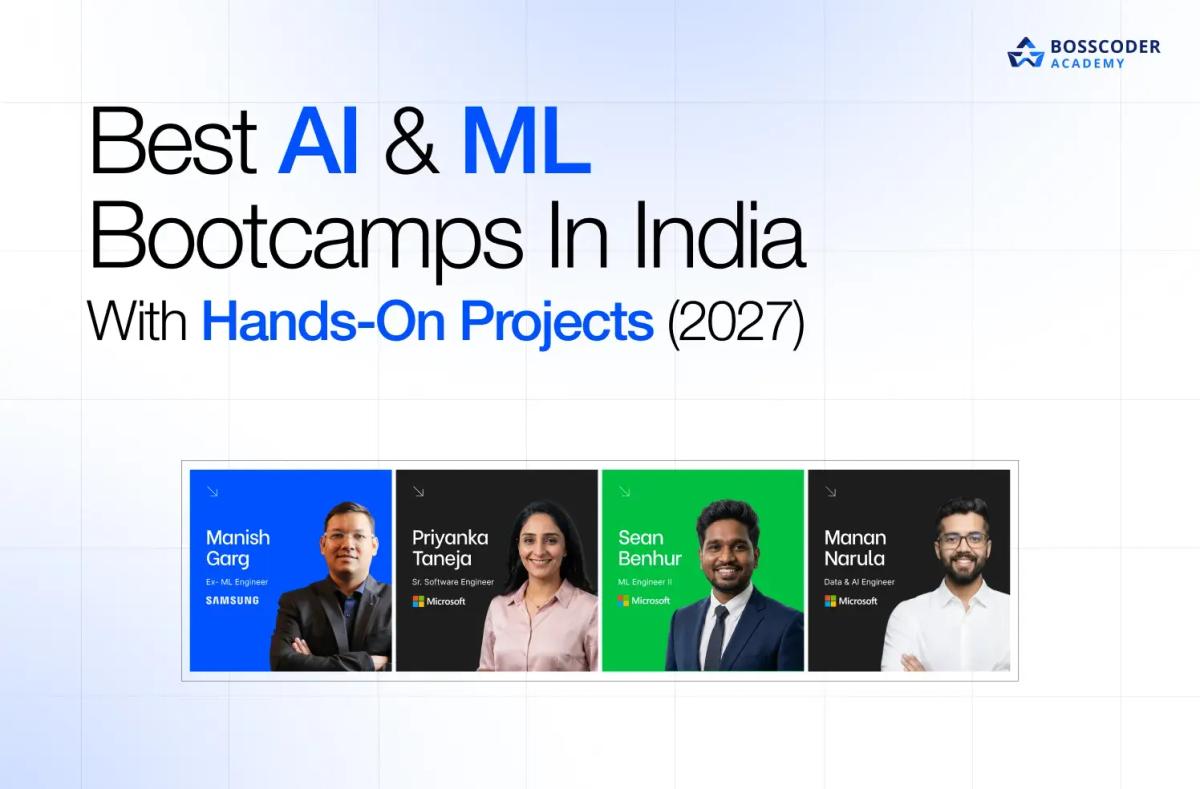
Our AI mentors are practitioners who build these systems for a living: Syed Mohammad Ali (Data and Applied Scientist 2, Microsoft), Anik Dutta (ML Engineer, RELX), Sean Benhur (ML Engineer 2, Comcast) and Chinmay Jain (Data Scientist II, Microsoft). Through one-on-one mentorship, they help you refine RAG pipelines, pressure-test agent designs, evaluate outputs and plan production deployment.
AI Engineer Career Opportunities in India
India's AI talent demand is growing at 4x the rate of supply, and several of the roles hiring today didn't exist three years ago. So where do these projects point you?
Roles you'll be ready for
- Forward Deployed AI Engineer: work directly with customers to understand workflows, build production-ready AI solutions and deploy agents that solve operational problems at scale. The Discovery Engagement and Data Excavation projects speak straight to this role.
- GenAI / LLM Engineer: build, optimize and deploy production-grade AI with LLMs, RAG pipelines, vector databases and scalable infrastructure. Your RAG and fine-tuning projects fit here.
- Agentic AI Developer: design agents and multi-agent workflows that plan, use tools, remember context and automate multi-step tasks. Think Operations Agent and Claims Desk.
- Technical Product Manager (AI/GenAI): define product requirements, work with engineering teams and ship AI features aligned with business goals.
Graduates also move into AI Solutions Engineer and Applied AI Engineer roles, with salaries ranging from ₹12 to 35 LPA depending on prior experience.
Building AI projects is a strong start, but understanding the full development lifecycle matters too. Explore the Bosscoder Academy Applied GenAI Program to learn more about its curriculum, mentorship, career outcomes and placement support.
What employers look for
Production-ready thinking. A strong project portfolio. The ability to build AI systems from day one. That's why every project ends in something deployed, measured or delivered to a client.
Product companies and AI-driven startups hire for these roles, including Google, Amazon, Microsoft, Adobe, Flipkart, Paytm, Salesforce, Netflix, Qualcomm, Samsung, Myntra and Cognizant.
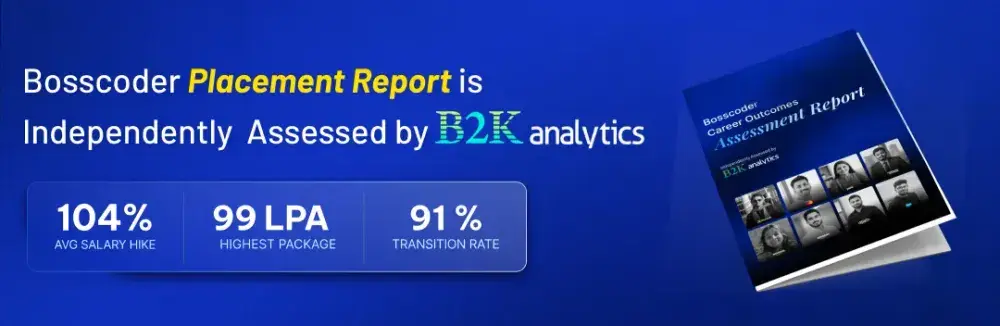
Placement support
- Profile building: a resume that highlights real work, an optimized LinkedIn profile, curated roles for your profile and application guidance.
- Referrals: access to our alumni network across product companies, mentors referring high-performing learners, and real-time hiring opportunities.
- Company tie-ups: 400+ hiring partnerships across top tech companies.
Final Thoughts
Building AI applications is more than writing prompts or connecting an LLM to a chatbot. You need to build reliable RAG pipelines, develop AI agents, deploy applications, monitor performance and handle real-world production challenges.
The Bosscoder Academy Forward Deployed AI Engineer program helps you develop these skills through 12+ hands-on projects and a fully deployed capstone, giving you practical experience building production-ready AI solutions.
Whether you want to build AI-powered products or strengthen your deployment skills, focus on hands-on projects that demonstrate what you can build, deploy and maintain in real-world environments.
Frequently Asked Questions (FAQs)
Q2. Who is this program for?
Working engineers (SDEs, backend, data, DevOps and platform engineers) who already write production code. If you've shipped software, you're ready to start.
Q3. Do I need prior AI or ML experience?
No. We built the program for engineers without an ML background. You'll start from Python fundamentals.
Q4. What roles can I target afterwards?
Forward Deployed AI Engineer, AI Solutions Engineer, Applied AI Engineer and GenAI Engineer, with salaries from ₹12 to 35 LPA depending on prior experience.