Becoming a Java Full Stack Developer involves more than just mastering Java programming or writing a few code snippets. The learner should have an understanding of how all the parts of frontend, backend, database, and APIs function together in application development.
As per the Stack Overflow 2025 Developer Survey, a total of 49,000+ developers from 177 countries have been part of the survey, out of which 69% learned a new way to code or new programming language during the year. This shows how important it is to continue learning in an ever-evolving technological era.
It can be difficult for aspiring developers and working professionals who want to change their career paths to know what to learn and how to apply what they have learned to actual projects. This Java Full Stack Developer roadmap will provide all you need to start your journey to becoming a full stack developer.
What Is a Java Full Stack Developer?
A Java Full Stack Developer is a software engineer working on the front end and back end of web applications.
Front end refers to the user interface, whereas the back end handles business logic, APIs, authentication, and all database transactions.
For example, in an eCommerce application, the front end will be responsible for displaying the items, the back end will handle order processing, and the database will have all customer and item information.
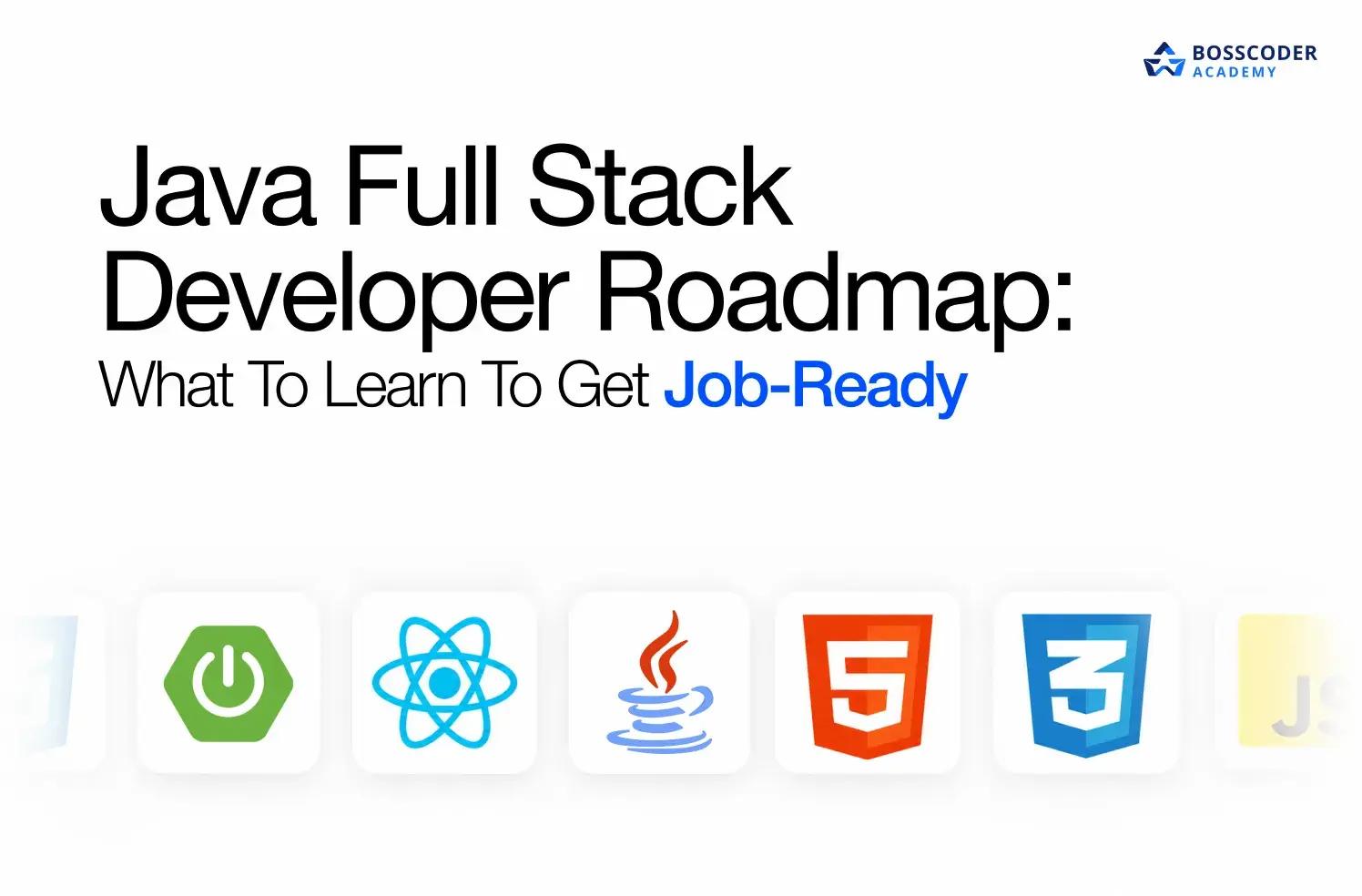
Technology Stack of a Java full stack includes Java, Spring Boot, SQL, HTML, CSS, JavaScript, and a front-end framework like React or Angular.
Java Full Stack Developer Roadmap: 8 Steps
Step 1: Master Core Java
Java forms the foundation of your back-end development path. It is advisable to start learning core java before starting with any framework.
Topics to be covered include:
- Variables, data types, operators, and looping constructs
- Arrays, string handling, and methods
- Classes, objects, and object-oriented programming concepts
- Inheritance, encapsulation, abstraction, and polymorphism
- Exceptions handling and collection classes
- Generics, lambdas, and Stream API
- Basic multithreading and concurrency concepts
Begin by building simple console applications like Library Management System and Expense Tracker.
Step 2: Data Structures and Algorithms Practice
DSA makes you efficient in problem solving and gets you ready for technical interviews.
Study data structures like arrays, strings, hashing, linked list, stack, queue, sorting and searching, trees, graphs, recursion, and basics of dynamic programming.
It is better to practice every day than to do hundreds of problems without knowing how to do them. You should learn how to describe your solutions and do time-space complexity analysis.
Step 3: Learn Front End Development
Frontend technologies are essential to learn in order to design user-interactive interfaces.
| Technology | What to learn |
|---|---|
| HTML | Structure, form, and semantic tags |
| CSS | Responsive design, Flexbox, and Grid |
| JavaScript | Functionality, DOM, promises, and async/await |
| React or Angular | Components, state management, routing, and API integration |
Start learning one framework at a time. Before getting into bigger applications, create a responsive dashboard, login page, and product listing.
Step 4: Learn SQL and Databases
Programs require databases in order to persist and fetch data. Learn MySQL and PostgreSQL before moving on to more complex ideas about databases.
Important things to know are:
- SELECT, INSERT, UPDATE and DELETE
- Joins, Subqueries, Grouping, Aggregation
- Primary Keys and Foreign Keys
- Relationships and Normalization of databases
- Indexing and Query Optimization
- Transactions and Data Consistency
And then learn JDBC and Hibernate or JPA to see how Java programs access databases.
Step 5: Master Spring Boot
Spring Boot is an essential technology used in Java backend development. This technology enables the creation of APIs and backend services without dealing with heavy configuration.
Study these topics:
- Spring Core and dependency injection
- Controllers, services, and repositories
- REST API development
- Spring Data JPA and Hibernate
- Validation and exception handling
- Spring Security and authentication
- JUnit and Mockito unit testing
An example of how Spring Boot APIs can be used is by a job portal where APIs enable the creation of jobs, searching jobs, managing applications, and authentication of users.
Step 6: Connect Frontend and Backend
It's time for you to put all your knowledge into use and develop a complete application.
You should know how to integrate React or Angular with Spring Boot APIs, make HTTP calls, handle exceptions, validate forms, and show database entries.
In addition, CORS, authentication, role-based access, and security configuration are necessary. Never store any password in plaintext format or expose any credentials on the frontend side.
You should be able to create an application where the user can perform something from start to finish.
Step 7: Learn Git, Testing, and Deployment
Professional development requires not only coding but also the ability to manage changes, testing, and deployments.
Concentrate on:
- Git and GitHub: Change management and collaboration.
- Maven: Dependency and build management for Java.
- Postman: Testing of RESTful APIs.
- JUnit and Mockito: Application logic testing.
- Basic Docker: Package applications consistently.
- Deployment: Set up environments and make applications available on the web.
Deploy one full application and write down how to start your project locally.
Step 8: Be Ready for Technical Interview Questions
After making some projects, revisit the basics and get prepared to explain your technical choices.
Get ready for queries regarding Java, OOPs, SQL, Spring Boot, REST API, debugging, and DSA. For more advanced positions, learn about low-level design (LLD), high-level design (HLD), and distributed system basics.
You can also explore Full Stack Developer Roadmap for additional guidance on frontend, backend, databases, and full-stack development.
Industry-Level Java Full Stack Projects to Build
Basic projects will make you learn the syntax, but industry-level projects will make you learn how to solve engineering problems.
Try to work on projects that involve business logic, database relationships, error handling, testing, and deployment. The below-listed projects have been suggested based on the system design and full-stack case studies in Bosscoder Academy's Transformer program.
1. E-Commerce and Order Management System
Create an online store application containing all features related to order cycle management which would be like an extensive e-commerce application.
Technology stack that could be used: Java, Spring Boot, React, Spring Security, JPA, and PostgreSQL or MySQL.
Features:
- Product listing and filtering
- User registration and login
- Shopping cart and payment
- Order management (creating, tracking, canceling)
- Inventory and order management
- Payment gateway integration using sandbox account
Industry-level issues: Avoiding overselling of products when more than one user purchases the same product, keeping orders and payments consistent and handling failed requests.
The following project includes backend development, database transactions, API development, and frontend & backend integration.
2. Food Ordering and Delivery Application
Develop a food ordering application similar to platforms like Zomato and Swiggy.
Recommended tech stack: React, Java, Spring Boot, and PostgreSQL.
Features to include:
- Listing of restaurants and searching menu
- Cart, checkout and order placement
- Restaurant admin panel
- Order update
- Authentication and order history of the user
Industry-level challenges: Simulate order process flow, restaurant availability, server side validation of price and prevent duplicate orders when checkout is done multiple times.
For advanced implementation: Add notifications and separate services for orders, payment, and delivery.
3. Video Streaming Platform
Create a simple video streaming application using inspiration from applications like JioHotstar.
The initial features would include content listing, categories, user accounts, watch lists, and video progress tracking. Use Spring Boot to handle the metadata of content, activities, and application APIs.
Further advanced tasks could include:
- Database schemas for users, content, and video watching history.
- Implementing cache for popular metadata.
- Ensuring separation of video storing and distribution from application APIs.
- Understanding CDN and load balancing.
- Handling traffic spikes caused due to live events.
It is not required to create a global video streaming platform. A working sample of an application along with architecture diagrams will showcase your engineering abilities.
4. Real-Time Messaging Application
Develop a messaging system modeled after WhatsApp Web, including messages, their delivery status, and conversation.
Recommended technologies: Java, Spring Boot, WebSockets, React, and relational database.
Requirements to include:
- User authentication and conversations
- One-on-one messaging
- Message history and timestamp
- Message delivery status and typing indicator
- List of conversations and unread message counter
Industries-level issues: Provide solution for reconnecting clients, ordering messages, message duplication, and growing number of simultaneous connections. Describe possible use of queue and horizontal scaling in large-scale system.
This is a project that will help understand concepts of event-driven systems, real-time communication, and backend systems.
How to Make These Projects Stand Out
Don’t just make the main features work. Take it further by incorporating:
- Automated testing of business logic
- Input validation and user authentication
- API documentation and meaningful error codes
- Indexes in database tables if necessary
- Error logging with meaningful errors
- Deployed demo with README file and architecture
Be prepared to talk about what you built, why you built it that way, and how you’d do things differently if there were ten times as many users.
Need a systematic approach to developing production-level systems? The Transformer Software Engineering Program at Bosscoder Academy is a combination of DSA, system design, full stack development using Spring Boot and MERN, and Applied GenAI. It has an industry-level curriculum consisting of industry-style case studies, projects, live classes, and 1:1 mentorship.
How Long Does It Take to Become Job-Ready?
The time you need will vary depending on your starting level, study time, and regularity. The following schedule can serve as an example for beginners who study regularly.
| Learning phase | Estimated time |
|---|---|
| Core Java | 4-6 weeks |
| Fundamentals of Data Structures and Algorithms | 4-6 weeks, along with other concepts |
| Frontend Development | 4-6 weeks |
| SQL and Databases | 2-3 weeks |
| Spring Boot and APIs | 5-7 weeks |
| Deployment and Projects | 4-6 weeks |
| Interview Preparation | Ongoing |
There are some overlapping stages. A focused learner can develop a strong base within six to nine months, but this is just an approximation and not a promise of job security.
What Skills Do Employers Look For?
It is always expected that the employers go beyond the number of technology stacks mentioned in your resume and evaluate your ability to employ these technologies for problem solving.
These skills need to be prioritized:
- Writing quality Java code and OOP concepts
- Problem Solving of DSA with proper reasoning
- Creating & Testing REST APIs with Spring Boot
- Schema Design and SQL queries
- Integrating front end with back end
- Debugging & Securing Application
- Elaboration of projects & technical tradeoffs
If you need more insight into this topic, check out Bosscoder Academy’s Software Engineering with Applied GenAI Curriculum.
Conclusion
Following the roadmap of Java Full Stack Developer becomes easy once you follow the correct sequence, which is Core Java, DSA, frontend, databases, Spring Boot, integration of full stack and deployment.
The real change happens in the way you implement the skills learned. Work on projects with practical problems, test your code, learn about database and API architecture, and know how to communicate technical details.
To improve your foundations alongside full-stack development and system designing, check out the Bosscoder Academy Transformer Program to see if it fits your needs.
Frequently Asked Questions About Java Full Stack Developer
Q1. Is Java Full Stack Development good for beginners?
Yes. Begin with Core Java, then learn SQL, frontend development, Spring Boot, and how to deploy. Construct mini-projects along the way.
Q2. Is Spring Boot necessary for Java Full Stack Development?
Spring Boot is one of the commonly used frameworks to construct backend applications and RESTful APIs in Java. Learning Spring Boot can be helpful if you wish to construct modern-day Java applications.
Q3. Which projects are best for a Java Full Stack Developer resume?
An order management system, a platform for food orders, a video streaming application, and a real-time chat app are some projects that showcase engineering skills. Construct such projects that you can create, explain, and improve upon.
Q4. Is DSA important to become a Java developer?
DSA comes in handy when it comes to taking coding interviews from product-based companies. The extent of knowledge required depends on the roles you are applying for.