Not long ago, most of us used AI like a fast intern who only answered questions. You typed, it replied, and you copied the answer somewhere else. Now the intern has started making calls. An AI agent can read a support ticket, look up an order, call an API, draft a fix and ask for your approval, without anyone scripting each step. That shift from chatting to doing is why working engineers keep asking us what to learn next. The Bosscoder Academy Applied GenAI & Agentic AI Program is our answer. In this post we'll walk through what's in it, who it suits, and how to judge any GenAI course, ours included, before you pay.
Why GenAI and agentic AI is the next big upskilling domain
Two things are happening at the same time.
- AI is becoming a normal part of software. Companies across industries are building AI-powered applications, automating workflows with agents and plugging LLMs into core systems. Titles like LLM Engineer or AI Application Engineer were rare in job posts a few years ago. Now they sit next to backend and platform roles. Our read is that demand for people who can actually build these systems is outpacing the supply of people who can.
- The work is moving from experiments to products. Anyone can wire up a chatbot demo over a weekend. It's much harder to build one that answers correctly from company documents, doesn't leak personal data, has a sensible cost per query and can be debugged when it misbehaves. That second skill set is what companies pay for, and it's why AI upskilling today is less about knowing a model's name and more about engineering.
If you write production code already, this is a GenAI career path that builds on what you know. You don't need to spend two years on ML theory to get started.
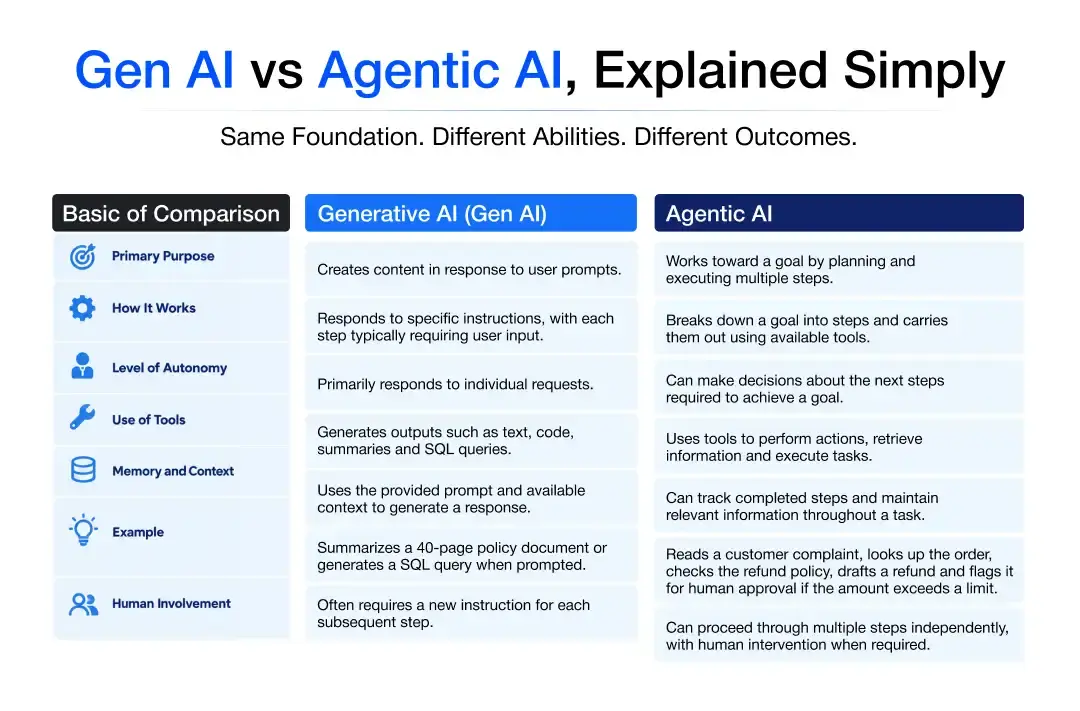
GenAI vs. Agentic AI
Skills Employers Look For
You need solid Python and API skills, since most of the work is glue between models, data and services. You need prompt design that goes past "act as an expert," including structured outputs and function calling. Retrieval matters too: embeddings, vector databases, chunking and search quality, because RAG sits behind a large share of business AI features. Then comes evaluation, which beginners often skip. If you can't measure whether your system got better or worse after a change, you're guessing. On top of that sit agent design (planning, tool use, memory) and the unglamorous production parts: deployment, monitoring, cost control and safety.
Notice how little of that is "knowing the latest model." It's engineering.
The Bosscoder Academy Applied GenAI & Agentic AI Program
The program runs for six months with live learning, and it's built around industry projects. Here's how the modules break down.
A few things we're proud of. Fine-tuning and local LLM deployment get real time instead of a passing mention, including cost and performance trade-offs. Evaluation and AI safety are woven in, with a dedicated week on safety and evals. And the program doesn't stop at notebooks. The final module is about getting systems into production the way real teams run them.
Projects
The Bosscoder Academy Applied GenAI & Agentic AI Program lists up to twelve project builds, each sized at roughly six to eight hours. Early ones are small and sharp:
- A Prompt Evaluation Lab that compares prompting strategies on cost and quality,
- An Enterprise Support Assistant you red-team against eight classes of prompt injection
- A Resilient Ingestor that pulls 50,000 paginated records from a flaky API. In the middle come retrieval and model work:
- A Policy Assistant over company documents, a Retrieval Bake-Off with hybrid search and reranking
- A Multi-Hop Investigator that answers complex questions with citations
- The Specialist, where you fine-tune a small open-source model to beat a larger one on a narrow task.
- The later ones are agentic and production-focused:
- An Operations Agent using MCP tool servers
- A Claims Desk with persistent memory and a human approval step
- A service deployed on AWS, and a Control Room for tracing and evals. The program builds toward a fully deployed AI product as its capstone.
You'll work with the Open AI and Anthropic APIs, Lang-Chain, LlamaIndex, Lang-Graph, Crew-AI, Pinecone, ChromaDB, Hugging Face, PEFT, FastAPI, Docker, Terraform, Kubernetes, AWS and evaluation tools like Deep-Eval, Prompt-Foo and RAGAS.
Live classes and mentors
Classes are live, up to four days a week, from 9 to 10:30 PM, which works for people with a day job. Recordings are available the next day, so a missed session isn't a lost one. Bosscoder also offers one-on-one mentorship as part of how we teach, since people come from very different backgrounds.
Here are some of the mentors you'll learn from:
Sankalp Tomar
Sr. Data Scientist at Microsoft, 11 years of experience.
Parijat Roy
Sr. Data Scientist at Microsoft, 9 years of experience.
Subhodeep
Data Scientist 2 at Amazon, 9 years of experience.
Syed Mohammad Ali
Data and Applied Scientist 2 at Microsoft, 8 years of experience.
Ekta Negi
Data Scientist at Fractal, 7 years of experience.
Sidharth Bajpai
Data Analyst at Amazon, 6 years of experience.
Placement and career support
Our career support works in three steps. Profile building covers a resume that highlights real work, a LinkedIn profile set up for visibility, curated roles for your profile and guidance on applications, along with mock interviews and interview preparation. Referrals come through our alumni network and from mentors and instructors who refer high-performing learners, and we share relevant openings as they appear. We also have 400+ hiring partnerships.
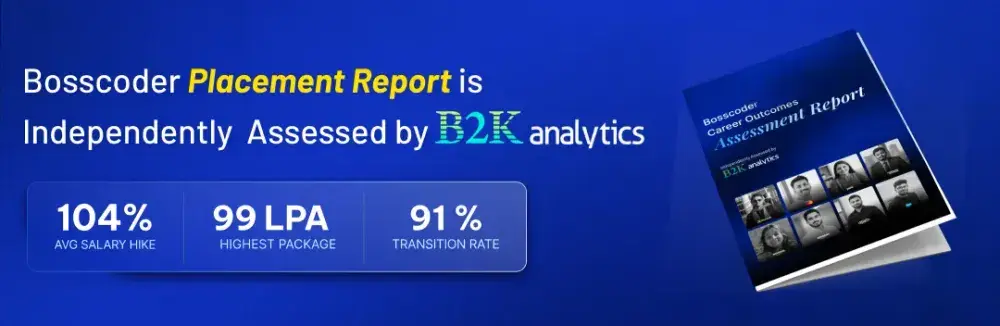
On outcomes, Bosscoder's performance has been independently assessed by B2K Analytics. According to our Outcomes Report, 91% of learners moved into better roles during the evaluation period, with an average salary hike of 104%. Those numbers describe Bosscoder learners overall. They're not a promise for any one person, and we'd rather you read the full report than take our word for it.
Who this program suits ?
The program is built for working engineers: SDEs, QA and automation engineers, and frontend and platform engineers who already ship code and want to move into AI engineering roles. You don't need an ML background. The program starts from Python fundamentals and builds up from there.
Think of Ankit, a backend developer with four years of experience who writes Java at work and some Python on the side. His team just added an AI assistant to their product, and he wants to be the person who builds the next one. That's the profile we have in mind.
Now the honest part. You do need to have shipped software. If you're a fresher who hasn't built and deployed anything yet, this probably isn't the right starting point, and we'd rather tell you that on the counselling call than after you've paid. In that case, spend a few months building real projects first, then come back.
Frequently Asked Questions ( FAQs )
Q1. Is the Bosscoder Academy Applied GenAI & Agentic AI Program right for you?
If you already write production code and want to build AI systems rather than just talk about them, the Bosscoder Academy Applied GenAI & Agentic AI Program is worth a serious conversation. It’s a structured six-month path with live classes, practitioner mentors, hands-on projects and career support, and it reaches all the way to deployment.
Q2. Do I need an ML background?
No. The program is built for people without one. You start with Python fundamentals and work toward production-grade GenAI and agentic systems. You do need to have shipped software.
Q3. What are the class timings?
Classes are live up to four days a week, from 9 to 10:30 PM. Recordings are available the next day.
Q4. Will I build real products or just exercises?
Real systems, end to end: fine-tuned models, multi-agent workflows and deployed services, using tools that AI teams run in production. The program builds toward a fully deployed capstone product.
Q5. What roles does it prepare me for?
GenAI Engineer, LLM Engineer, Agentic AI Developer, AI Application Engineer and Technical Product Manager (AI/GenAI). These are the roles our curriculum targets. We can’t guarantee any particular offer.