Ask any engineer who has built an AI prototype what happened next, and you'll hear a familiar story. The demo worked. Then someone asked where the data would come from, it turned out to live in an old database nobody fully understands, the security team had questions, and the project quietly stalled.
That gap between a working prototype and a system running inside a real company is what our Forward Deployed AI Engineering (FDE) program is built around. This post walks through the full curriculum, module by module, so you can see exactly what you'd be signing up for.
First, what does "forward deployed" mean?
A forward deployed engineer works close to the customer. They work out what the business really needs, which is often different from what was first asked for. They get data out of legacy systems, get through security reviews, and make the AI work inside someone else's infrastructure.
Most AI projects fail at deployment, not at the model.
So we put deployment, and the work around it, at the center of the curriculum instead of treating it as an extra at the end.
Bosscoder Academy FDE program at a glance
The program runs for about six months across seven modules, with live learning, industry projects and one-on-one mentorship. Here is how the time is split.
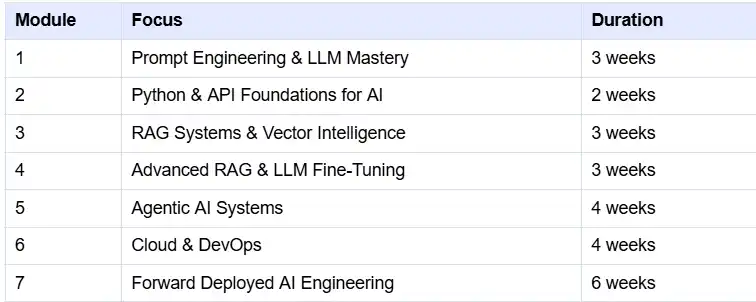
The longest stretch, six weeks, belongs to Module 7. That's deliberate. You can pick up most of the earlier material from good documentation. The client-facing work is much harder to learn on your own.
Inside Each Module
Module 1 | 3 weeks
Prompt Engineering & LLM Mastery
We start with how these models actually work: transformer architecture, attention, KV cache, mixture-of-experts and reasoning models. Once that's clear, the prompting techniques make a lot more sense, and you can tell when to use chain-of-thought, tree-of-thought, self-consistency, reflection or plan-and-execute.
The practical side covers structured outputs with Pydantic and instructor, function calling, tokenization and cost (tiktoken, prompt compression), prompt injection defense, and automatic prompt optimization with DSPy. You'll work with the Open AI, Anthropic and Gemini APIs, because real clients rarely stick to one provider.
Module 2 | 2 weeks
Python & API Foundations for AI
This is the least flashy module, and one we care about a lot. It covers async Python, testing with py-test and mocked API calls, type checking with mypy, structured logging, retries with exponential backoff and jitter, webhook signature verification, idempotent handling, and prompt caching with the Anthropic SDK.
These are the habits that keep a service running when the network misbehaves. The project for this module, ingesting 50,000 paginated records from a flaky API with retries and checkpointing, is built to test exactly that.
Module 3 | 3 weeks
RAG Systems & Vector Intelligence
Here you build retrieval-augmented generation from the ground up: embeddings (Open-AI, sentence-transformers, bge), vector databases (Pinecone, Chroma DB, FAISS), chunking strategies and how they affect quality, and Lang-Chain's LCEL.
Evaluation comes in early, using RAGAS to measure faithfulness, answer relevancy and context recall. The hybrid search section covers BM25, HyDE, Reciprocal Rank Fusion, alpha-weighting and cross-encoder reranking, and you compare each against a pure-vector baseline so you can see what helps and what doesn't.
Module 4 | 3 weeks
Advanced RAG & LLM Fine-Tuning
This module goes into query rewriting, multi-hop retrieval and self-correcting RAG (CRAG, Self-RAG, Agentic RAG). Then it moves to fine-tuning: LoRA and QLoRA with bitsandbytes, PEFT, Axolotl, GPU rental on RunPod and vast.ai, RLHF and DPO with trl, and experiment tracking with Weights & Biases.
It finishes with local deployment using Ollama and GGUF quantisation, with models like Llama 3, Phi-3 and Mistral, and a hard look at cost versus performance. The project asks you to fine-tune a small open-source model so it outperforms a larger general-purpose one on a narrow task.
Module 5 | 4 weeks
Agentic AI Systems
You'll learn the ReAct loop and planner-executor patterns, function calling, and MCP (Model Context Protocol). You'll build with Lang-Graph (state machines, checkpointing, human-in-the-loop) and Crew-AI for role-based multi-agent teams, and cover memory (short-term, long-term, episodic), orchestration and trajectory evaluation.
Safety is part of the module itself: guardrails, prompt injection defense, PII scrubbing and output filtering.
Module 6 | 4 weeks
Cloud & DevOps
This module covers how an AI service gets shipped and kept healthy: FastAPI with streaming SSE and rate limiting, Docker and Compose, CI/CD with GitHub Actions (including prompt regression tests), Kubernetes with autoscaling, Helm, Terraform, and AWS services such as ECS Fargate, ECR, S3 and RDS.
On the observability side you'll use Lang-Smith tracing, cost and latency dashboards, Locust load testing, SLOs and alerting, and run Deep-Eval and Prompt-Foo in the pipeline. It also explains why non-deterministic AI systems need different operations practices than regular software, which is the heart of LLM-Ops.
Module 7 | 6 weeks
Forward Deployed AI Engineering
This is the module the program is named after. It has three parts.
Discovery and enterprise data access. Separating the stated problem from the real one in a discovery call, scoping under budget and political constraints, writing PRD-lite documents, statements of work and architecture decision records, extracting data from firewalled legacy databases (read replicas, change data capture), schema archaeology on undocumented systems, and PII masking at the point of extraction.
Deployment and enterprise architecture. VPC-only, private-endpoint and air-gapped inference patterns, SSO, SAML and OIDC, why a client's security team rejects your first architecture, throughput planning under real SLAs, vector search at 10M+ document scale, and the token economics conversation with a CTO.
Compliance and stakeholder defense. India's DPDP Act, GDPR and data residency, audit logging, model cards and retention policy, human-in-the-loop approval gates, incident response when a live system fails, and presenting to a hostile stakeholder panel.
Two of the projects sit here: a client discovery engagement that turns a vague business ask into a signed, estimated scope, and a data excavation project where you reverse-engineer an undocumented legacy system using CDC and entity resolution.
Electives | self-paced
DSA and System Design for interviews
Alongside the core program, there are self-paced electives for interview preparation. System design covers load balancing, caching, sharding, consistency models, queues, rate limiting and classic design problems. The DSA track covers arrays through dynamic programming and complexity analysis.
The projects
You'll build 14 projects across the program, most of them around six to eight hours each. A few examples:
- The Resilient Ingestor: fault-tolerant async ingestion from a flaky API
- The Retrieval Bake-Off: hybrid search and reranking, measured with RAGAS
- The Specialist: a fine-tuned small model that beats a larger one
- The Claims Desk: a Lang-Graph agent with persistent memory and human approval
- The Control Room: tracing, dashboards and CI-integrated evals
- The Data Excavation: reverse-engineering an undocumented legacy system
They're ordered so each one builds on the last: prompts, then retrieval, then agents, then deployment, then working with a client.
The tools you'll use
The stack was chosen from what working teams actually use:
- Open-AI and Anthropic APIs,
- Lang-Chain, LlamaIndex, Pinecone and - -ChromaDB for building;
- Lang-Graph, Crew-AI, MCP, DSPy and Ollama for agents;
- QLoRA, Axolotl, PEFT and Hugging Face for fine-tuning;
- Deep-Eval, Prompt-Foo, RAGAS, Lang-Smith and Arize for evaluation;
- FastAPI, Docker, GitHub Actions, Terraform, Kubernetes and AWS for shipping.
Who Can Benefit?
This program is for working engineers: SDEs, backend and data engineers, DevOps and platform engineers who already write production code. You don't need an ML background. We start from Python fundamentals and build up.
You do need to have shipped software before. If you haven't, this isn't the right starting point, and we'll tell you that on the counselling call rather than after you've paid.
Roles it prepares you for
The program is designed for roles such as Forward Deployed AI Engineer, GenAI or LLM Engineer, Agentic AI Developer, and Technical Product Manager for AI.
Ready to build AI that ships?
Apply to the Forward Deployed AI Engineering program and talk to our team about whether it fits where you are right now.
Frequently asked questions
Q1. How does the 1-on-1 mentorship work?
Q2. What if I miss a live session?
All live sessions are recorded and made available so you can catch up at your own pace around your full-time job.
Q3. Do I need an ML background?
Q4. Does Bosscoder offer a 100% job guarantee?
No. It offers placement support, which includes profile optimization ,mentor sessions, mock interviews and access to hiring partners. Hiring decisions are made by employers.