You've shipped features for a couple of years. You can find your way around a Docker file, you've restarted a failing service at 2 a.m., and you've watched the infra team own decisions you'd like to own too. So what's the next step? For many engineers who talk to us, it's a structured move into DevOps. That's why we built the Bosscoder DevOps course, officially our DevOps, Cloud & AI Platform Engineering program. Below, we walk you through the curriculum, the projects, how mentorship works and where it can take your career.
Why DevOps, and Why Learn It With Bosscoder
DevOps is how modern software ships. Teams across industries are automating pipelines, running Kubernetes at scale and building infrastructure to serve LLMs in production. And the demand for engineers who can own these systems is outpacing supply.
We designed this program as a focused, hands-on path from code to production-scale infrastructure. It runs for 9 months across 8 phases, with live learning and production projects at every stage. Our curriculum goes well past CI/CD basics into Terraform, Git Ops, Dev Sec Ops, observability and a dedicated MLOps track.
You don't need to be a senior architect to step in. You need the right structure.
Bosscoder DevOps Course Curriculum, Module by Module
The Bosscoder Academy DevOps course is designed to be progressive, meaning that each module follows from the previous one. When you get to Kubernetes, you won't struggle with basic Linux concepts. Here is the brief summary:
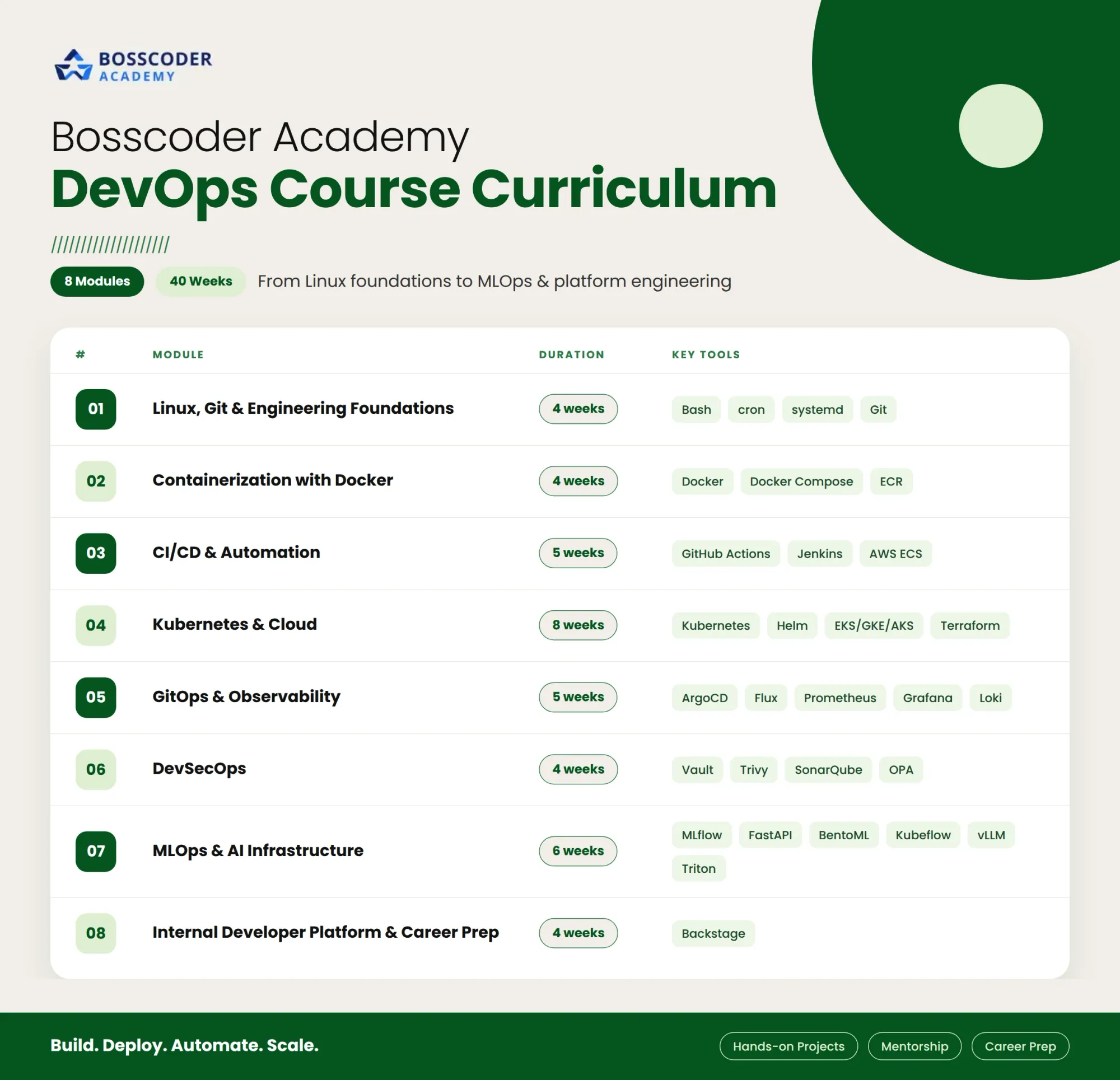
Module 1: Linux, Git & Engineering Foundations
Everything in DevOps is based on Linux. In particular, you’ll have to deal with filesystems, permissions and processes, write Bash scripts, configure cron jobs, and control services using systemd. We'll also study SSH, DNS, ports and firewalls, Git branches and rebase, as well as pull requests. The solution to failed deployment will come through the terminal.
Tools change. Fundamentals remain the same.
Module 2: Containerization with Docker
You’ll understand what a container is made of (namespaces, cgroups, images and layers), write Dockerfiles using multi-stage builds, use Docker Compose for running local stacks, and push tagged images to ECR.
The course will cover health checks, image scanning, and debugging. In practice, this is how “works on my machine” becomes an image you can rely on.
Want to see how Docker, Kubernetes, Terraform, and CI/CD are applied in real projects? Explore our blog to the Forward Deployed AI Engineer curriculum and projects.
Module 3: CI/CD & Automation
We designed this module around build-test-deploy automation. You'll set up GitHub Actions workflows with runners and secrets, write declarative Jenkins pipelines and manage artifacts and automated tests. Then you'll practice blue-green, canary and rolling deployments: the skills behind a pipeline that deploys on every merge without taking the app offline.
Module 4: Kubernetes & Cloud
Our longest module, at 8 weeks. Kubernetes runs from Pods, Deployments, Services and Ingress through RBAC, Helm, Operators and autoscaling. On the cloud side, you'll work with compute, storage, IAM and VPC across AWS, GCP and Azure, run managed clusters on EKS, GKE and AKS, and manage infrastructure with Terraform modules and state. Employers want people who can rebuild an environment from code.
Module 5: Git Ops & Observability
Git becomes your single source of truth. You'll use Argo CD for sync, drift detection and rollbacks, explore progressive delivery and get an intro to Flux. The second half is SRE territory: Prometheus, Prom QL, Grafana, Alert Manager and Loki for metrics, logs and traces, plus SLIs, SLOs, error budgets and incident response. On-call engineers live by these skills.
Module 6: Dev Sec Ops
Security shifts left here. We start with Dev Sec Ops culture, OWASP risks and threat modeling, then move to secrets management with Hashi Corp Vault. You'll add SAST, DAST and dependency scanning to pipelines, scan containers with Trivy, check code quality with SonarQube and write policies as code with OPA. Audit and compliance are covered too.
Module 7: MLOps & AI Infrastructure
Infrastructure, meet AI. You'll study the ML lifecycle and the training-to-production gap, track experiments with ML flow and handle model registries, versioning and feature stores. Then comes model serving with FastAPI, Bento ML and Kubeflow, GPU scheduling on Kubernetes and LLM deployment with v LLM and Triton, with model monitoring built in.
Interested in how cloud and DevOps skills support AI applications in production? Read our guide to preparing for Forward Deployed AI Engineering.
Module 8: Internal Developer Platform & Career Prep
The final module covers Internal Developer Platform concepts, Backstage service catalogs and templates, and self-service infrastructure with golden paths. Alongside it, we prepare you for DevOps and SRE interviews (system design included) and help you sharpen your resume, GitHub and LinkedIn.
DevOps Projects that Show Your Skills to Employers
You’ll create 8 real-world DevOps projects related to what you have just learned. What does it mean? Having a functioning EKS cluster on your GitHub account is better than any certification.
CI/CD Pipeline with Blue-Green Deployment (12 hours)
An end-to-end pipeline that deploys to AWS ECS with zero downtime, automated testing and Trivy security scanning, using GitHub Actions and Docker. It proves you can ship changes safely.
Kubernetes Cluster on EKS (12 hours)
You'll provision a production-grade EKS cluster with Terraform, complete with Helm charts, RBAC and horizontal autoscaling. Hiring managers read this as real cluster ownership.
Full Observability Stack (12 hours)
Dashboards, alerting rules and centralized log aggregation with Prometheus, Grafana and Loki. It shows you can spot problems before users do.
Git Ops Pipeline with Argo CD (12 hours)
A self-healing deployment system with drift detection, automated rollbacks and Git as the single source of truth. A strong talking point for platform roles.
3-Tier AWS Infrastructure (12 hours)
VPC, RDS, EC2 autoscaling and a load balancer, all written as code with Terraform. Proof that you can design a full cloud architecture on your own.
Dev Sec Ops Pipeline (12 hours)
Code analysis, container scanning and dynamic secret injection at every stage, using Trivy, SonarQube and Vault. Security-minded engineers stand out in interviews.
MLOps Platform (16 hours)
An end-to-end ML platform with a data lake, experiment tracking, model serving and monitoring, built on ML flow, FastAPI and Prometheus. It positions you for MLOps and AI platform roles.
Curious about the technologies powering modern AI applications? Read our Applied GenAI and Agentic AI guide to explore relevant frameworks and tools.
Internal Developer Platform Capstone (16 hours)
A Backstage portal integrated with GitHub, provisioning Kubernetes resources, with golden path templates for self-service infrastructure. Your strongest portfolio piece.
DevOps Mentorship and Learning Style
The DevOps course offered by Bosscoder Academy is done through live learning. You learn while doing it, and you get to ask questions while learning, and apply each concept learned in a project soon after.
Mentorship has been at the core of Bosscoder from the start. Our founders began by personally guiding engineers one-on-one, and we still offer 1:1 mentorship because every learner arrives with a different background.
Your DevOps mentors are practitioners who guide you on the actual work: reviewing your pipelines, talking through deployment strategies, helping you shape cloud infrastructure and showing you how incidents get handled in production.
DevOps Career Opportunities in India
So where does this lead? Our program prepares you for four role families:
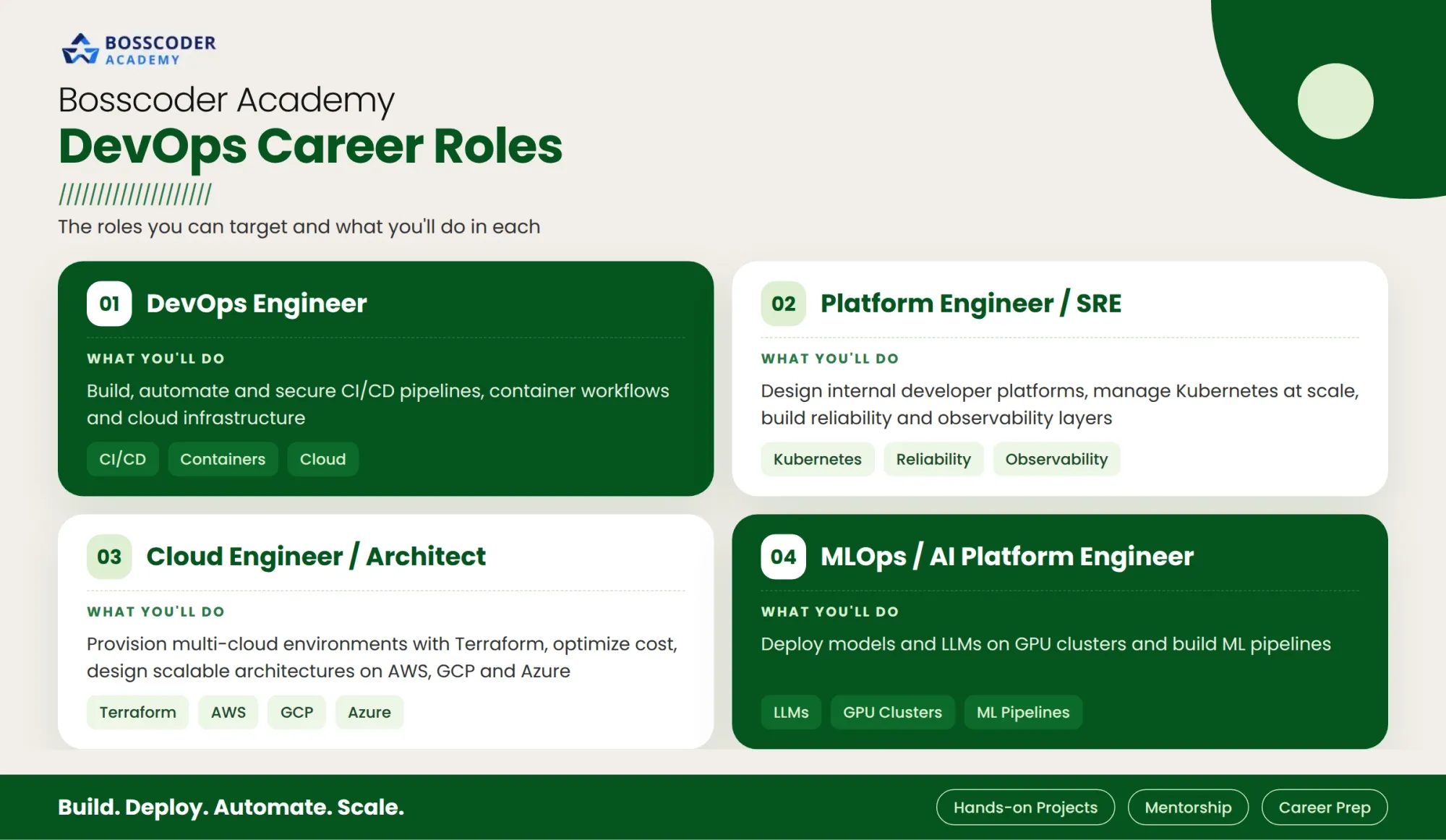
Product companies, GCCs and cloud-driven startups actively hire for these roles. Graduates typically move into salaries of ₹12 to 30 LPA in DevOps and Cloud roles, or ₹20 to 45 LPA in Platform and MLOps roles, depending on prior experience.
What do employers look for? Hands-on Kubernetes and Terraform, pipelines with real deployment strategies, observability and a security-first mindset. Your projects cover each one.
Placement support
This is a DevOps course with placement support that's end-to-end and continues until you're placed. It works in three steps.
First, profile building: a resume that highlights real work, a LinkedIn profile optimized for visibility, curated roles for your profile and guidance on applications. Second, referrals through our alumni network across product companies, with mentors and instructors actively referring high-performing learners and sharing relevant openings in real time. Third, company tie-ups, with 400+ hiring partnerships across top tech companies.
Our outcomes are independently assessed by B2K Analytics: a 91% placement percentage, a 20 LPA average package, a 104% average salary hike and a 99 LPA highest package.
Frequently Asked Questions (FAQs)
Q1. How long is the Bosscoder DevOps course?
It runs for 9 months across 8 modules, with live learning and production projects throughout. Modules range from 4 weeks to 8 weeks, with Kubernetes & Cloud being the longest.
Q2. Do I need prior DevOps or cloud experience?
No. If you have a technical background, you're ready to start. You'll build on your existing skills and progress toward production-grade Kubernetes, cloud infrastructure and AI/ML platform engineering.
Q3. Which tools will I learn?
Docker, Kubernetes, Helm, GitHub Actions, Jenkins, ArgoCD, Terraform, AWS, GCP, Azure, Prometheus, Grafana, Loki, Trivy, SonarQube, Vault, MLflow, vLLM, Triton and Backstage, among others.
Q4. How many projects will I build?
Eight production-grade projects, from a blue-green CI/CD pipeline on AWS ECS to an Internal Developer Platform capstone built with Backstage.