Artificial intelligence (AI) is not just something that we see in science fiction movies anymore. It allows us to access our mobile phones, find our way to work fast, find new music, do shopping online, and even spot suspicious transactions on our bank accounts.
A lot of people use artificial intelligence in their daily routines. Knowing how artificial intelligence can be applied to solve practical problems will let you learn more about the technology itself, its benefits, and impact on our lives and business.
In this blog, we are going to explore 10 examples of AI in everyday life, understand how each of them operates, and see what implications they bring for the future.
What Is AI in Everyday Life?
Artificial intelligence is a technological tool that helps computers do something that usually requires intelligence of humans, for example, understanding language, recognizing patterns, making predictions, and generating content.
When a shopping application gives you a suggestion on something you would enjoy based on what you do, it makes a prediction.
AI does not always look like a chatbot or a robot. Sometimes, it works quietly in the background, helping apps and devices make better decisions.
10 Examples of AI in Everyday Life
Following are 10 examples of applications of artificial intelligence in daily life activities.
1. Voice Assistants and Smart Speakers
Examples: Siri, Google Assistant, and Alexa.
Voice assistants rely on AI technology to understand voice commands and reply to inquiries. You may ask them to remind you about something, tell the weather, play songs, or control your smart home devices that are connected to them.
How AI benefits here:
- Translates voice into text.
- Understands the intention behind your query.
- Uses connected services to perform the task or provide a reply.
For example, if you ask the voice assistant to set up an alarm, it needs to understand your command and schedule the alarm accordingly.
2. Personalized Recommendations on Streaming Platforms
Examples: Netflix, YouTube, and Spotify.
Did you ever wonder why your streaming service is always recommending videos, music, or movies based on your taste?
The recommendation algorithms, using artificial intelligence, look for patterns like your search history, watching and listening preferences, and other activity and predict what would interest you next.
Practical advantage: Saves your time from searching, since you get recommended the content you may be interested in.
Recommendations are just predictions and do not always guarantee you will get new experiences.
3. Navigation and Traffic Prediction
Examples: Google Maps and other navigation applications.
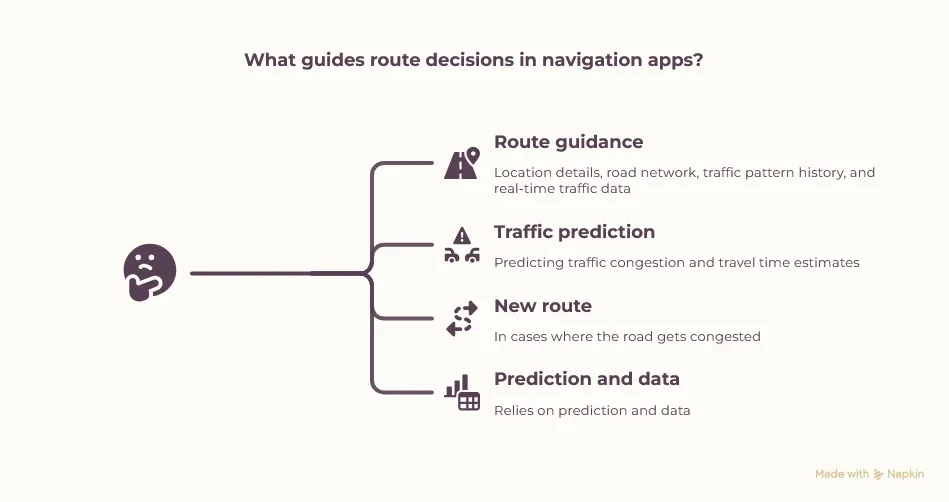
A navigation app uses the combination of location details, road network, traffic pattern history, and real-time traffic data to guide users towards deciding routes.
Artificial intelligence could help in predicting traffic congestion and travel time estimates, which could help in suggesting a different route by the app.
In cases where the road gets congested, your navigation app might suggest a new route.
What matters most about AI navigation is that it relies on prediction and data. The precision of such navigation could depend on incomplete or unexpected traffic conditions.
4. AI Chatbots and Customer Support
Examples: Website support chatbots, conversational AI assistants.
Many tech companies employ AI chatbots to provide common answers, explain company policies, and help users troubleshoot.
Modern conversational AI is capable of understanding natural language questions and producing answers according to its training and knowledge.
For example, a user can be interested in password reset options or order tracking without involving any support personnel.
For complex complaints, account problems, and wrong answers, human involvement is still necessary.
5. Fraud Detection in Banking and Digital Payments
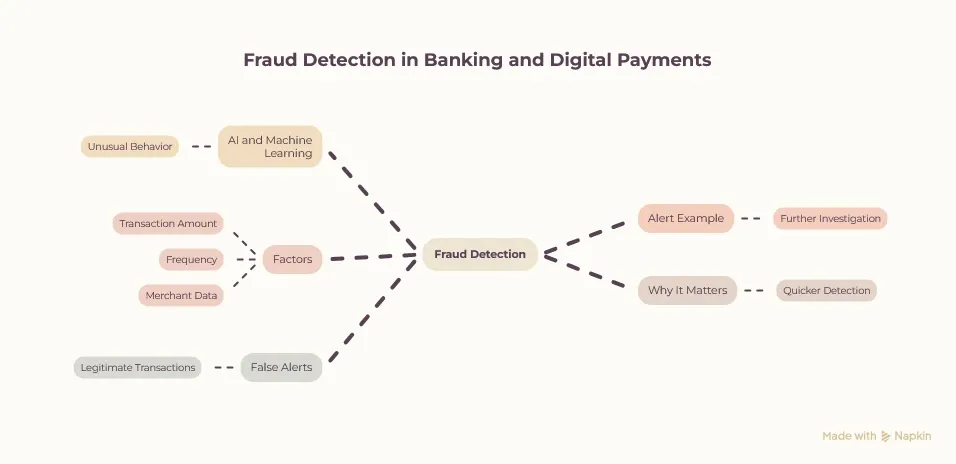
AI and machine learning technology is used by banks and payment processors to detect unusual transactional behavior.
For example, when there are a number of unusual transactions using a particular card within a short period of time, the system might generate an alert for further investigation.
Such an AI system takes into account a number of factors that include transaction amount, frequency, merchant data, and more.
Why it matters: Such systems allow banks and financial organizations to detect potential fraud more quickly.
However, an unusual transaction does not always mean fraud. Sometimes, legitimate transactions will trigger an alert.
6. Face Recognition and Phone Security
Many modern phones have facial recognition and other biometric techniques for identifying their users.
AI algorithms may use the analysis of a person’s facial features to determine whether it is a user who had been registered or just an incorrect attempt of unlocking the device. Some other devices use fingerprint recognition instead of face recognition.
For example, the phone may unlock automatically after recognizing your face in specific conditions.
The usage of such technology is very convenient however, its effectiveness depends on different factors. It does not mean identifying each person that comes into view.
7. Healthcare and Medical Imaging
There is increasing use of artificial intelligence in the healthcare sector to enable medical professionals in the processes of analyzing medical images, pattern recognition and prioritizing patient reviews among others.
In this case, the artificial intelligence program could assist the radiologist in pinpointing areas of concern in an X-ray or scan.
AI could also be helpful in administrating processes such as managing clinical information.
The important thing to remember is that AI can help the medical professional, but cannot take the place of professional diagnosis and clinical expertise.
8. Smart Devices and Appliances in the Home
Examples: Smart thermostats, smart lights, and robotic vacuum cleaners.
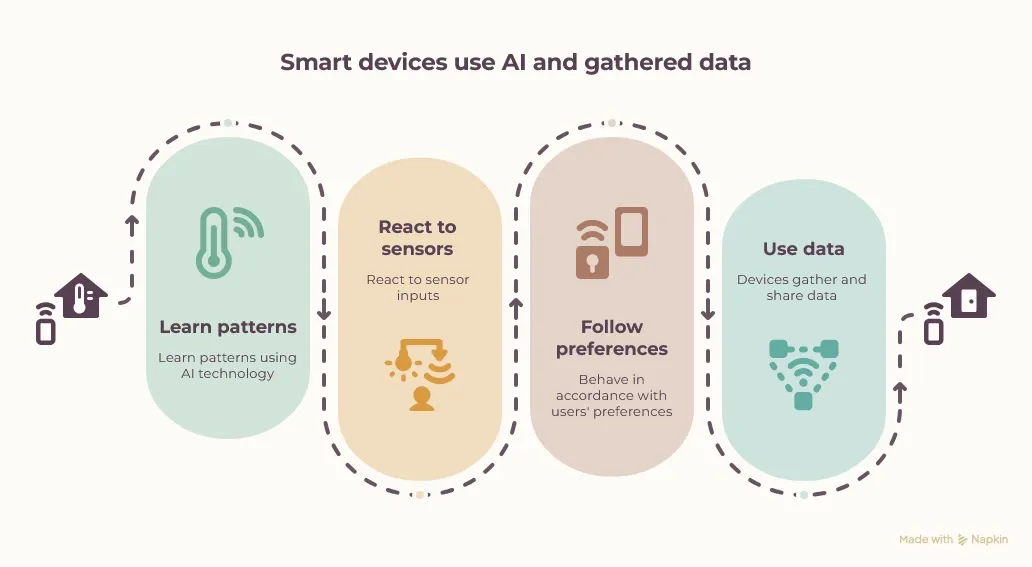
Smart devices can learn patterns, react to sensor inputs, or behave in accordance with users' preferences using AI technology.
For instance, a smart thermostat can utilize data on whether a room is occupied and temperature patterns to assist in the regulation of heating or air conditioning. A robotic vacuum cleaner can utilize sensors to navigate its way around furniture.
The examples demonstrate the relationship between artificial intelligence and the Internet of Things, when devices gather and share data.
One example of a study on how connected devices and embedded computing can impact people's lives is the report of the Pew Research Center published in 2014. The findings were based on an expert canvassing, not a survey of general public opinion.
9. Online Shopping and Product Suggestions
The e-commerce website utilizes AI to provide personalization in terms of product recommendations, enhance their search algorithms, demand forecasting, and customer service.
For instance, after visiting a page for running shoes, you will get recommendations about sportswear or complementary items.
Machine learning algorithms are capable of learning from product features, browsing history, purchasing activity, and patterns of similar customers.
The company may use machine learning for predicting demand of certain products and planning inventory accordingly.
These forecasts can help in increasing relevance, but at the same time, the recommendations can be based on the company’s priorities rather than yours.
10. AI Tools for Learning and Productivity
The use of AI tools can help learners and professionals to summarize documents, clarify obscure information, proofread their texts, brainstorm ideas, and code.
For example, a learner can request an AI to help him or her to understand an obscure programming term through an illustrative example. Software developers can rely on AI code assistants to come up with a function or find out a problem with the code.
The generative AI creates a completely new content in the form of text, images, code, and others according to users' requests.
Those who want to learn about the architecture of such systems should consider enrolling into Bosscoder Academy Applied GenAI Program that covers prompt engineering, large language models, retrieval-augmented generation (RAG), AI agents, and applications among others.
Want to understand how Generative AI works beyond everyday applications? Explore the Bosscoder Academy Applied GenAI Program to learn about LLMs, prompt engineering, RAG, and AI agents.
Quick Comparison: How AI Is Used in Daily Life
| Everyday activity | AI application | Key advantage |
|---|---|---|
| Utilizing voice assistant | Speech and language processing | Hands-free support |
| Watching videos | Recommendation system | Personalized content |
| Driving or commuting | Traffic forecasting | Better route planning |
| Contacting customer service | Conversational AI | Quick replies |
| Processing digital payments | Fraud detection | Recognizing fraudulent transactions |
| Unlocking mobile devices | Biometric authentication | Easy unlocking |
| Seeking healthcare services | Image analysis and decision making | Helps clinicians review information |
| Controlling smart home | Sensor control | Convenience and efficiency |
| Buying online | Recommendation system | Customized recommendations |
| Working or studying | Generative AI assistants | Help with learning and productivity |
What Are the Advantages of Using AI in Our Daily Lives?
AI can help simplify our daily tasks provided that it is used correctly.
The main advantages are the following:
- Saves time: Makes routine work easier and facilitates the search for information.
- Personalization: Recommends content, goods, and educational materials based on certain cues.
- Detects patterns: Enables detection of strange transactions, trends, and possible problems.
- Support in making decisions: Gives predictions and analysis, which people can consider along with their personal opinions.
- Accessibility: Voice recognition and translation software can make digital services more accessible for more people.
Such advantages are determined by the quality of data, the system itself, and people's ability to apply the outcomes of its functioning.
What Are the Challenges of AI in Daily Life?
AI also has disadvantages that need to be understood equally well as the practical uses of this technology.
- Personal data: Some AI services gather personal and behavioral information.
- Incorrect answers: Generative AI can generate false but plausible information.
- Prejudice: The systems may generate unfair results that are part of the training data.
- Overreliance: The use of AI without verification of results can bring to wrong decisions.
- Security issues: The AI systems and interconnected devices may create more security issues.
The general principle here is to use AI as a helpful tool and verify information rather than rely on it.
Conclusion
AI is already a part of our lives, whether through recommendations or the various AI-based applications we use when banking, traveling, healthcare and learning. The true value of AI lies in making it easier for people to save time, identify patterns and make better decisions despite its shortcomings.
If you want to go beyond just using AI-based applications and wish to learn how to create AI applications, then you should take a look at the Bosscoder Academy Applied GenAI Program.
FAQs About AI in Everyday Life
Q1. What are five examples of AI used in our daily lives?
Five common examples include voice assistants, streaming recommendations, maps, bank fraud protection, and AI chatbots.
Q2. How is AI used in daily life without us noticing?
AI is used in the background to rank search results, filter out spam, make product recommendations, analyze transactions for fraud, and monitor traffic situations.
Q3. Is ChatGPT an example of artificial intelligence?
Yes. ChatGPT is an AI assistant using generative AI technologies to generate replies based on understanding prompts given to it.
Q4. How can beginners learn to build AI applications?
Beginners could start with Python programming, machine learning, AI APIs, prompt engineering, and then go on to large language models, RAG, and AI agents. The Bosscoder Academy Applied GenAI Program is one possibility for professionals seeking such courses.