Do you wonder how a self-driving car reacts to traffic, how Netflix makes recommendations about films, and how an AI assistant performs tasks? All these applications apply different techniques to sense information, decide, and act.
An intelligent agent in artificial intelligence is a system which observes its environment and performs actions in order to accomplish a particular objective. Agents can be either rule-based, planning, comparative, or learning.
In this blog, we will explain what an intelligent agent is, how it operates, five types of intelligent agents, and some practical examples of such agents.
What Is an Intelligent Agent in AI?
An intelligent agent is a software or hardware system which senses its environment and performs actions in order to fulfill the task at hand.
For example, a smart thermostat monitors the room's temperature and switches on/off the heating system in order to ensure that the desired temperature is maintained. The navigation system analyzes the possible paths and suggests an appropriate one to reach your destination.
The difference between an intelligent agent and a simple program is that an intelligent agent is able to choose actions based on the information it receives.
An intelligent agent usually consists of the following parts:
- Sensors: Collect information from the environment.
- Actuators: Perform actions in the environment.
- Agent function: Maps observations into actions.
- Environment: The world or system in which the agent operates.
In the case of software agents, the sensors can be user input, databases, and APIs; actuators may be actions such as messaging and execution of commands.
How Does an Intelligent Agent Work?
An intelligent agent usually operates in a continuous loop of perception, decision, and action.
- Perception: Gather data from the environment.
- Processing: Analyze the data through rules, models, or patterns.
- Decision: Choose a particular action according to the current situation and desired goal.
- Action: Take the chosen action.
- Evaluation: Assess the results and apply the feedback as needed.
For example, consider a robotic vacuum cleaner that senses obstacles, decides on its actions according to this state and cleans the place.
However, not all agents learn from all actions. Some of them can only operate with the help of a set of predefined rules while others can learn from their experience.
What Are the Five Types of Intelligent Agents in AI?
There are five kinds of intelligent agents described in AI textbooks, each taking a different strategy for making decisions.
| Type of agent | How it works | Example |
|---|---|---|
| Simple reflex agent | Uses rules based on the current situation | Simple thermostat |
| Model-based reflex agent | Has an internal model of the environment | Obstacle avoidance robot |
| Goal-based agent | Takes actions that will accomplish its goal | Route-planning system |
| Utility-based agent | Compares outcomes based on their desirability | Route planner for time and tolls trade-off |
| Learning agent | Improves itself through experience | Personalized recommendation system |
1. Simple Reflex Agents
Simple reflex agents respond to the present inputs based on their predefined rules.
For example, a thermostat may activate the heater if the temperature goes below a certain value.
Suitable for: Simple and predictable environments where pre-defined rules are sufficient.
Limitation: Simple reflex agents are incapable of using history in decision making unless this ability is built within the agents
2. Model-Based Reflex Agents
Model-based reflex agents have an internal model of the environment, which enables them to make decisions even in the absence of complete information.
As an example, a robot can continue tracking the previous location of an obstacle even when the obstacle is briefly out of sight.
Good for: Environments in which information is not complete and keeps changing.
3. Goal-Based Agents
Goal-based agents choose their choice of action on a particular goal. They can compare various options for action before they make a decision.
Example: Navigation system looks for a route which gets you to your destination. If a particular road is closed, it finds another route but achieves the same goal.
Best suited for: Planning-oriented multi-step tasks.
4. Utility-Based Agents
The utility-based agents evaluate the desirability of particular outcomes. Unlike simple action selection based on finding the way of achieving the goal, they consider various possible outcomes taking into account criteria such as cost, time, risk, convenience, etc.
Example: A navigation system recommends going by a somewhat longer route to avoid expensive tolls and heavy traffic.
Best suited for: Trade-offs between several desirable options.
5. Learning Agents
Learning agents enhance their performance through experience, feedback, or further training.
For example, a recommendation system could use user behavior to enhance future recommendations. The performance of such an agent would be determined by the way it learns, available data, and criteria of success.
Best for: Tasks where patterns change or predefined rules are not enough.
A learning agent can have components such as learning, decision making, a critic, and a problem generator.
Intelligent Agents vs. Modern AI Agents
An intelligent agent is a general notion in AI. Modern AI agents use a large language model (LLM) to understand the instructions, make plans, and work with third-party tools.
In other words, while a standard rule-based support agent may be capable of reacting to a specific list of keywords, an LLM-based support agent will have the ability to comprehend a client's query, obtain any necessary information, and utilize an authorized third-party utility to review an order.
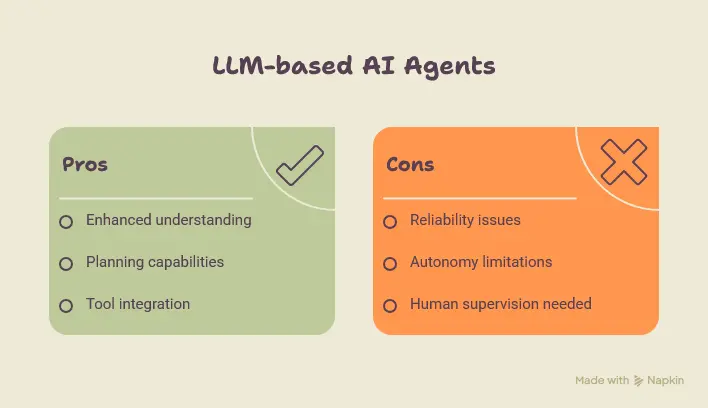
However, the implementation of an LLM cannot guarantee reliability and full autonomy on behalf of contemporary AI agents. They also require proper instructions, permission to perform particular tasks, assessment, and monitoring by a human being.
If you want to explore how these systems are built, read the Bosscoder Academy Applied GenAI Program guide, which covers LLMs, RAG, and agentic AI development.
Where Are Intelligent Agents Used in Real Life?
Intelligent agents are used in a variety of industries where decisions need to be automated and responses can depend on changing information.
- Healthcare: Assist in managing clinical workflows and medical data analysis.
- Banking: Help identify any suspicious transactions and abnormal activity.
- E-commerce: Assist in product recommendation based on user activity.
- Transportation: Help plan routes and drive cars autonomously.
- Customer support: Answer users' questions and provide relevant information.
- Software development: Helping developers write, test, and debug code.
Creating such software requires considering issues related to accuracy, privacy, security, and the impact of errors.
How Can You Start Learning to Build AI Agents?
Start with Python, basics of AI, APIs, and data management. After that move to Machine Learning, LLMs, Retrieval Augmented Generation (RAG), Tool Calling, and evaluating agents.
Bosscoder Academy’s GenAI learning program is a choice for tech professionals who need to learn how to use Generative AI. This roadmap covers LLM applications and Agentic AI fundamentals.
For a more detailed route from fundamentals of AI to developing your own AI applications, consider the Bosscoder Academy AI Engineer Roadmap.
When practicing, start from building something simple like document assistants. Define their goal, connect them to data, and check if the answers provided are correct according to the existing information.
Conclusion
In AI, an intelligent agent senses the environment around it, takes decisions and acts upon them to accomplish a particular objective. The five types of agents based on the classical approach include simple reflex agent, model-based reflex agent, goal-based agent, utility-based agent, and learning agent.
This knowledge will be useful for you when choosing the correct decision-making process to solve a certain problem, regardless of whether you develop an old-fashioned automation system or a modern AI agent.
Frequently Asked Questions About Intelligent Agents in AI
Q1. What is an intelligent agent in AI?
Intelligent agent in AI refers to a system which observes the environment, processes information and takes actions towards achieving a particular goal. Examples of such agents include intelligent thermostats, recommendation systems, navigation software and intelligent agents.
Q2. What are the five types of intelligent agents in AI?
There are five types of intelligent agents including simple reflex agents, model-based reflex agents, goal-based agents, utility-based agents, and learning agents. Different decision-making methods are used by these different kinds of intelligent agents.
Q3. How does an intelligent agent work?
Intelligent agents operate in terms of a decision-making process involving perception, decision, and action. Intelligent agents make observations about their environment, analyze data available, select an action, and perceive the results of that action.
Q4. What is the difference between an intelligent agent and an AI agent?
An intelligent agent is an overarching AI term for any system that perceives its surroundings and behaves in a way to reach a certain objective. An AI agent is a term used frequently in relation to software programs using AI techniques to make decisions and execute actions. Current AI agents employ large language models, API calls, and even memory to execute workflows involving multiple steps.
Q5. How can I learn to build intelligent agents and AI applications?
Begin your journey into this exciting field by learning about Python programming, basic concepts of AI, APIs, and machine learning. Further expand your knowledge base to include LLMs, RAG, Tool Calling, and Agent Evaluation. Bosscoder Academy's GenAI course is one way you could get there!