AI can code, give answers to questions, and even do complex actions. However, what happens when AI agents make mistakes, misuse tools, or keep doing the same mistake again and again?
This is when harness engineering in AI comes into play.
Harness engineering is not about making AI models more advanced, but rather creating the ecosystem that allows them to utilize tools, follow instructions, evaluate themselves, and overcome errors.
This blog will explain what harness engineering is, how it works, how it differs from prompt engineering, and its importance when creating a reliable AI agent.
What Is Harness Engineering?
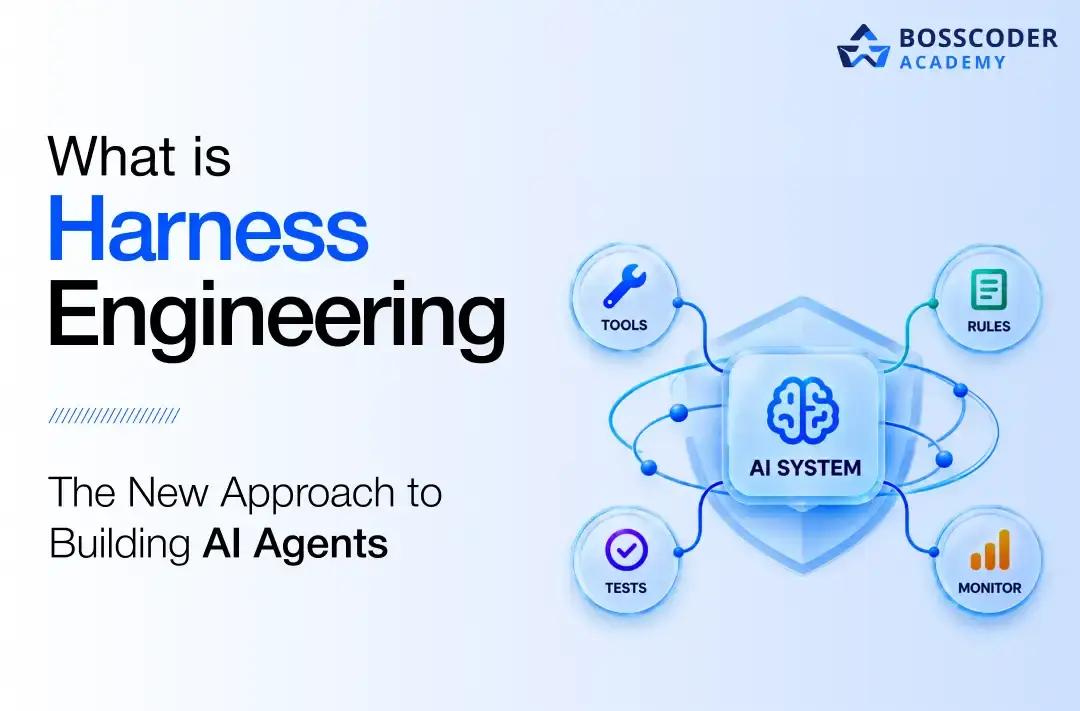
Harness engineering refers to the design of the software tools, instructions, memory storage, authorizations, and validation processes needed to support the operations of an AI agent.
While an AI model can provide a solution, an AI agent requires much more for performing its tasks. It requires an environment wherein it can act, access information, validate its performance, and choose further action steps to take.
For example, an AI coding agent might produce correct code but end up breaking a certain function. A properly built harness will test the code, identify any problems, validate the failure, and ask the AI agent to correct itself.
In simpler terms:
- AI model: Reasoning and response generation.
- Harness in AI: Provides tools, rules, execution, and feedback.
- AI agent: Utilizing the model and harness in order to accomplish a particular task.
The term “harness engineering” started gaining more popularity in 2026 as engineers were able to share experience in working on the development of AI coding agents and autonomous systems. The main principle behind this concept is quite simple - when an agent makes a mistake, the surrounding system should be improved to avoid similar mistakes.
How Does Harness Engineering Work?
Harness engineering is where an AI model is connected to its resource requirements and validation for a particular task.
The following is usually what happens during the process:
- Define the goal: Set the goal for the agent and the criteria for completing the task.
- Provide context: Present relevant files, code, instructions, or prior output to the agent.
- Give access to tools: Grant the agent permission to utilize approved API, database, terminal, or other means.
- Task execution: Permit the agent to formulate its next move and execute an action.
- Result verification: Evaluate test or rule success or failure of the action performed by the agent.
- Handle failures: Provide the agent with valuable feedback on errors.
- Termination: Ending the process upon completing the goal, hitting a safety limit, or human intervention.
Example: Consider the case of an AI agent which is trying to fix a bug in a web application. It inspects the code, makes changes, tests the application and evaluates its performance. In case there is a failure, it gets the report back, fixes the error and submits the result for further evaluation.
In this way, the harness restricts the process from being accepted unless the check passes.
What Are the Main Components of an AI Harness?
An effective AI harness typically consists of the following components:
| Component | What it does |
|---|---|
| Instructions/Specifications | Describe task, rules, and expected outcome |
| Tools/APIs | Enable the agent to interact with software and data |
| Context/Memory | Provide relevant information across steps |
| Permissions/Sandboxing | Restrict agent's access capabilities |
| Verification/Evaluation | Check whether the output meets requirements |
| Feedback/Recovery | Help the agent respond to errors |
| Logging/Monitoring | Document actions, failures, cost/time of execution |
There is no need for a complex harness for every AI agent. Some may only require a few tools and verification processes, but others might require more robust measures.

Harness Engineering vs. Prompt Engineering vs. Context Engineering
These three approaches solve different problems, but they work best together.
| Approach | Main focus | Example |
|---|---|---|
| Prompt engineering | What the model is asked to do | Asking AI to code a Python function |
| Context engineering | What information the model gets | Providing relevant code and documentation |
| Harness engineering | How the agent acts and verifies its actions | Tests and restriction on unsafe operations |
Improving the prompt may lead to improvement in the quality of the answer, while improving the context will help the model to make more informed decisions. Yet neither approach guarantees execution safety or correctness of the results produced by the agent.
Harness engineering closes that gap.
Why Is Harness Engineering Important for AI Agents?
The AI agent may take multiple steps before completing a task. Each step can be a source of failure, unanticipated tool behavior, or wrong assumption.
Well-engineered harness will enable teams to:
- Ensure reliability: Validate the results instead of relying on generated output.
- Restrict permissions: Limit access to potentially harmful or confidential files, APIs, and other functionality.
- Eliminate common errors: Convert errors into better instructions or validation.
- Control costs: Place restrictions on the number of calls to a tool, running time, and use of models.
- Enable human control: Ensure human approval for potentially harmful or irreversibly actions.
One useful practice is to evaluate task success rather than response quality. In case of coding agent, one could track the percentage of tests passed, regression, successful task completion, and human interventions.
Such measurements will help understand if the harness really helps.
How to Start Building a Reliable AI Harness
There is no need to have a complex multi-agent architecture in order to get started. Start off with something simple and measurable.
- Select one workflow, such as answering questions about company documents.
- Specify what a successful outcome looks like.
- Limit the access of the agent to just the functionality that it really needs.
- Introduce checks for correctness, format, or completeness of results.
- Set limit for number of attempts, execution time and other factors.
- Capture errors and refine the harness based on errors captured.
For example, a document-question-answering agent can find appropriate documents, formulate an answer, and verify if the claims are consistent with the documents available. In case of no proof found, the agent should state so, rather than make something up.
This way you can quantify the progress you are making and help your team evolve from a showcase to something more reliable.
How Can You Learn to Build AI Agents?
Apart from mastering prompts creation techniques, developers need to learn about LLMs, APIs, RAG, tool invocation, evaluation, and production.
The Bosscoder Academy GenAI program is one option for learners who want to develop practical skills in Generative AI and agentic systems.
For those looking for information on the overall training path, take a look at the Bosscoder Academy Applied GenAI Program guide that discusses the curriculum, mentorship, and career readiness.
Having such skills gives you the foundation of understanding how models relate to tools, data, and applications. For building reliable agents, you will also need to practice adding verification, permissions, and error handling to your project.
Conclusion
Harness engineering is about enhancing the reliability of AI agents through better systems design. Harness engineering integrates various aspects such as tools, context, authorization, feedback, and verification for the purpose of accomplishing tasks under control.
When AI is employed for applications other than chatbots, harness engineering becomes essential for developing robust systems.
The main lesson here is very straightforward: don’t just ask an AI agent to accomplish a task, create a system to perform this task for the agent, verify it and knows when to stop.
Frequently Asked Questions About Harness Engineering
Q1. What is harness engineering in AI?
Harness engineering is the development of the infrastructure necessary for AI agents to perform the task successfully, such as tools, instructions, memories, permissions, and verification systems. This process makes sure that an agent can access tools, validate results, deal with any mistakes, and operate within defined limits.
Q2. How does harness engineering work in AI agents?
The process of harness engineering involves providing an AI model with the required tools and systems needed to perform the task. An agent receives instructions and context, takes an action, validates the result, and deals with any mistakes using the feedback. The process ends when the task is completed or safety limits are exceeded.
Q3. What is the difference between harness engineering and prompt engineering?
While prompt engineering is about the way of writing instructions for an AI model, harness engineering is about the environment that regulates the operation of an AI agent. A prompt gives the instruction to a model; a harness provides it with tools, permissions, execution workflow, and validation mechanisms.
Q4. Why is harness engineering important for building reliable AI agents?
Harness engineering allows making the development of reliable AI agents more successful due to the addition of results validation, access management, error handling, and limitations of execution. Such components will allow you to decrease the frequency of repetition, unauthorized actions, control the cost and monitor the operation of the agent.
Q5. How can I learn to build AI agents and understand harness engineering?
First of all, you should study LLMs, APIs, RAG, tool calling, and AI evaluation. Next, try building an agent with results validation, permissions management, and error handling. One such way is the Bosscoder Academy GenAI course.