Joining engineering college always presents you with this basic question:
Which skills should I develop to have a successful career?
Academic success is important. Programming, project work, internship, and placements are all important. But there is a lot more to building a career than just having one skill or excelling in one exam.
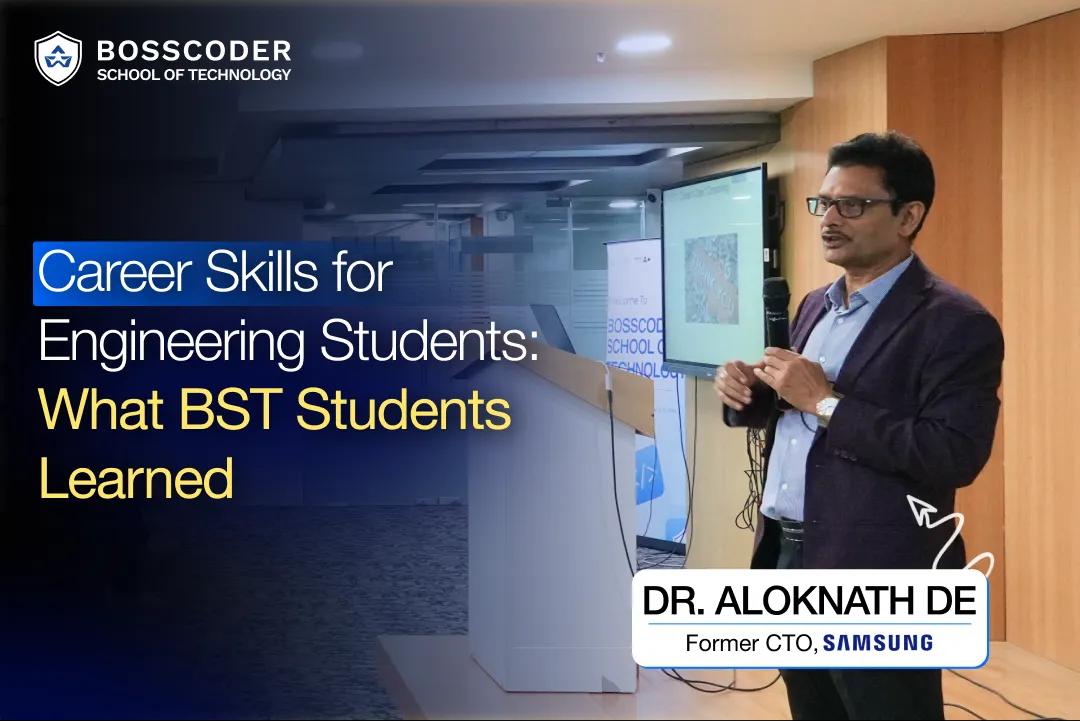
While at the Orientation Week of Bosscoder School of Technology (BST), students got the privilege of listening to Dr. Aloknath De, Founder & CEO of Techcrafter.cps and Former CTO & CVP at Samsung, in a talk on Skills for Career Trajectory.
The session focused on practical ideas that engineering students can use throughout their college journey.
1. Stay Curious
Technology is always evolving, so one should never stop learning about technologies after taking classroom lessons.
Curiosity motivates students to ask:
- Why does it work this way?
- Can this thing be done differently?
- What problem can this technology solve?
- What will happen if I change something?
Asking questions and exploring ideas can help students develop a stronger understanding of technology.
2. Utilize the Opportunities at College
The college provides more opportunities than just classrooms and tests.
There are faculty members, mentors, peers, projects, events, laboratories, and communities. This issue was raised during the session as the importance of utilizing all these resources instead of confining oneself only to the process of attending classes.
Sometimes a talk with the mentor or a project may reveal the student's new interests and career perspectives.
3. Develop Good Communication Skills
While technical expertise is critical for engineers, communication skills also matter.
In most cases, an engineer may require communication and collaboration with colleagues, explaining and pitching projects, among other tasks.
Being able to construct an item and being able to explain how it works are two different things.
Good communication skills could complement good technical skills.
4. Balance Theory With Practice
Understanding of a particular idea may mark the start of learning.
Understanding of any concept becomes better when that particular idea is put into practice.
The importance of balance between theory and practice was pointed out in the session.
5. Understand Domains, Not Just Technologies
Technologies can be applied in various fields, such as medicine, banking, manufacturing, agriculture, and entertainment.
Learning about the domain in which technologies can be applied is equally beneficial as understanding how the technologies work. Researching various domains will allow students to find out what they like.
6. Develop Skills Along With Grades
Getting good grades is necessary; however, good grades do not guarantee readiness for the career.
students can also work on developing:
- Technical knowledge
- Projects
- Problem-solving skills
- Communication
- Practical experience
- Industry exposure
The goal is not to ignore academics, but to combine academic learning with real skills.
7. Treat Internships as Learning Experiences
An internship does not have to be just another line on a resume.
It should allow students to see what working at a real company looks like, try out different positions, and find out what they like and what they don’t.
Both are valuable experiences.
8. Move beyond the Technology
The technology has been created to solve some problem.
The workshop highlighted a Tech + Business approach, where the student would not just focus on how the technology is built, but what problem it solves and why.
This approach will become increasingly valuable as the engineer tackles more complex issues and products.
9. Start Networking Early
Students need not wait till their final year to begin creating networks professionally.
This will include:
- Faculty
- Mentors
- Seniors
- Alumni
- Industry professional
- Other students
10. Keep Learning and Adapting
During the session, there was talk on Massive Open Online Education and Hybrid Learning. There were discussions on how students are exposed to other learning materials apart from college curriculum.
Students do not necessarily have to wait to be taught by someone else. They can explore, learn, experiment, and grow individually.
This would help the engineering students adapt to the changes in technology and career.
Career = Core x Computing
One of the main points covered in the presentation was:
Career = Core × Computing
The theory makes a link between having a good foundation in Core subjects and being able to use computing to tackle any issue.
For an engineering student, career preparation should therefore not be limited to knowing one particular programming language or being prepared for a specific job role.
It should instead include having a solid foundation and using technology to solve problems.
What Engineering Students Can Take Away
Through Dr. Aloknath De’s session, BST students gained another way of looking at their four-year engineering career.
Not only can they ask themselves “What should I study?”; they can also ask:
- What am I interested in?
- What skills am I acquiring?
- Am I putting what I am learning into practice?
- What domains do I find fascinating?
- Can I explain my ideas effectively?
- Am I getting any practical experience?
- From whom am I learning?
- Am I adaptable?
Professional growth does not happen in the final year of college. It begins with little choices made by students in college.
Conclusion
Engineering college should not only be about getting a degree.
Instead, it should be a place where you learn, experiment, do projects, make connections, discover your interests, and gain skills for the future.
That is the overall take away from Dr. Aloknath De's session at Bosscoder School of Technology.
Be curious. Build skills. Gain experience. Stay adaptable.
Frequently Asked Questions
Q1. What did Dr. Aloknath De discuss at Bosscoder School of Technology?
Dr. Aloknath De discussed Skills for Career Trajectory where he gave thoughts on curiosity, practical learning, communication, internships, networking, domain knowledge, and adaptability.
Q2. What career skills can engineering students learn at BST?
Engineering students at BST can concentrate on skills like technical knowledge, problem-solving, communication, practical learning, adaptability, and continuous learning as their career skills.
Q3. Why was Dr. Aloknath De's session important for BST students?
The session provided a new perspective to students in terms of shaping a career beyond academics. It helped students to build practical skills, try out various domains, continuous learning, and prepare for the changing world of technologies.
Q4. How does industry exposure help engineering students at BST?
Industry exposure will allow students to learn about the real world expectations for the careers they plan to pursue and gain experience from experienced professionals.