Why Data Engineering, and Why Now?
Raw data is useless until someone collects, cleans, organizes, and delivers it in a usable form. That's the data engineer's job. Data scientists, analysts, and AI teams all depend on the pipelines data engineers build. Without reliable data infrastructure, even the most advanced AI model has nothing to learn from.
That's also why data engineering is one of the more future-proof tech careers. AI tools can help write code, but designing scalable pipelines, making architecture decisions, and owning production systems still need an engineer who understands the whole picture. The rise of AI has increased demand for strong data foundations, not reduced it.
Who Can Join the Bosscoder Academy Data Engineering Course?
The course is designed for learners at different career stages. Here's who benefits most.
1.Working Professionals in Software, IT & Tech
This makes the course relevant for software developers, backend engineers, QA professionals, support engineers and other IT professionals looking to transition into data engineering.
For you, the course is about specializing: building the batch and streaming pipelines, data warehouses, and cloud data platforms companies actively hire for.
Real outcome: Kunal Das moved from Deloitte to KPMG after completing the program. In his words: "I enrolled into the Data Engineering program and I was able to crack 5 offers due to the knowledge gained through the live sessions." His story shows that even professionals already at top firms use data engineering to level up and create more options for themselves.
2. Data Analysts and BI Professionals
If you work with SQL, Excel, Power BI, or Tableau, you already understand data from the consumer side. You know what clean data looks like, and how painful it is when it isn't.
Data engineering is your natural next step: moving from using data to building the systems that deliver it. Your SQL skills carry over directly, and the course adds programming depth, pipeline design, and big data tools to your profile.
For many data analysts, this transition means moving from consuming and analyzing data to building the pipelines and systems that make that data available.
3. Career Switchers from Non-Tech Roles
Can someone from a non-technical background join? Yes, but honestly, it takes extra effort. If you're coming from operations, finance, or mechanical engineering, plan to spend more time on programming fundamentals and SQL early on. The key consideration is not only your degree or previous job title, but whether you are prepared to build the programming, SQL and data fundamentals needed for the role.
What Skills Do You Need Before Joining a Data Engineering Course?
You don't need to be an expert. But these will help you get the most out of the course:
- Fundamental programming knowledge: Familiarity with any language, ideally Python, smooths the learning curve.
- SQL: Comfort with SELECT, JOIN, and GROUP BY is a strong starting point.
- Logical thinking: Structured problem-solving matters more than memorized syntax.
- Time commitment: Working professionals should plan regular weekly study hours. Consistency beats intensity.
- A growth mindset: Tools evolve fast. Curious learners thrive.
Missing some of these? Don't let that stop you. It just means spending extra time on fundamentals in the early weeks.
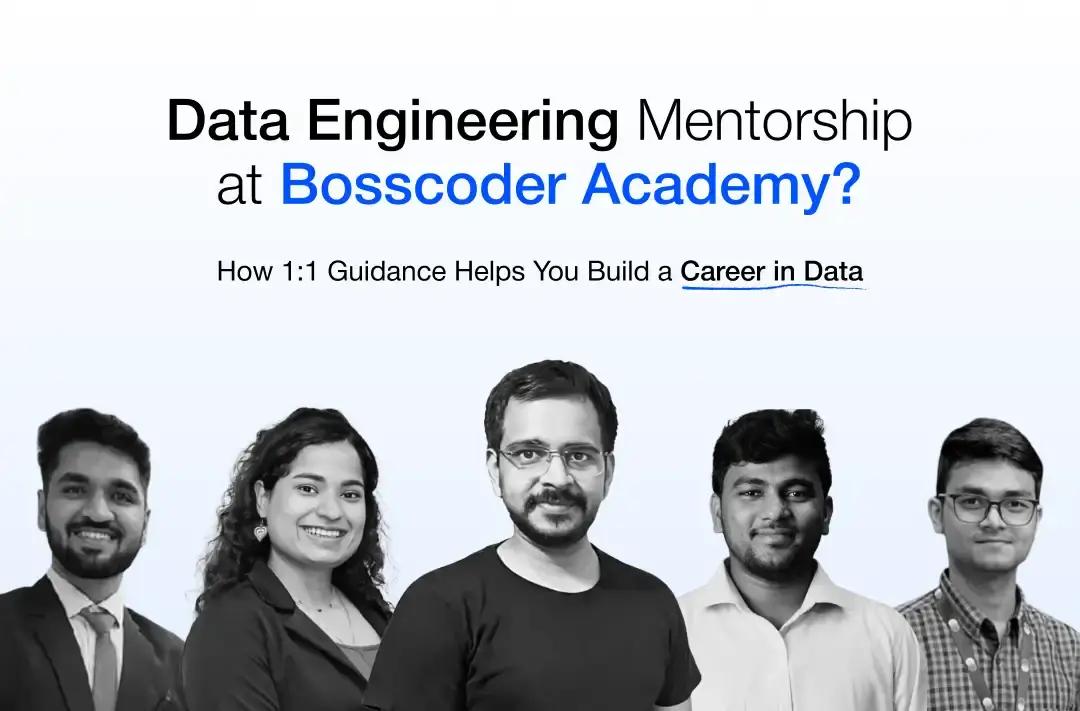
If you're unsure how to approach the learning journey, Data Engineering mentorship at Bosscoder Academy explains how 1:1 guidance can help with concepts, practice and career preparation.
What Will You Learn in the Data Engineering Course?
The Bosscoder academy data engineer curriculum is built around skills data teams use in production: advanced SQL, Python for data processing, data modeling and warehousing, distributed processing with Apache Spark, workflow orchestration with Airflow, real-time streaming, and cloud data platforms.
What makes the learning stick is the combination of live sessions and hands-on projects. As Alumni experience shows, live sessions let you ask questions, learn from real scenarios, and build the depth interviewers test for. Projects then become your portfolio and give you real talking points in interviews.
Data Engineering Career Paths After the Course
Data engineering opens several directions:
- Data Engineer: Designing and maintaining pipelines that move and transform data.
- Big Data Engineer: Working with distributed systems that process massive datasets.
- Cloud Data Engineer: Building data platforms on AWS, Azure, or GCP.
- Analytics Engineer: Turning raw data into clean, trusted models for business teams.
- ETL Developer: Specializing in extracting, transforming, and loading data across systems.
- Data Architect (long term): Designing an organization's entire data strategy.
A Clear Word on Placements
Bosscoder Academy provides placement assistance, not a placement guarantee. That includes mentorship, mock interviews, resume guidance, and interview preparation. The outcome depends on you: how consistently you learn, how strong your projects are, and how well you prepare.
You showed up, did the work, and used every resource available. That's the pattern behind every success story.
Explore Bosscoder Academy's Data Engineering career outcomes to see the reported transition and compensation data alongside alumni experiences.
Conclusion: Is Data Engineering the Right Next Step for You?
Data engineering isn't a career path that requires you to know everything before you start. It requires a willingness to learn how data systems actually work, build strong technical fundamentals, and keep improving as the technology changes.
For software professionals, it can be a way to specialize. For analysts and BI professionals, it can be a natural move from working with data to building the systems behind it. And for career switchers, it can be a challenging but achievable transition with the right preparation and consistency.
The important question isn't simply whether data engineering is "the next big thing." It's whether the work itself interests you. If you enjoy programming, problem-solving, working with large datasets, and understanding how systems move and process information, it is a career worth exploring.
A course can provide structure, mentorship, projects, and interview preparation, but it cannot replace the work you put in. The strongest outcomes come from learners who consistently practice, build projects, understand the fundamentals, and actively use the resources available to them.
Q1. Can a non-CS graduate join the Bosscoder Data Engineering course?
Yes. Learners from non-CS backgrounds can join, but should expect to invest extra time in programming and SQL fundamentals at the start.
Q2. Do I need to know coding before enrolling?
Fundamental programming knowledge helps, but you don't need to be an expert. Python and SQL fundamentals are the ideal starting point.
Q3. Is this course suitable for working professionals?
Absolutely. Working professionals are the core audience, and the live-session format is designed to fit alongside a job.
Q4. Does Bosscoder guarantee placement?
No. Bosscoder offers placement assistance, including mentorship and interview preparation, but outcomes depend on the learner's effort.