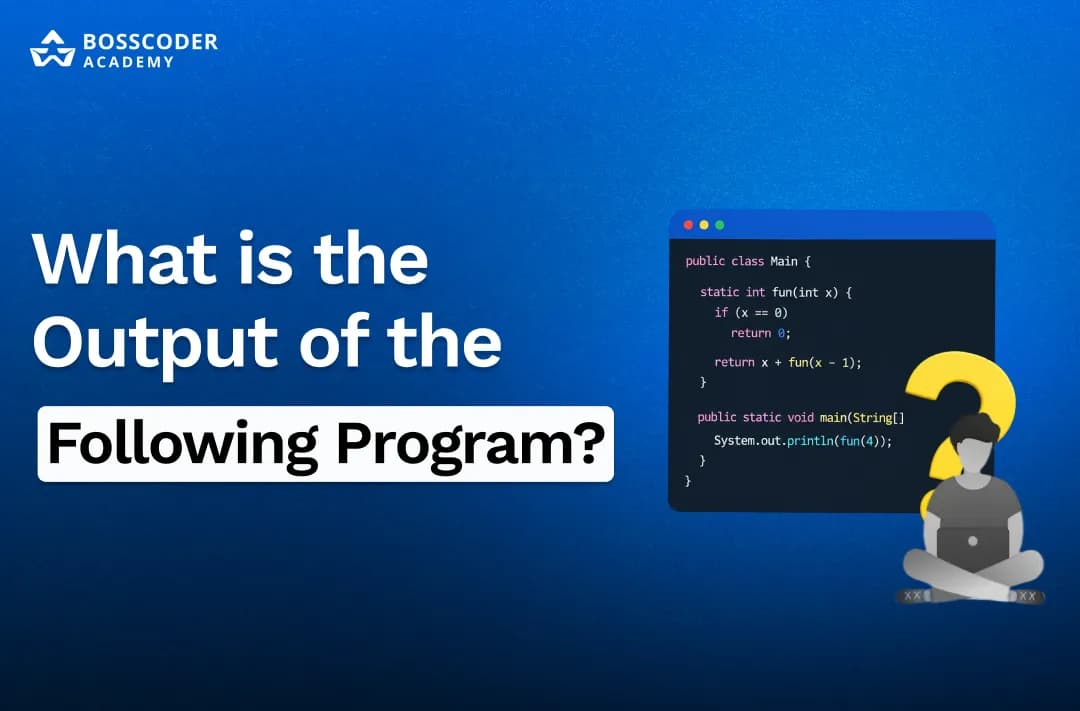
The most common interview question asked during the interview process for software engineering is:
"What is the output of the following program?"
The question appears simple, but there is more to it than just reading the code. The interviewer wants to check whether you have knowledge about the execution of the program, operators, and logic of the code.
Questions related to output of code are common in the coding interviews, as it helps to test your basic knowledge of programming. Even the expert programmers make mistakes due to the ignorance of little aspects such as operator precedence, increment operator, loop, and function call.
If you are preparing yourself for coding interviews or willing to shift to the product-based company, then solving these types of questions is necessary for you.
Why Do Companies Ask Output-Based Questions?
Writing code is only one part of software development. Reading, understanding, and debugging existing code are equally important skills.
This is why interviewers generally provide a Java program and ask you to determine what the output of the code will be.
This allows them to test your:
- Fundamentals of programming
- Logical thinking
- Code reading abilities
- Understanding of method execution
- Problem-solving capabilities
- Debugging capability
- Attention to details
Unlike coding questions, output-based questions quickly reveal whether you understand how a program executes internally.
Many product-based companies use these kinds of questions in their Online Assessments (OA), technical interviews, and campus recruitment round.
How to Solve Output Questions?
Every time you come across a question based on output, do the following:
Step 1: Study the Entire Program Carefully
Do not rush to answer the question immediately. First, understand the purpose of the program.
Step 2: Locate Variables and Methods
Identify:
- Variables
- Method definitions
- Parameters
- Returned values
It will be much easier for you to solve the question if you first find out these parts of the program.
Step 3: Determine the Base Case (In Case of Recursion)
If there is any recursion used in the program, first look for the case when the recursion will stop.
Recursion never ends without a base case and you will get a StackOverflowError.
Step 4: Execute the Program Line by Line
Put yourself in place of Java Virtual Machine (JVM) and run the program line by line or any language you used.
Do not make assumptions and do not skip any step.
Step 5: Record Intermediate Values
Record each method called and the returned value from it. Most candidates get questions wrong due to their wrong calculations.
Example for Interview-Style Question
The below mentioned code is one of the most frequently asked interview-style questions used by candidates to prepare for product-based companies.
Real Product-Based Company Interview Style Question
The following java code is an interesting example of a recursion based company interview question. It tests your understanding of recursive method calls, the call stack, base conditions, and return values.
public class Main {

  static int fun(int x) {

    if (x == 0)
      return 0;

    return x + fun(x - 1);
  }

  public static void main(String[] args) {
    System.out.println(fun(4));
    }
}
What Is the Output?
10
Now let's understand why the output is 10.
Understanding the Recursive Method
The recursive method is:
static int fun(int x) {

if (x == 0)

return 0;

return x + fun(x - 1);

}
Base Case
if (x == 0)
return 0;
The base case informs the recursive function when to stop recursing.
Once the value of x equals 0, the recursion stops and the method begins returning values.
Otherwise, there would be an infinite number of recursive calls which would lead to a StackOverflowError.
Recursive Case
return x + fun(x - 1);The statement above informs the method to recurse with a decreased value of x.
Unlike other programming statements that return values directly, the current method pauses and waits for the next recursive call to finish execution.
Every recursive call saves its own value of x in memory and waits for the next method to return.
Once the base case is reached, all these paused methods begin returning their values one by one.
This is the most crucial concept to learn while solving recursion-based output questions.
Steps Involved In Execution
Execution takes place within the main() method.
System.out.println(fun(4));The JVM first calls:
As 4 does not satisfy the condition of being equal to 0, the following is executed:
4 + fun(3)
Another recursion call starts from here.
For fun(3): 3 + fun(2)
After this, fun(2) turns into 2 + fun(1)
Further,
fun(1) turns into 1 + fun(0)
And
fun(0) returns 0
Here, the recursion ends since the base condition is reached. Recursion will now start returning step by step from the call stack.
Sequence of Recursive Function Calls
This is how the sequence of recursive function calls takes place:
fun(4)
↓
fun(3)
↓
fun(2)
↓
fun(1)
↓
fun(0)
As you can see, the program goes down until the base condition is met.
After the base condition is hit, then only does Java start to return values upwards from one method call to another.
Understanding this sequence will help you solve any recursion based output question during Java interview with confidence.

Returning Values through Call Stack
After the function encounters the base condition (fun(0)), then it begins to return values one by one.
Now let’s analyze the program:
fun(0) = 0
fun(1)
= 1 + fun(0)
= 1 + 0
= 1
fun(2)
= 2 + fun(1)
= 2 + 1
= 3
fun(3)
= 3 + fun(2)
= 3 + 3
= 6
fun(4)
= 4 + fun(3)
= 4 + 6
= 10
Hence, the value obtained at last will be:
10
Time Complexity
The function will be executed for every element starting from 4 and ending at 0.
Time Complexity: O(n)
where n is the value of input.
Space Complexity
As every recursive function call will be pushed into the call stack, the space complexity will also increase according to the input size.
Space Complexity: O(n)
Common Errors by Candidates
While solving problems on recursion output, many candidates tend to do the following:
- Neglecting the base case.
- Missing one or more recursive calls.
- Getting confused with the return value.
- Trying to solve all things in mind without any writing.
- Making confusion about returning from recursive functions.
A simple dry run can help you avoid such errors.
Tips for Interview
While answering an output-based question:
→ Understand the program.
→ Identify the base case first.
→ Trace the flow of every function call step by step.
→ Write down any intermediate values if required.
→ Share your thought process rather than just the final output.
Reasoning of your solution is valued in many cases even as much as the answer itself.
Practice Is the Key
Recursion is one of the most important concepts in Java. It occurs in a lot of coding interview questions. The more output-based questions you practice, the better you get at recursion, debugging, and efficient coding.
Apart from recursion, practice topics such as loop, array, string, Object-Oriented Programming, and Data Structure & Algorithms to improve your interview skills.
Learn, Don't Memorize
Many professionals tend to memorize answers to different interview questions, but a successful software engineer always understands the logic behind the code.
At Bosscoder Academy, learners are encouraged to build strong programming fundamentals through structured DSA practice, core computer science subjects, mock interviews, and real coding problems. Developing this problem-solving mindset helps not only in technical interviews but also in real-world software development.
Conclusion
Output-based problems might seem simple, but they evaluate your knowledge about the execution of Java program. Instead of making assumptions about what output it will produce, follow the function calls, find out base case and track the return values.
With consistent practice of such problems, you will be able to develop your logic and debugging skills, which are essential during the interviews. Most importantly, you will gain knowledge to solve real-life programming tasks.
Frequently Asked Questions (FAQs)
Q1. What is the output of the following program?
The output will vary depending on the execution of the program. In order to get the right output, one should read the code and analyze its execution step by step.
Q2. Why are output-based programming questions included in technical interviews?
Such questions allow you to assess your programming basics, logic, debugging skills, and understanding of code written by someone else. Output-based questions are often used for coding interviews in software engineering positions.
Q3. How can I improve my accuracy in solving output-based programming questions?
In order to solve output-based questions, one needs to read the whole program, understand what variables and functions are used, find out what the execution path will be like, and trace it line by line.
Q4. How can Bosscoder Academy help me prepare for software engineering interviews?
Bosscoder Academy provides you with the best way to prepare for your interview through DSA, Computer Science Fundamentals, Mock interviews, actual Coding problems, and guidance from professional engineers. Apart from Coding, the learners develop their problem-solving skills through such a platform.