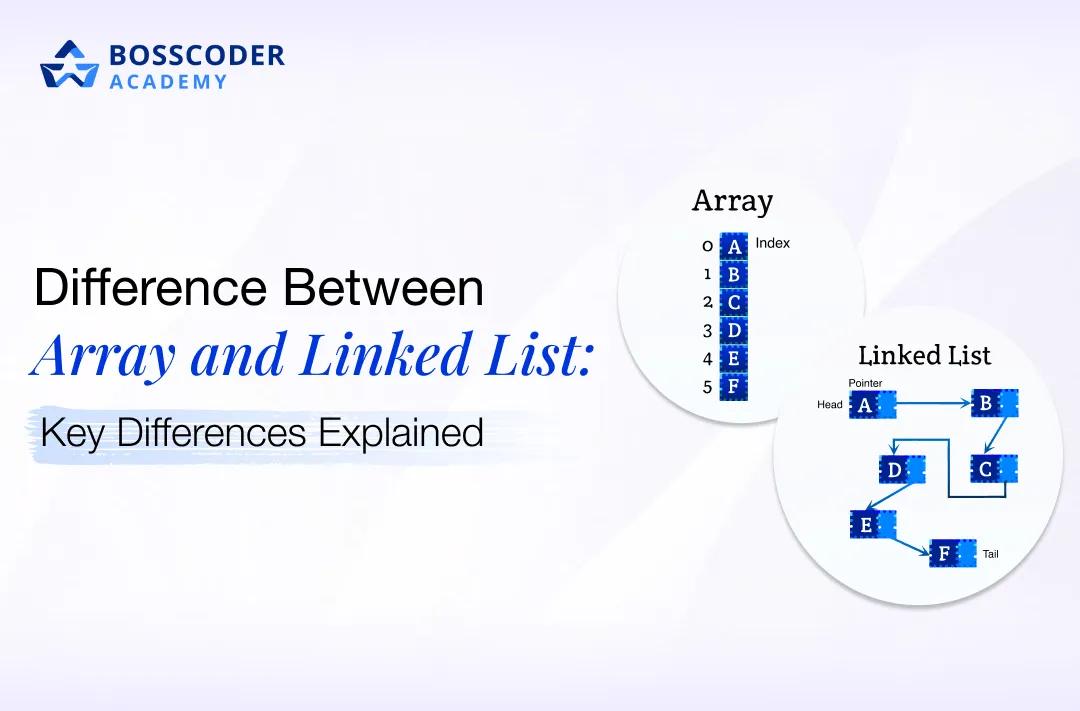
Array and Linked List are two of the basic data structures that programmers are introduced to when they begin learning Data Structures and Algorithms (DSA), and there is no wonder why because of their significance in creating various algorithms and organizing data in software applications.
Even though these two data structures perform almost the same functions in terms of storing a collection of items, they differ significantly in terms of how they allocate memory and how they perform in various operations. Learning the difference between array and linked list will help you become a more effective coder.
In any case, whether you are starting to learn DSA, need to revise some basic concepts, or want to prepare yourself for technical interviews in product-based companies, it is crucial to know the difference between arrays and linked lists.
In this blog, we will compare both data structures through examples, time complexity, and interviews questions.
Quick Tip:
There is no need to memorize the comparison table rather, you should understand the reasons behind the higher efficiency of one or another data structure.
What is an Array?
An array is a data structure in which elements are stored in contiguous memory. Each element has an index, making accessing any element by its index a constant-time operation.
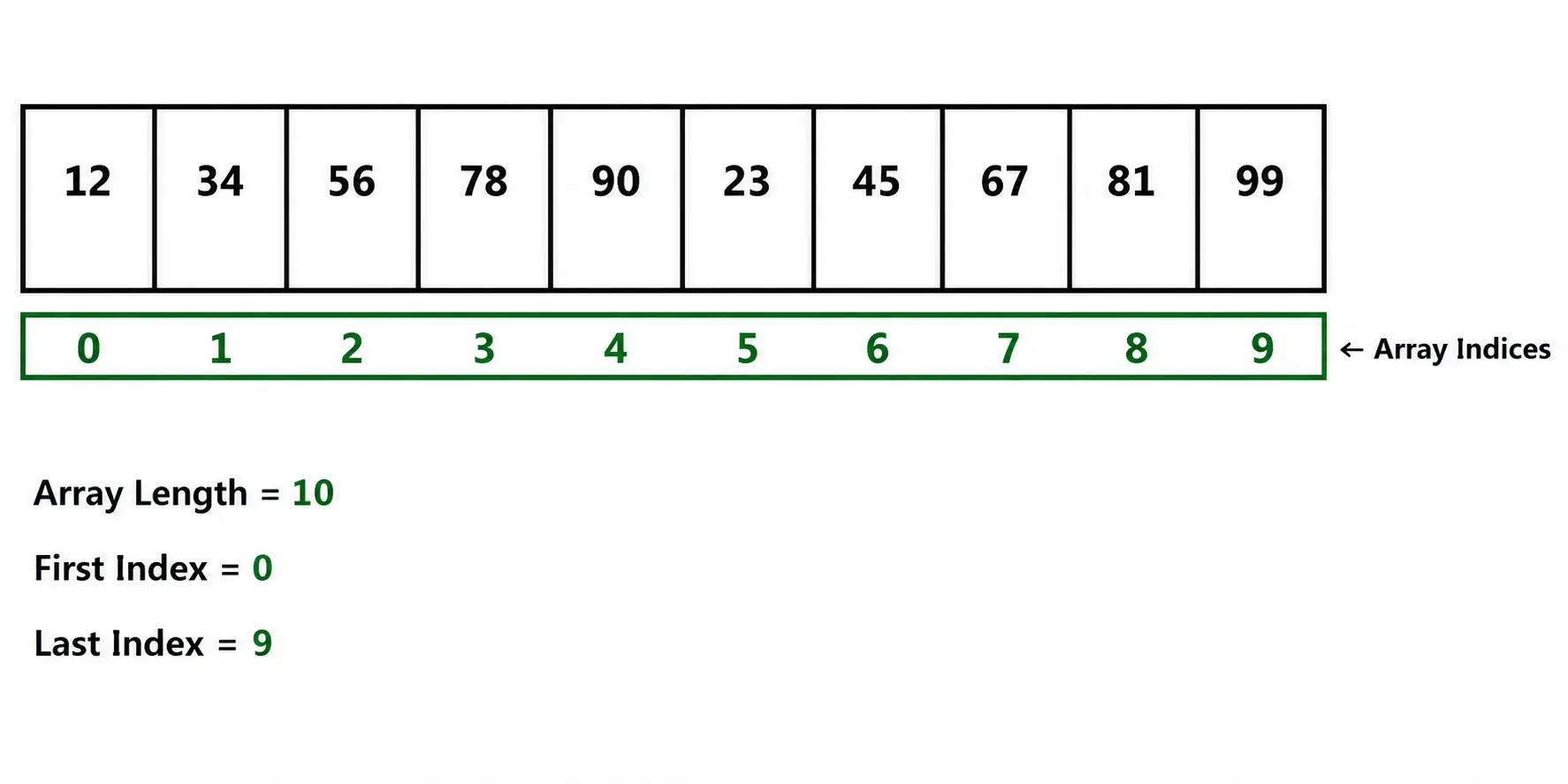
Data storage scheme of an array
Example:
Index:  0  1  2  3
Value: 10 20 30 40
Accessing the element 30 is done via the index 2.
Advantages of Arrays
- Random access via indices
- Improved cache behavior
- Low memory overhead
- Easy to implement
Disadvantages of Arrays
- Fixed-size in some programming languages
- Expensive insertion/deletion since elements have to be moved
- Contiguous memory allocation requirement
What is a Linked List?
A Linked List is a linear data structure that consists of nodes. Every node includes:
Data
Reference to the next node
In contrast to arrays, nodes are not stored in contiguous memory addresses and are linked via pointers.
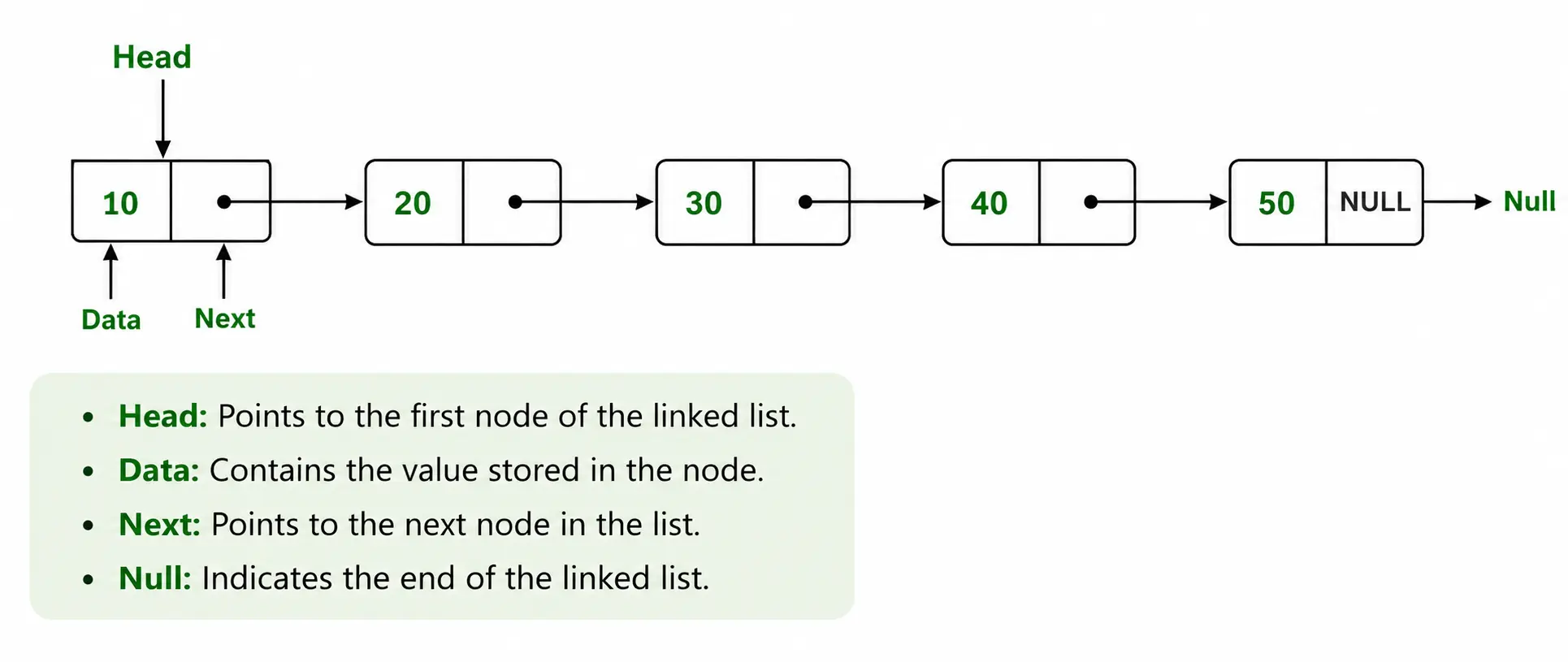
Example:
10 → 20 → 30 → 40 → NULLEvery node points to the next node till the end of the list.
Advantages of Linked Lists
- Flexible size
- Easily insert/delete elements
- Do not require contiguous memory space
Disadvantages of Linked Lists
- Accessing elements slower than array
- Need extra memory for pointers
- Bad cache performance compared to arrays
Array vs. Linked List: Data Representation in Memory
One of the biggest differences lies in how data is stored.
Array
Memory

1000   1004  1008  1012
┌─────┬─────┬─────┬─────┐
│ 10  │ 20  │ 30  │ 40  │
└─────┴─────┴─────┴─────┘
In an array, all the elements are stored sequentially.
Linked List
                Head
                  │
                  ▼

 Address
 1000         3024         5012         9008

┌────────┐   ┌────────┐   ┌────────┐   ┌────────────┐
│10 | •──┼──▶│20 | •──┼──▶│30 | •──┼──▶│40 | NULL  │
└────────┘   └────────┘   └────────┘   └────────────┘
 Data  Next Pointer
Since nodes in a linked list are connected using pointers, they can be allocated anywhere in memory.
Did You Know?
Arrays are generally more cache-friendly because consecutive elements are stored together in memory, making access faster.
Difference Between Array and Linked List
| Feature | Array | Linked List |
|---|---|---|
| Allocation of Memory | Contiguous | Non-contiguous |
| Size | Usually Fixed | Dynamic |
| Time to Access | O(1) | O(n) |
| Search | O(n) | O(n) |
| Insertion | O(n) | O(1)* |
| Deletion | O(n) | O(1)* |
| Memory Consumption | Lower | Higher (stores pointers) |
| Cache Efficiency | Good | Less |
| Binary Search | Possible in sorted arrays | Not efficient (No random access) |
| Complexity in Implementation | Easy | More complex |
*If the desired node or pointer is already known.

Quick Coding Example (Java)
In some cases, looking at the difference in coding will help make the idea clearer.
Array Example
int[] arr = {10, 20, 30, 40};

// Access the third element
System.out.println(arr[2]); // Output: 30
Since arrays allow indexing, accessing any element will take O(1) time.
Linked List Example
LinkedList<Integer> list = new LinkedList<>();

list.add(10);
list.add(20);
list.add(30);
list.add(40);

// Access the third element
System.out.println(list.get(2)); // Output: 30
A LinkedList, on the other hand, contains items in form of nodes, linked to each other via reference pointers. Thus, in order to reach the third node, it is necessary to go through the whole list and the time needed will be O(n).
Interview Trick:
While it is possible to use the get(index) method in LinkedList, it does not perform in constant time because of the traversal that has to be done either from start or end until the required node is found.
Comparison of Time Complexity
| Feature | Array | Linked List |
|---|---|---|
| Access | O(1) | O(n) |
| Search | O(n) | O(n) |
| Insertion At The Beginning | O(n) | O(1) |
| Insertion At The End | O(1)* | O(n)** |
| Deletion | O(n) | O(1)** |
* Average time for a dynamic array.
** With node or tail pointer.
When Should You Use an Array?
An array is preferred when:
- Indexing is needed for quick access.
- Size of data does not change often.
- Performance is important.
- Reading is done more often than writing.
Real-life Applications
- Students' data
- Pixels of an image
- Matrices
- Look-up tables
- Game rankings
When Should You Use a Linked List?
A linked list will suit better when:
- Insertion and deletion operations happen frequently.
- The size of data is variable.
- Traversal in sequence is acceptable.
- Dynamic allocation of memory is required.
Real-life Applications
- History of browsing
- Song lists
- Undo/redo functionality
- Dynamic memory management
- LRU cache implementation
Interview Questions That are Commonly Asked
If you are preparing for product based company interview rounds, some common questions include:
- What is the difference between array and linked list?
- Why is insertion efficient in linked list?
- Why are arrays cache-efficient?
- Can binary search be done on a linked list?
- Which data structure would you use for browser history and why?
- Why do we need more memory in case of linked list compared to an array?
Interview Tip:
It's always advisable to mention the trade-offs rather than comparing any data structures as better than other.
Common Mistakes Learners Make
Don’t commit these mistakes:
- Thinking linked lists will always be faster than arrays.
- Overlooking additional memory consumption due to pointers.
- Going for arrays when there are frequent insertions and deletions.
- Remembering that linked lists can never have constant-time access.
Knowing these differences will ensure that you make the right choice depending on the situation.
Array vs Linked List: Which is Better?
There is no clear winner here.
Opt for an Array if you:
- Need fast indexing.
- Need to perform better.
- Need efficient memory management.
Go for a Linked List if you:
- Need dynamic memory allocation.
- Have frequent insertions and deletions.
- Have flexible data sizes.
The best choice depends entirely on the problem you're solving.
Why This Topic Matters in Coding Interviews
Arrays and Linked Lists form some of the initial topics in DSA as many advanced topics depend on them. For instance, questions related to stacks, queues, trees, graphs, and dynamic programming can be solved well only after understanding the basics of Arrays and Linked Lists.
At Bosscoder Academy, learners strengthen these core concepts through structured DSA lessons, mentor guidance, coding practice, and mock interviews. Rather than memorizing solutions, the focus is on understanding why a particular data structure fits a specific problem, an approach that helps working professionals perform better in technical interviews at leading product-based companies.
Conclusion
Knowing the difference between array and linked list is not only for academic purpose but a very essential skill set for every software developer. The advantage of arrays lies in its fast random access and cache utilization whereas Linked List has the advantage of flexibility with dynamic memory allocation and quick insertion/deletion.
It is important to learn about DSA not for memorizing the definition of the topic but for using the right data structure for solving the right problem.
Frequently Asked Questions (FAQs)
Q1. What is the main difference between an Array and a Linked List?
Array uses contiguous memory allocation and supports O(1) random access, and Linked List uses non-contiguous memory allocation with nodes being connected using pointers.
Q2. Which one is faster, Array or Linked List?
Accessing items in Array is faster than Linked List, but insertion and deletion are faster in Linked List.
Q3. Why Linked List uses more memory?
Linked List allocates memory for both data item and pointer to another node.
Q4. Can binary search be used on a Linked List?
No, because Binary Search requires random access to middle item, which is not possible with Linked List.
Q5. Is this topic relevant to coding interviews?
Yes, Linked List and Array is one of the most commonly asked DSA topics in product-based companies interviews.