Tree happens to be one of the most commonly utilized data structures in Computer Science. Unlike arrays and linked lists that arrange data in linear form, a tree arranges data in a hierarchical manner making it more accessible to find, store, and manipulate larger amounts of data.
Whether it’s file system on your laptop, databases, search engines, Artificial Intelligence, or networks, trees are used in almost everything. This is the reason why interview questions related to trees are commonly asked by product-based companies including Amazon, Google, Microsoft, Flipkart, and Walmart Global Tech.
If you are preparing for coding interviews or you want to change your career from service-based companies to product-based companies, then learning about the application of Tree in data structure becomes very important.
Through this blog, you will understand the usage of trees, importance of trees, and their real-life examples.
What is a Tree in Data Structure?
Tree is a non-linear data structure that contains nodes and edges. It begins from one single root node, and each node can have multiple child nodes.
Differences between trees and arrays and linked lists are that trees easily represent hierarchy.
Example
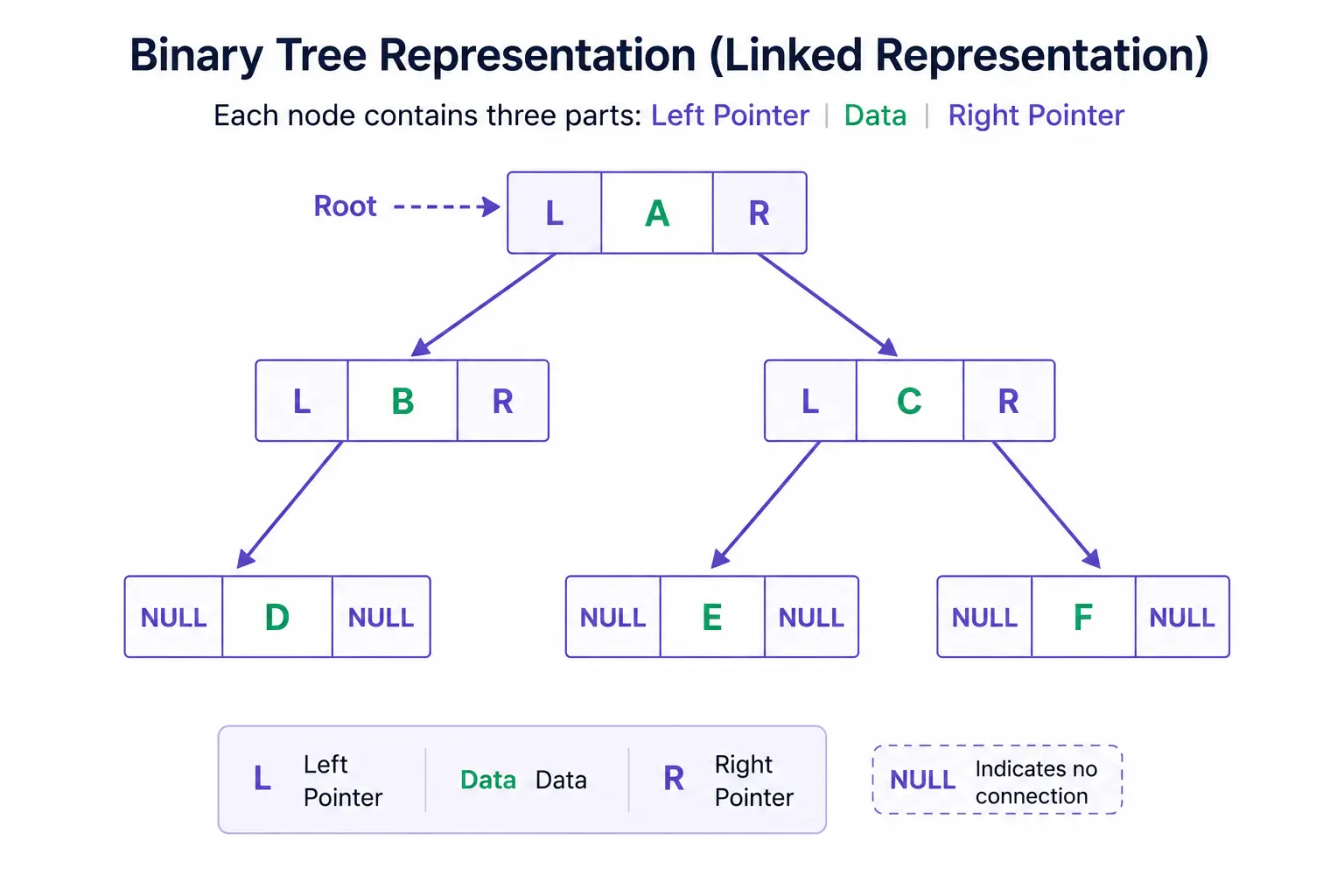
Trees are easier to understand when representing hierarchical relationships.
Tip: Whenever there are parent-child relations in data, tree is always the best choice.
Why Trees are Important?
Trees are important in solving problems that involve fast searching, sorting, and hierarchical organization of the data.
Major benefits include:
- Efficient searching
- Improved data organization
- Fast insertion and deletion
- Hierarchical relation support
- Effective memory utilization in various applications
That is why trees form one of the most commonly used data structures in software engineering.
Top Applications of Tree in Data Structure
1. File Systems
All operating systems organize files and folders using trees.
Example:
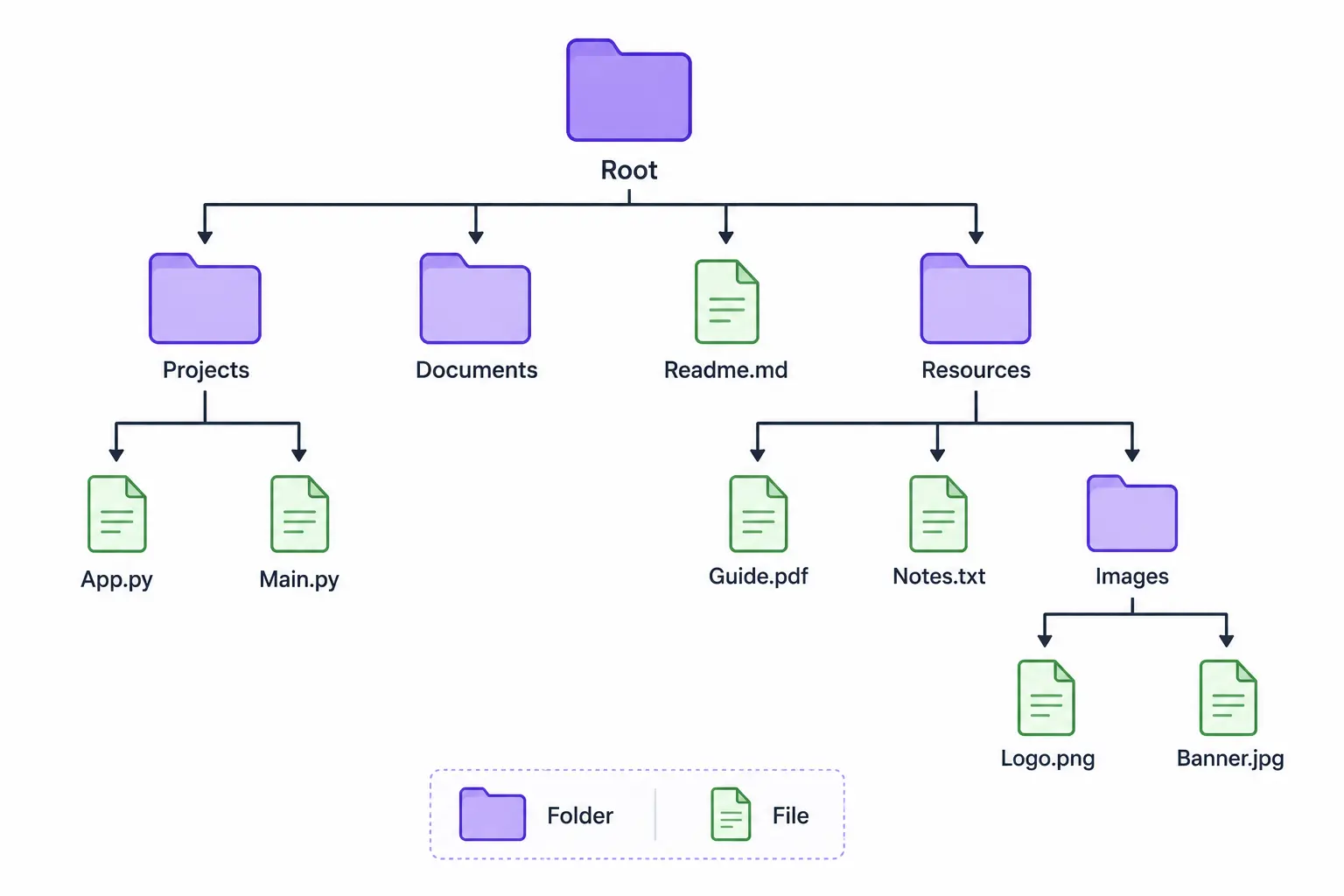
Users can easily move from one folder to another.
Used in:
- Windows
- Linux
- macOS
2. Indexing Databases
Trees and B+ Trees are used in databases for locating data instantly without having to scan the whole database.
Instead of going through millions of records one by one, tree indexing makes it possible for databases to locate data very quickly.
Used in:
- MySQL
- PostgreSQL
- Oracle
- SQL Server
3. Search Engine
Search engines use multiple tree structures to store and fetch large amount of information.
Trees are useful in searching engines because they:
- Index web pages
- Answer queries
- Provide result faster
All this leads to better performance in millions of searches per second.

4. Binary Search Tree (BST)
Binary Search Tree holds sorted values.
It allows efficient:
- Search operation
- Insert operation
- Delete operation
Average case time complexity of BST is O(log n).
BST is one of the most popularly asked interview topics.
Interview Tip: Study BST questions on insertion, deletion, traversals, validation before the interview.
5. Decision Trees in Machine Learning
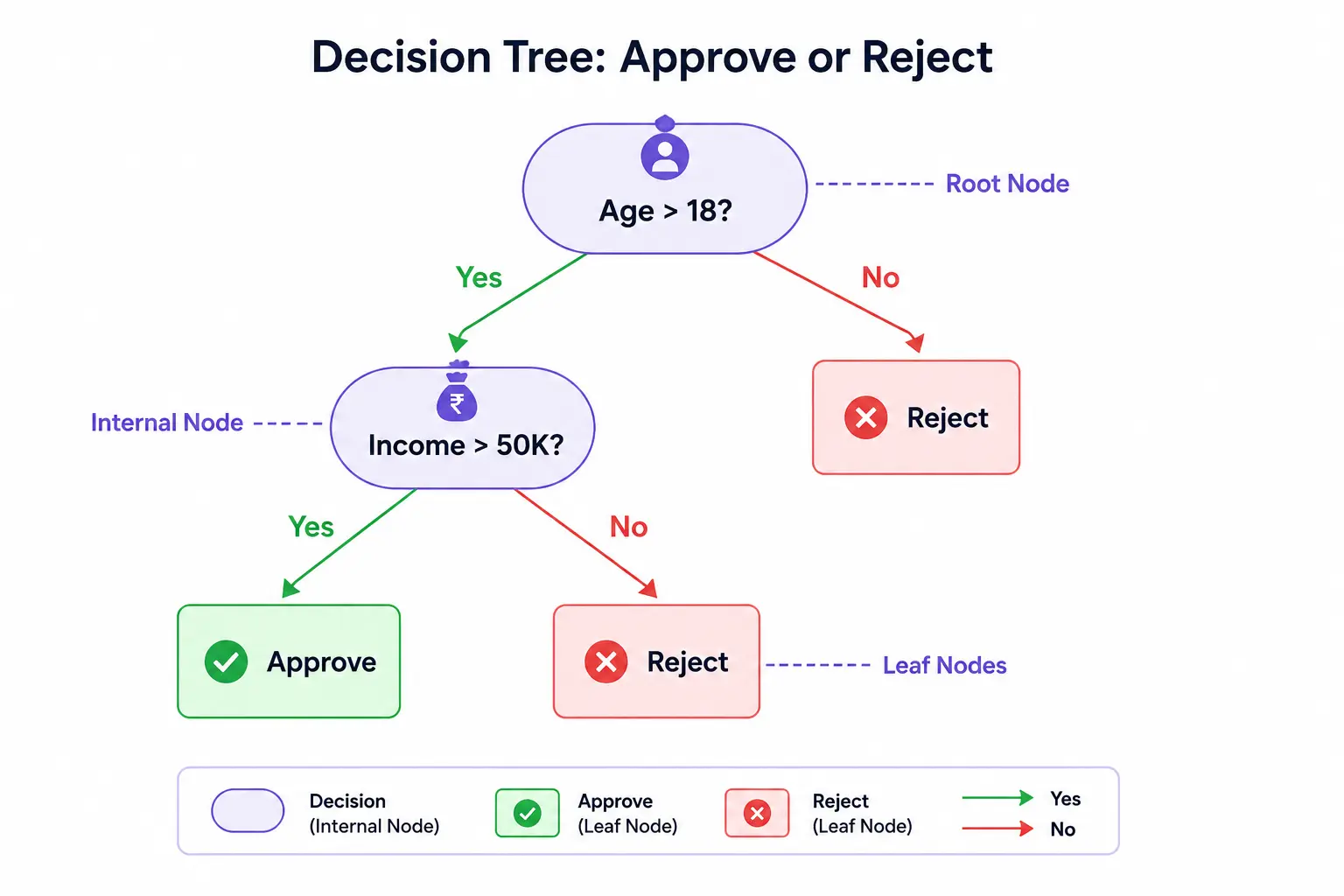
Decision Trees enable AI to predict outcomes based on a set of yes-no questions.
Example:
6. Compiler Syntax Trees
Programming languages are converted into ASTs (Abstract Syntax Trees) before execution.
Trees are used by compilers for:
- Program Structure Analysis
- Syntax Errors Detection
- Code Optimization
- Machine Code Generation
Whenever you compile your Java, C++, and Python code, you have trees at play!
7. Routing in Computer Networks
Trees are used in routers to establish the optimal route for transmitting information through networks.
Areas where trees are applied include:
- Internet routing
- Network administration
- Broadcast communications
This helps in efficient data transfer between devices.
8. XML and HTML Documents
Tree structure is inherent to HTML and XML documents.
For example:
<html>
   <body>
      <div>
         <h1>
A tree data structure is constructed by web browsers to construct DOM trees.
In case you are studying front-end development, you will be dealing with trees on most days.
9. Organizational charts
Companies usually use trees for representing their hierarchy among employees.
Example:
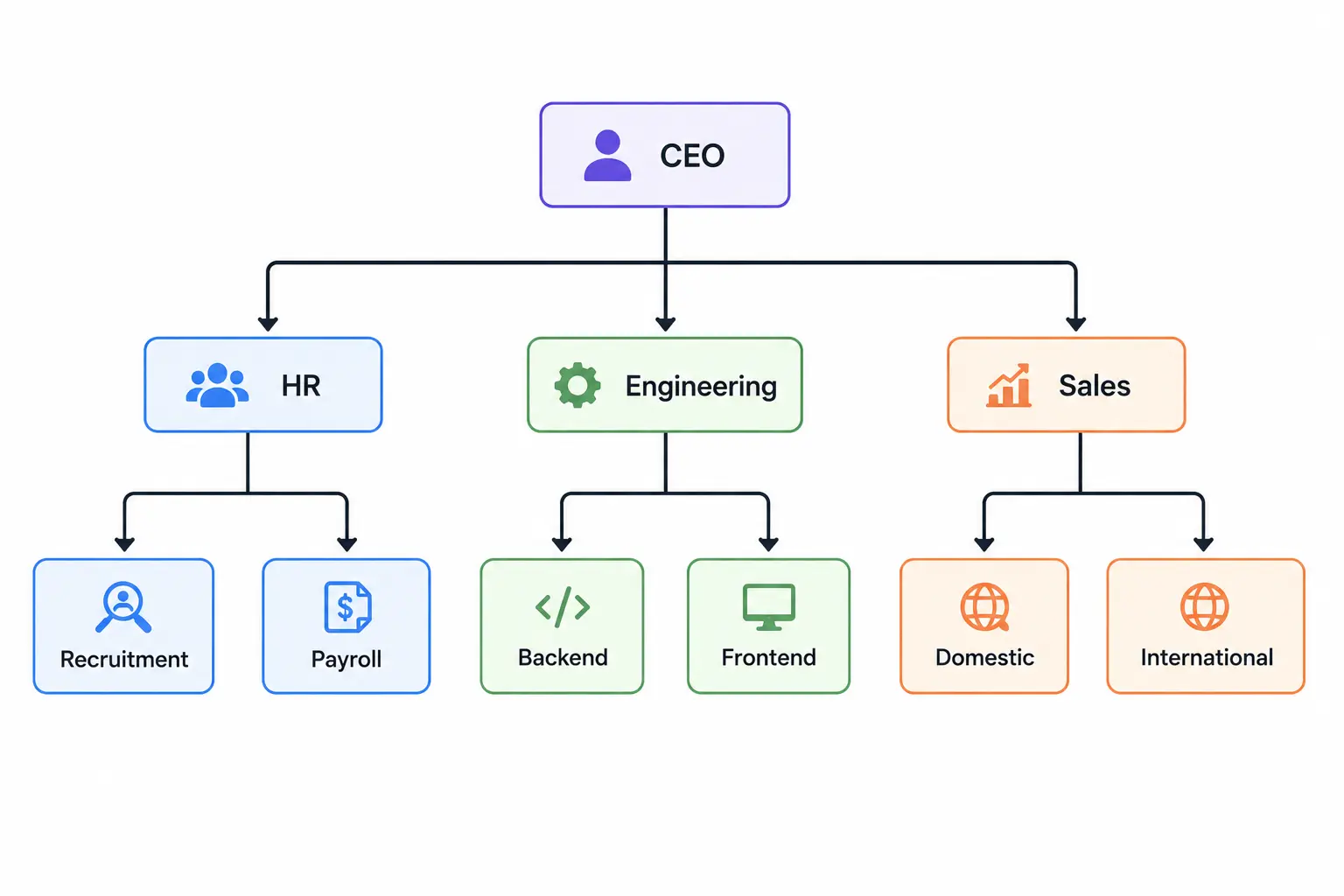
It helps companies to have clear organizational structures.
10. Expression Trees
Trees representing mathematical expressions are called expression trees.
Example:
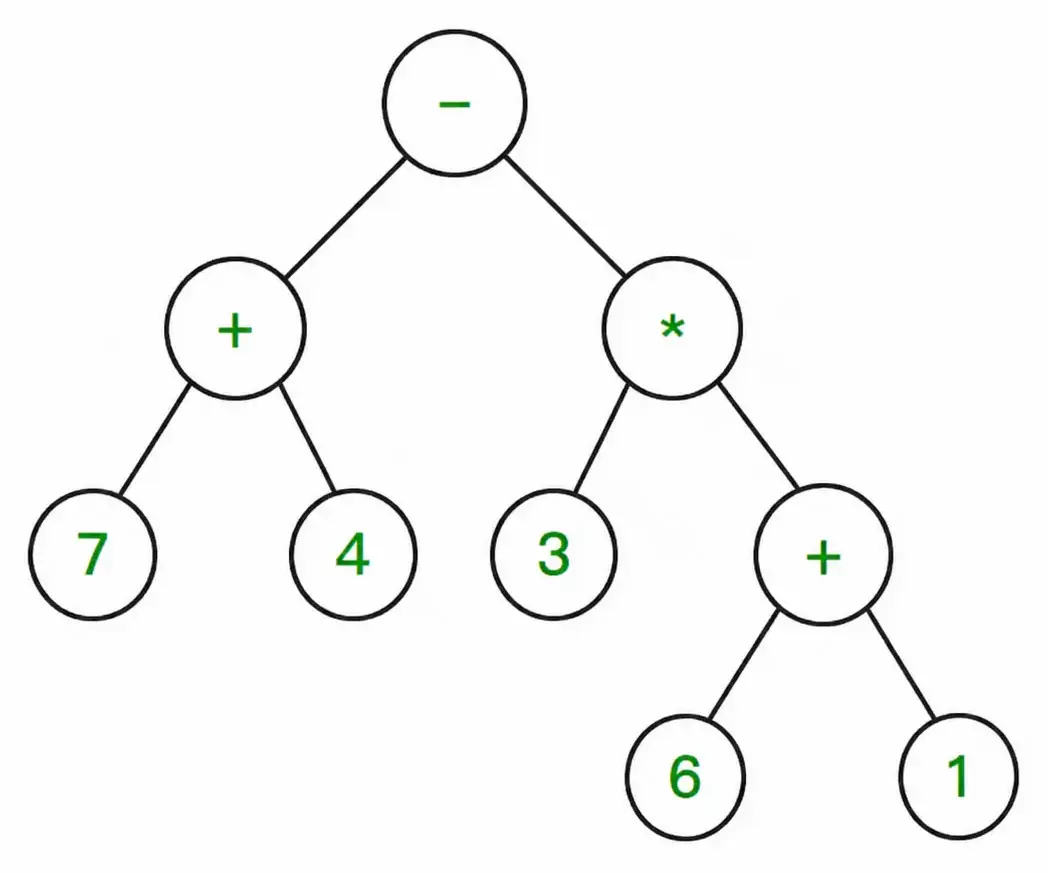
These types of trees are used in the following applications:
- Calculation
- Compiler
- Expressions
- Mathematical software
Real World Applications of Trees
Following are some of the real-life examples where trees are used:
| Application | Tree Used |
|---|---|
| File System | General Tree |
| Index in Database | B-Tree, B+ Tree |
| Suggestions in Search | Trie |
| DOM in HTML | DOM Tree (N-ary Tree / General Tree) |
| Decision Making in AI | Decision Tree |
| DNS Lookup | Trie (Radix Tree) |
| Compiler Design | Abstract Syntax Tree |
| Hierarchy in a company | General Tree |
Some Interview Questions on Tree Applications
In case you are preparing for software engineer interviews, you must know answers to:
- Where is the tree data structure applied in real life?
- Why do database systems use B-Trees?
- What is the difference between BST and binary tree?
- Why is tree different from graphs?
- Why is the DOM represented as a tree?
Applying these concepts helps in improving coding and system design discussion skills.
Learn Trees for Product-Based Company Interviews
Interviewing on tree concepts is crucial in DSA interviews for top tech companies. However, knowledge of the theoretical concept alone is not sufficient. Instead, one needs practical knowledge on how to traverse, use Binary Search Tree, heap, try data structures, and code interview level problems.
At Bosscoder Academy, learners strengthen these concepts through structured DSA roadmaps, mentor-led sessions, regular coding practice, and mock interviews designed around real product company interview patterns. For individuals interested in advancing or switching from other roles to product roles, knowing the tree data structure can help.
Conclusion
The applications of tree in data structure are much more than just interview problems. Tree is the backbone of file systems, databases, search engines, web browsers, machine learning algorithms, compilers, and networking systems that are commonly used on a daily basis.
For any software engineer, studying about trees will be a great asset for problem-solving and design of systems.
Frequently Asked Questions (FAQs)
Q1. What are the main applications of tree in data structure?
Trees are used in file systems, database indexing, search engine, HTML DOM, machine learning, compiler design, networking and organizational hierarchy.
Q2. Why are trees used instead of arrays?
Trees are good to use as they are able to represent hierarchical data and also enable fast searching, insertion, and deletion for several applications.
Q3. Which tree is mostly used in databases?
B Trees and B+ Trees are most used as they are efficient in managing large amounts of data.
Q4. Why are trees important for coding interviews?
As trees have many properties like recursion, traversal, searching, optimization which are very useful for interviews and are often asked by product-based companies in interviews.
Q5. Is it sufficient to learn tree data structure for DSA interviews?
Trees are one of the very important topics, but apart from that you also need to practice arrays, linked lists, stacks, queues, graphs, heaps, dynamic programming, and system design.