AI development is moving beyond the simple prompt to response model.
AI agents can now write code, search documentation, call tools, inspect files, run tests, and take multiple actions toward a goal. But there is a major difference between getting an AI agent to perform an action and getting it to complete a task reliably.
That is where loop engineering comes in.
Loop engineering is an emerging approach to designing AI agent workflows where the system can repeatedly act, observe, verify, and decide what to do next instead of requiring a human to provide a new prompt at every step.
In simple terms: Prompt engineering tells AI what to do. Loop engineering designs how AI keeps working until the job is done.
If you're exploring prompt engineering as a career, you can also learn about the prompt engineer salary and career outlook.
What Is Loop Engineering?
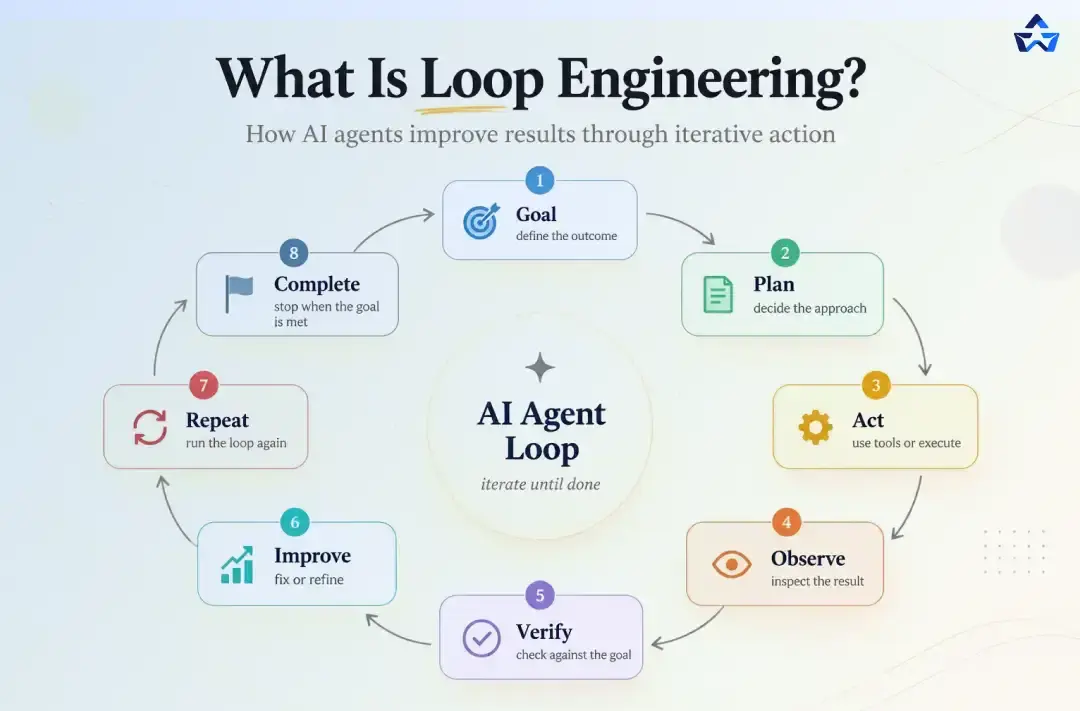
Loop engineering is the practice of designing AI agent systems that iteratively guide an AI toward a defined goal through actions, observations, verification, feedback, and repeated execution.
Instead of:
Human → Prompt → AI → Answer → Human → New Prompt
a loop-engineered system can work like:
Goal → Agent → Tool → Result → Verification → Next Action → Completion
The human still defines the goal, constraints, permissions, and success criteria. The AI system handles more of the intermediate work.
Addy Osmani describes loop engineering as moving from being the person who repeatedly prompts an agent toward designing the system that prompts and guides the agent. IBM similarly defines it around agentic workflows that allow AI systems to dynamically act, observe, decide, and iterate toward a user-defined goal.
Why Is Loop Engineering Important in AI?
AI tools are becoming a normal part of software development.
According to Stack Overflow's 2025 Developer Survey, 84% of developers were using or planning to use AI tools in their development process. However, 46% said they distrust the accuracy of AI output, compared with 33% who said they trust it.
This creates an important challenge:
How do you move from AI that produces an answer to AI that produces a reliable result?
A single AI response may be enough for a simple question. Real engineering tasks are different.
For example, fixing an authentication bug may require an AI coding agent to:
- Understand the issue
- Inspect the codebase
- Find the relevant files
- Modify the code
- Run tests
- Analyze failures
- Make another change
- Run the tests again
- Check quality requirements
- Stop when the success criteria are met
The value of loop engineering is therefore not simply automation.
It is controlled and verifiable automation.
How Does Loop Engineering Work?
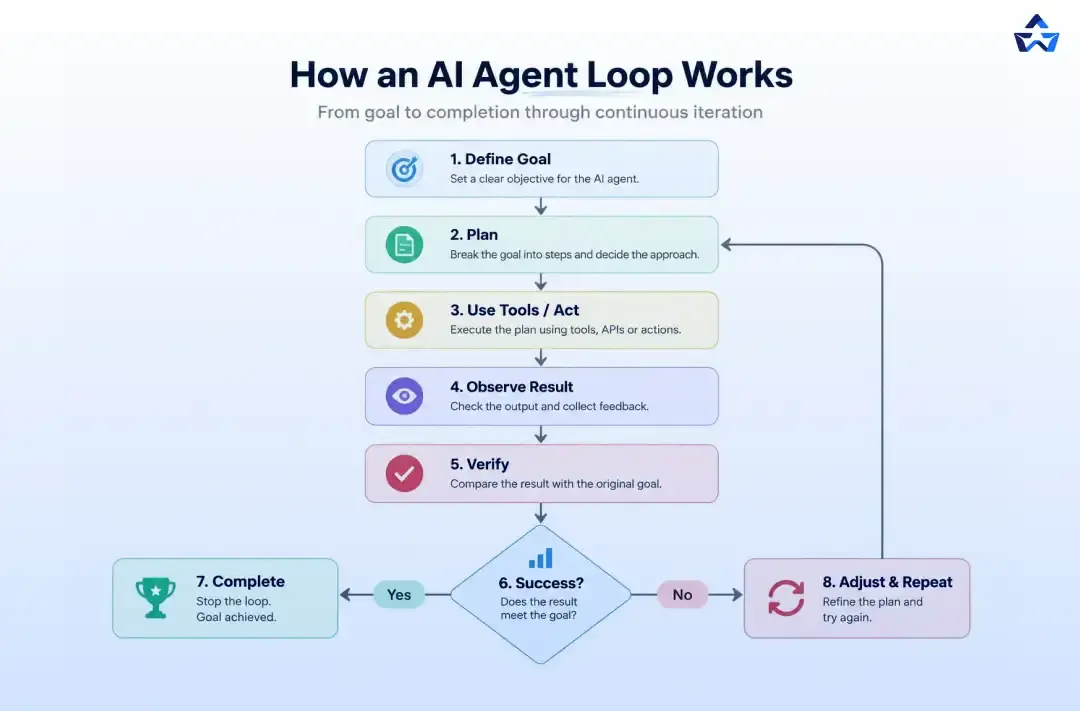
There are usually five fundamental steps in an AI loop:
1. Define the Goal
First, the AI needs a clear objective that can be measured.
Not:
“Make this application work better.”
But rather:
“Optimize API response time to make it lower than 500 ms while maintaining the public API.”
Measurable objectives provide the endpoint for an AI agent.
2. Plan
The plan of action for deciding on what should be done next is derived from the context, resources, and current situation.
In this case, the agent may choose to examine the API implementation and its performance logs.
3. Act
The tool is used by the agent to take actions.
Tools may include:
- APIs
- Git
- Databases
- Browsers
- Code execution
- Testing framework
- Issue tracker
This is how an AI agent moves from generating ideas to doing the actual work.
4. Observe and Verify
Once an action has been taken, the system verifies the outcome.
For an agent that writes code, verification may involve:
- Unit testing
- Integration testing
- Type checking
- Code inspection (Linting)
- Security testing
- Output checking
This forms a cycle:
Generate -> Test -> Evaluate -> Fix -> Test again
According to LangChain, the basic agent is described as a model using tools within a loop, while other loops and levels of verification help agents to do work.
5. Continue or Terminate
The system makes a decision as to whether the goal has been met.
In case of failure, the agent may analyze the problem and undertake another step.
In case the conditions of success are fulfilled, the loop terminates.
A production loop can terminate because:
- The maximum number of iterations has been performed
- The budget has been exceeded
- Human approval is needed
- The agent cannot solve the problem in a safe manner
- Confidence falls below an acceptable threshold

Example of Loop Engineering in AI
Consider the following instruction:
“Fix the authentication bug and ensure that all previous tests pass.”
An example AI process would generate the code change and then terminate.
A loop engineered AI coding process would instead do the following:
Step 1: Repository inspection
Step 2: Search for authentication code
Step 3: Diagnose the likely cause
Step 4: Change the implementation
Step 5: Test
Step 6: Analyze failures in tests
Step 7: Change the implementation again
Step 8: Test again
Step 9: Lint and type check
Step 10: Terminate upon satisfaction of the necessary criteria
It is not merely the fact that the code was written by AI that is important here.
What is important is the loop built around the generated code.
This is why loop engineering is so valuable for AI coding assistants and other agentic AI systems.
This approach is especially relevant to modern AI agent systems, where models can use tools, reason through multiple steps, and work toward a defined outcome.
Loop Engineering vs Prompt Engineering
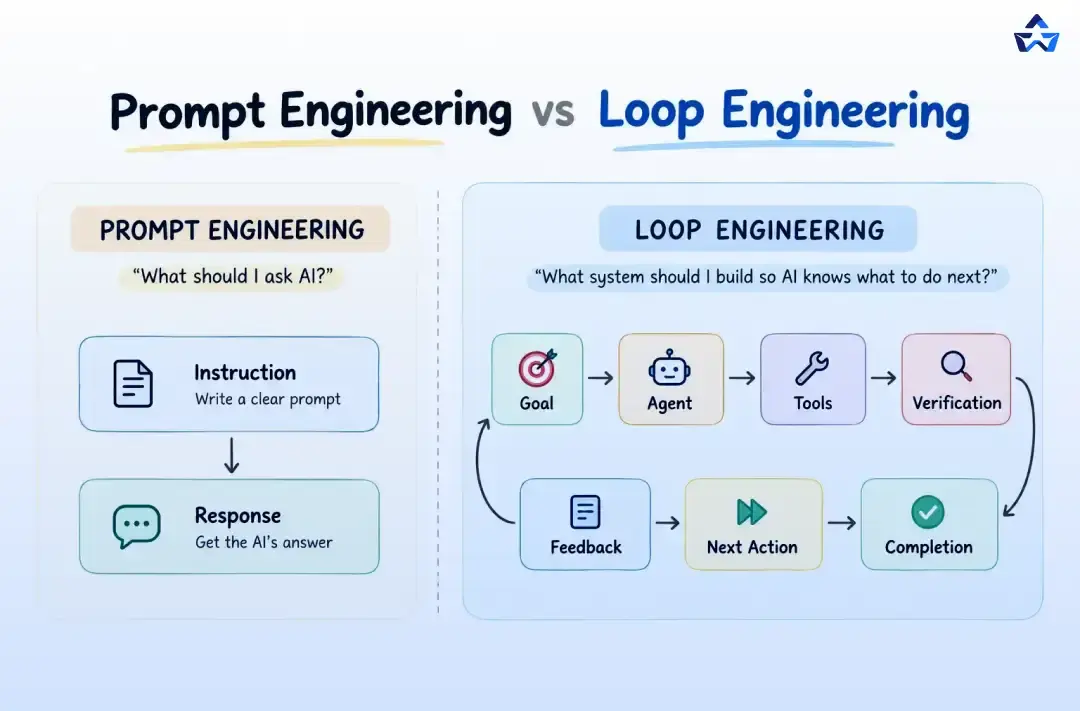
Prompt engineering and loop engineering are connected, but they solve different problems.
| Prompt Engineering | Loop Engineering |
|---|---|
| Improves the AI instruction | Designs the whole AI process flow |
| Normally concerned about one interaction | Handles multiple interactions |
| Human gives next prompt | System can decide next action |
| Output may be checked manually | Automatic verification is possible |
| Suitable for individual tasks | Suitable for multi-step workflows |
| Focuses on what to ask | Focuses on how the system works |
A simple way to remember the difference:
Prompt engineering creates the instruction. Loop engineering creates the system for the instruction.
What Are the Key Components of Loop Engineering?
A reliable AI loop requires more than just a big language model.
Clear Goals
The agent should have objectives that are measurable for success.
Context
The machine needs useful information like:
- Documentation
- Code
- Business rules
- Past actions
- Requirements for the project
- Data
Context minimizes unnecessary guesswork.
Tools
Tools enable the agent to communicate with external systems using APIs, databases, web browsers, Git, code execution, and many more.
State & Memory
Long-running processes must retain their memory regarding previous actions.
State consists of:
- Tasks completed
- Failures in the past
- Results from tools
- Decision making
- Intermediate outputs
- Current task state
Verification
It requires some mechanism to determine the following question:
"Has the agent solved the problem?"
Verification may be done automatically, manually, or both.
These concepts are also important when learning Agentic AI development, where AI systems are designed to plan actions, use tools, maintain context, and evaluate their results.
Stop Conditions
There has to be some boundary for each autonomous loop.
Some useful stop conditions are:
- Goal is met
- Max iterations exceeded
- Budget is exceeded
- Manual approval needed
- An irrecoverable error occurs
Without such constraints, increased autonomy could be more costly and repetitive.
Where Can Loop Engineering Be Used?
This kind of engineering can be applied wherever the AI system will have to execute several actions and make observations on their results.
Common examples include:
AI Code Agents
They can examine the repository, alter the code, do the testing, and rectify any problems.
Research Agents
An agent can search for the information, analyze the sources, notice any gaps, do another search, and produce the final outcome.
Customer Service
The AI system can classify a question, get the information, take an action, check the result, and refer exceptions to humans.
Data Engineering
AI processes can discover data problems, investigate pipeline issues, validate the output, and retry or escalate the action if required.
Event-Driven AI
GitHub issue, webhook, monitor alarm, scheduled tasks, or new documents can trigger the process.
The general pattern is:
Trigger → Agent → Action → Observation → Verification → Action
If you're a working professional trying to build an AI/ML learning path with structured mentorship can also help you move from individual AI concepts to practical engineering skills.
What Are the Benefits of Loop Engineering?
When designed correctly, loop engineering can help teams:
- Automate repetitive multi-step work
- Reduce manual prompting
- Build verification into AI workflows
- Handle longer-running tasks
- Connect AI with existing software
- Improve workflow consistency
- Run event-driven AI processes
- Learn from previous execution failures
However, more autonomy does not automatically mean better results.
A poorly designed loop can repeat the same mistake, use the wrong tool, consume unnecessary tokens, or continue running without making meaningful progress.
That is why production AI systems also need evaluation, observability, permissions, security, cost controls, and human oversight.
How to Start Learning Loop Engineering
You do not need to create an independent AI system right away.
Here is a sensible way forward:
Step 1: Learn Software Engineering Fundamentals
Develop expertise in:
- Python
- APIs
- Git
- Databases
- Testing
- System architecture
These fundamentals become even more useful when combined with Software Engineering with Applied GenAI, especially for developers building AI-powered applications.
Step 2: Learn Generative AI
Acquire knowledge in:
- Large language models
- Prompting
- Embeddings
- RAG
- Structured outputs
- Function and tool invocation
Step 3: Build AI Agents
Study how agents:
- Plan out actions
- Invoke tools
- Keep track of context
- Maintain state
- Complete multiple actions
Step 4: Add Evaluation
Create systems that can assess whether the output of the agent is actually correct.
Step 5: Build the Loop
Everything comes together like this:
Goal → Agent → Tools → Verification → Feedback → Iteration
For professionals interested in creating real-world GenAI skills, Bosscoder Academy's GenAI Course might prove relevant to learn about GenAI systems.
For professionals interested in building Applied GenAI skills, learning how AI agents, tools, evaluation, and production workflows work can provide a strong foundation for loop engineering.
Conclusion
Loop engineering refers to designing AI systems that do more than just come up with the solution. It enables AI agents to plan, perform an action, verify the result, and take further action accordingly.
Since AI agents are increasingly becoming capable of carrying out more complicated tasks, it means that apart from prompts, developers have to pay attention to other factors such as tools, context, verification, memory, and stopping conditions.
The core idea is simple:
Goal → Agent → Tools → Verification → Feedback → Next Action
For developers and professionals who work in various industries, learning about loop engineering is one of the most important steps toward designing AI applications.
If you are interested in learning about GenAI skills, then you should definitely take Bosscoder Academy's GenAI Course.
Frequently Asked Questions (FAQs)
Q1. What is loop engineering in AI?
Loop engineering is designing AI agent flows where the AI agent acts, checks, verifies, and corrects until a pre-defined goal or criterion is met.
Q2. How is loop engineering different from prompt engineering?
While prompt engineering aims to improve the input instructions provided to an AI model, loop engineering deals with the design of the more complex system enabling an AI agent to take actions, assess outcomes, and select future actions.
Q3. What is an AI agent loop?
AI agent loop is a series of actions taken by an AI agent when it gets context, uses tools, observes, and selects an action until completion of the task.
Q4. Why is verification important in loop engineering?
Verification shows proof that the agent has really done what it needed to do. Without verification, an agent might stop its operations after creating an inaccurate or incomplete output.
Q5. Is loop engineering only for AI coding agents?
No. Loop engineering can be utilized in coding agents, research agents, customer support, data processing, event handling, and other multi-stage AI processes.