The field of AI Engineering has evolved rapidly.
A few years ago, learning machine learning and deep learning was often the starting point for an AI career. Today, AI engineers also need to know how to work with LLMs, RAG systems, AI agents, APIs, cloud infrastructure, evaluation, and production deployment.
It may seem like a lot to learn. So, what should one do?
A practical approach is to build your skills step by step: start with programming and LLM fundamentals, learn how AI applications retrieve and use information, move into agents and fine-tuning, and finally learn how to deploy AI systems in real environments.
This AI Engineer roadmap for 2026 breaks that journey into clear stages.
What Does an AI Engineer Do?
An AI Engineer works on building and deploying AI-powered applications and systems.
The role can involve:
- Working with Large Language Models (LLMs)
- Building RAG pipelines
- Creating AI agents and multi-agent systems
- Integrating AI models through APIs
- Fine-tuning open-source models
- Building AI backends and APIs
- Deploying AI applications on the cloud
- Evaluating model and agent performance
- Managing production AI systems
Modern AI engineering therefore goes beyond prompting a chatbot. You need to understand how the pieces work together and how to turn an AI prototype into a usable product.
AI Engineer Roadmap: Step-by-Step
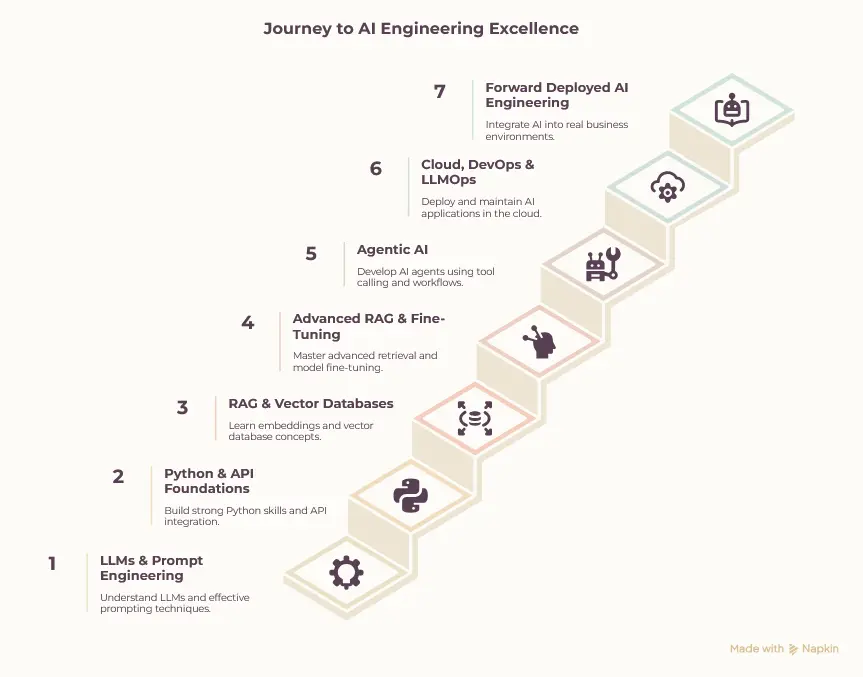
Below is the roadmap that you can follow:
| Stage | What to Learn |
|---|---|
| 1 | LLM Engineering and Prompting |
| 2 | Python and API Development |
| 3 | RAG & Vector Databases |
| 4 | Advanced RAG & Fine-Tuning |
| 5 | Agentic AI and Multi-agent Systems |
| 6 | Cloud, DevOps & LLMOps |
| 7 | Forward Deployed AI Engineering |
These stages closely follow the structure of Bosscoder Academy's Forward Deployed AI Engineering program, which is properly organized into 7 modules over 6 months.
Step 1: Learn LLMs and Prompt Engineering
Before building complex AI applications, understand how modern LLMs work.
Start with:
- Transformer architecture
- Attention and KV Cache
- Mixture-of-Experts (MoE)
- Reasoning models
- Prompt engineering
- Zero-shot and few-shot prompting
- Prompt chaining
- System prompts
- Structured outputs
- Function calling
- Prompt injection defence
You should also become familiar with popular LLM platforms and tools such as OpenAI, Anthropic, Gemini, ChatGPT, Claude and Copilot.
Don't just learn how to write better prompts. Understand how prompts, tokens, APIs, tools, and model behaviour fit together.
Step 2: Build Your Python and API Foundations
Python plays a vital role in the workflow of AI engineering.
It isn't necessary for you to learn all the Python libraries, but it is essential for you to write production-ready code.
Learn about:
- Python fundamentals
- Object-oriented programming
- Error handling
- Type hints
- Unit testing
- Async Python
- JSON and file handling
- Git and environment management
- APIs and SDKs
- Authentication
- Retry logic
- Webhooks
Moreover, you must learn to use LLM APIs such as OpenAI and Anthropic.
In this stage, you will learn to build applications using AI tools rather than playing around with them. This stage will teach you everything from Python fundamentals, testing, async python, APIs, SDKs, authentication, retries, and DSPy.
Step 3: Learn RAG and Vector Databases
Once you understand LLM APIs, learn how applications can give models access to external information.
This is where Retrieval-Augmented Generation (RAG) becomes important.
Learn:
- Embeddings
- Cosine similarity
- Vector databases
- Document chunking
- Retrieval pipelines
- LangChain
- Context compression
- RAG evaluation
- Hybrid search
- BM25
- Reranking
Popular technologies include Pinecone, ChromaDB, FAISS, LangChain and sentence-transformers.
A good beginner project here is a document-based question-answering application.
Instead of asking an LLM to answer from general knowledge, your application retrieves relevant information from your own documents and uses that context to generate an answer.
Bosscoder's program covers embeddings, vector databases, end-to-end retrieval, production RAG evaluation, hybrid search and reranking.
Step 4: Move Into Advanced RAG and Fine-Tuning
Basic RAG is just the start.
With increasing complexity in your applications, you can advance to more complex techniques like retrieval and model tuning.
Consider:
- Query rewriting
- Multi-hop retrieval
- Cross-encoder reranking
- Corrective RAG
- Self-RAG
- Agentic RAG
- LoRA and QLoRA
- Hugging Face
- PEFT
- Knowledge distillation
- RLHF and DPO
- Local deployment of LLMs
Also explore tools like Ollama, Axolotl, bitsandbytes, and Weights & Biases.
At this point, you're moving beyond simply consuming AI models and learning how to adapt and operate them.
If you want to understand the broader AI engineering journey, you can also explore best course in software domain and how it fits into modern GenAI systems.
Step 5: Learn Agentic AI
AI applications are increasingly moving from simple question-answer systems toward systems that can reason through tasks, use tools, maintain context, and complete multiple steps.
This is where Generative AI and Agentic AI start to overlap, particularly when applications need to reason, use tools and complete multi-step tasks.
Learn:
- ReAct
- Planner-executor architecture
- Tool calling
- MCP
- Function calling
- Agent memory
- Multi-agent systems
- Human-in-the-loop workflows
- Agentic RAG
- Agent evaluation
- Safety and guardrails
Frameworks such as LangGraph, CrewAI and n8n can help you build these systems.
For example, rather than creating a simple Q&A chatbot, one could create a system that will receive the task, invoke the external programs, retrieve the required information, process the results, and finally execute the workflow.
Bosscoder's Agentic AI module includes LangGraph, CrewAI, MCP, tool use, memory, multi-agent orchestration, evaluation, and safety techniques.
Step 6: Learn Cloud, DevOps and LLMOps
Not only does an AI application require a model to be functioning.
It also requires knowledge on how to serve, deploy, monitor and maintain it.
You should know about basics of:
- FastAPI
- Docker
- GitHub Actions
- CI/CD
- Kubernete
- Terraform
- AWS
- Secrets management
- Logging
- Monitoring
- Load testing
- LLM evaluation
- Cost and latency monitoring
This is where concepts such as LLMOps become important.
Understanding AI deployment and MLOps in software course is also important because building an AI model is only one part of taking an AI application into production.
Cloud & DevOps module of Bosscoder FDE program covers FastAPI, Docker, GitHub Actions, Kubernetes, Terraform, AWS infrastructure, observability, safety, and LLM evaluation.
Step 7: Learn Forward Deployed AI Engineering
This is the stage where AI engineering moves closer to real customer environments.
If you're planning a broader AI career roadmap, it is useful to understand how these engineering skills connect with different AI roles and career paths.
Building an AI application in a notebook is different from deploying it inside an organization with existing systems, security requirements, data restrictions, and performance expectations.
Learn about:
- Customer discovery
- Problem scoping
- Enterprise data access
- Legacy systems
- PII identification
- Private endpoints
- Enterprise authentication
- AI system architecture
- Security and compliance
- Model versioning
- Cost modelling
- Human approval workflows
- Incident response
- Stakeholder communication
Projects You Should Build
Learning AI concepts is important, but projects are where the skills come together.
Some practical projects from the Bosscoder curriculum include:
- Enterprise Support Assistant - build and test a multi-turn support assistant.
- Policy Assistant - create a production RAG system over company policy documents.
- Multi-Hop Investigator - build a RAG agent that retrieves information across multiple steps.
- The Specialist - fine-tune an open-source model using LoRA/QLoRA.
- Operations Agent - build a tool-calling agent using MCP.
- The Service - turn an AI prototype into a production API using FastAPI, Docker and AWS.
- The Control Room - build an observability and evaluation stack for LLM systems.
It is necessary to create such projects that would show how you build, evaluate and deploy the AI systems rather than just mentioning AI tools in your resume.
Where Does Bosscoder Academy Fit Into This AI Engineer Roadmap?
If you already have software engineering experience and want a structured path into production AI, Bosscoder Academy's Forward Deployed AI Engineering Program follows this progression directly.
The program runs for around 6 months, with live learning and industry projects. Its curriculum moves from LLM Engineering and Python to RAG, fine-tuning, Agentic AI, Cloud & DevOps, and Forward Deployed AI Engineering.
The program is specifically designed for SDEs, backend engineers, data engineers, DevOps engineers and platform engineers who already write production code and want to move into AI-focused roles.
It also includes electives covering DSA and System Design for technical interviews, which can complement the AI-focused curriculum.
AI Engineer Career Paths
An AI engineering roadmap can lead to different types of roles depending on your interests and existing experience.
Some roles covered by the Bosscoder program include:
- Forward Deployed AI Engineer
- GenAI / LLM Engineer
- Agentic AI Developer
- Technical Product Manager (AI/GenAI)
The program also describes its preparation around building and deploying production-grade AI systems, working with customers, and integrating AI into real operational environments.
Final Thoughts
You don’t have to study everything about AI all at once.
You can begin with LLMs and Python, and later proceed to RAG, fine-tuning, and agents. Once you can make AI applications, you can study cloud, DevOps, and LLMOps. In the end, understand what’s needed to deploy AI in actual business environments.
The best AI Engineer career path is the one that enables you to progress from learning → building → deploying.
And if you already have a software engineering background, a structured program such as Bosscoder Academy's Forward Deployed AI Engineering Program can bring these areas together in one learning path, with live learning and hands-on industry projects.
Frequently Asked Questions (FAQs)
Q1. What should I learn first to become an AI Engineer?
Firstly, you should start by learning Python, LLM fundamentals and how to create APIs. Later, advance your knowledge of RAG, fine-tuning, AI agents, cloud and LLMOps.
Q2. Do I need an ML background to learn AI Engineering?
You don’t need ML experience in order to learn AI Engineering, although it’s supposed to be for engineers who have already shipped some software.
Q3. What is the difference between an AI Engineer and an ML Engineer?
ML Engineer is supposed to work mainly on developing ML models. AI Engineer may have a much wider scope of tasks like LLMs, RAG, agents, APIs, evaluation, infrastructure, and production of AI solutions.
Q4. Is RAG important for AI Engineers?
Yes, RAG is one of the most important methods in creating applications with LLMs and other private/external data sources. The roadmap for an AI Engineer must include embeddings, retrieval, vector database, evaluation, and retrieval.