Introduction
Data is growing faster than most businesses can manage manually. Every online payment, product search, food delivery, video stream, and customer interaction generates information that companies need to collect, process, and use.
This is also changing the technology job market. According to Careers360 - India Tech Hiring Report 2026, Data Engineering's share of technology job postings increased from 4.3% in July to 7.7% in October 2026, based on 18,752 live job postings. That's a nearly 79% increase in its share of postings in just three months.
But why is Data Engineering so important? And what does it take to become one?
First, let us understand what is meant by the term Data Engineering, the tools used by such professionals, their daily tasks, and possible careers for 2026 and later on.
What Is Data Engineering?
Data Engineering is the practice of creating, managing, and maintaining systems for the collection, storage, processing, and delivery of data in usable form.
Essentially, what Data Engineers do is ensure that the relevant data gets to the relevant people and systems at the right time.
Imagine an online shopping platform. Every day, it will produce data generated through customer queries, purchase transactions, payments, shipments, and returns. This data comes from various applications and databases.
A Data Engineer sets up pipelines that bring the data together, process it, and store it in a centralized data warehouse. Analysts can use the data to generate reports, and data scientists or AI engines to train models on it.
Data Engineering is not just about getting data from one place to another. It is much more than that.
To understand how these concepts connect in real-world applications, explore our guide to the Data Engineering fundamentals and industry applications
How Does Data Engineering Work?
Almost all Data Engineering systems operate on what is usually called an ETL (extract, transform, load) or ELT (extract, load, transform) method.
| Stage | What happens | Example |
|---|---|---|
| Extract | Collect data from multiple sources | Orders, payments, and customers’ actions |
| Transform | Data cleaning, validation, and structuring | Eliminate duplicates and unify date formats |
| Load | Store processed data in a destination | Loading data into Snowflake/BigQuery |
| Serve | Make data available for consumption | Power dashboards, reports and AI applications |
For example, whenever you purchase something online, the transaction details might pass through several pipelines of data before ending up in the company’s sales dashboard.
Fun fact: Modern Data Engineering also provides support for AI use cases. RAG (Retrieval-Augmented Generation), recommendation systems, and AI agents need clean and organized data to function effectively. The quality of data affects the performance of even the best AI models.
Want to see how these processes work in practice? Explore these Data Engineering projects with source code to understand how pipelines are built and implemented.
What Does a Data Engineer Do? Key Responsibilities
A Data Engineer is a professional who takes care of the data infrastructure of the organization behind the scenes. The role of Data Engineers involves more than writing SQL queries and constructing pipelines.
The tasks of Data Engineers include:
- Building data pipelines:: Extracting data from the API, application, database, and various external sources.
- Data cleaning and transformation: Dealing with missing values, duplicates, formatting issues, and incorrect information.
- Managing databases: Creating and maintaining databases, data warehouse, and data lakes.
- Workflow management: Scheduling and managing data workflows with the help of the orchestration system (e.g., Apache Airflow).
- Performance optimization: Reducing time spent executing the pipeline, improving the performance of queries, and increasing storage efficiency.
- Data validation, management, and security: Validating information, controlling access, and protecting sensitive business data.
- Enabling analytics and AI solutions: Providing datasets for BI analysis, machine learning algorithms, and generative AI.
In summary, Data Engineers provide the backbone for making correct decisions by the team members.
Key Data Engineering Skills That You Must Master
To be a Data Engineer, you should have skills in programming, databases, data processing, and cloud computing.
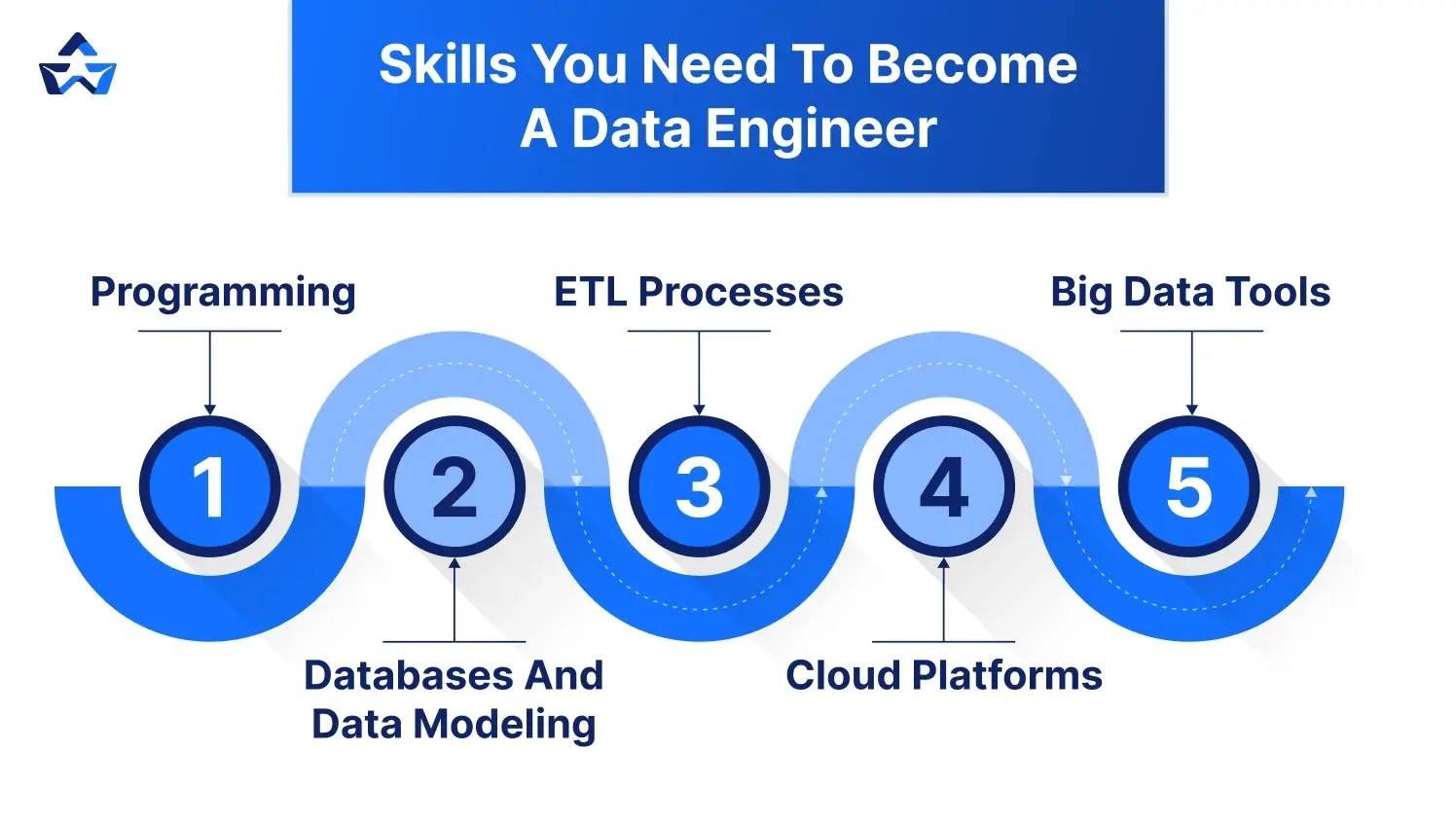
The following list includes some of the key Data Engineering skills that you should master:
1. SQL and Python
SQL and Python can be regarded as the two fundamental skills of the Data Engineers.
SQL can be used to access, filter, combine, and manipulate data from databases.
Python will be needed to automate processes, process data sets, build ETL workflows, and integrate systems.
A strong understanding of SQL joins, window functions, CTEs, Python functions, and error handling will be a good starting point.
If you're unsure where to start, this Data Engineering curriculum explains the skills and technologies to learn in a structured sequence.
2. Database and Data Warehousing
Data engineers interact with different kinds of storage depending on the use case.
You need to know:
- Relational databases like PostgreSQL and MySQL.
- NoSQL databases like MongoDB.
- Data warehouses like Snowflake, Amazon Redshift, and Google BigQuery.
- Data modeling techniques like Star Schema, Snowflake Schema, and Slowly Changing Dimensions (SCD).
3. Big Data and Distributed Processing
If the datasets are large, it is essential to use distributed processing techniques to deal with them.
Study topics like:
- Apache Spark and PySpark.
- Hadoop and distributed storage.
- Batch and Stream processing.
- Partitioning, Fault Tolerance, and Data Parallelism.
To understand how these technologies work together, explore these Data Engineering projects, covering practical applications of PySpark, Kafka, Spark Streaming, and other tools.
4. Cloud Computing and DataOps
Data platforms are becoming more cloud-based in the modern world.
Learn about at least one cloud platform:
- AWS: S3, Glue, Redshift and EMR.
- Microsoft Azure: Azure Data Factory, Azure Data Lake and Databricks.
- Google Cloud: BigQuery, Cloud Storage and Dataflow.
It is also important to learn about workflow orchestration, versioning, monitoring, and deployment processes.
Popular Data Engineering Tools & Technologies
There are different tools in the Data Engineering ecosystem, each used for solving particular problems. It is not necessary to know all of them at once. Learn from the fundamentals and build up your stack of technology.
| Category | Popular tools | Primary use |
|---|---|---|
| Programming | Python, SQL | Data Processing and querying |
| Big Data | Apache Spark, PySpark | Data processing using distributed systems |
| Streaming | Apache Kafka | Data Transfer in real time |
| Orchestration | Apache Airflow | Data pipeline scheduling |
| Data Transformation | dbt | Transforming warehouse data |
| Data warehousing | Snowflake, BigQuery, Redshift | Storage of analytical data |
| Cloud | AWS, Azure, GCP | Scalable data infrastructure |
| Data Lakehouse | Databricks, Delta Lake | Unified data processing and storage |
Tip for learning: Don't learn tools only to put them on your resume. Learn what problems those tools solve. For instance, learn SQL before you start with Spark and learn about ETL before creating Airflow DAGs.

Data Engineer vs Data Analyst vs Data Scientist
These three positions work with data but their job is different.
| Role | Primary responsibilities | Common tools |
|---|---|---|
| Data Engineer | Builds and maintains data infrastructure | SQL, Python, Spark, Airflow |
| Data Analyst | Analyzes data to derive business insights | SQL, Excel, Power BI |
| Data Scientist | Builds predictive models and statistical solutions | Python, ML, TensorFlow |
Career Options in Data Engineering in 2026 and Beyond
There are many career opportunities in Data Engineering for various industries like banking, healthcare, e-commerce, fintech, SaaS, and tech.
Some popular job roles are:
- Junior Data Engineer: Builds basic pipelines and uses SQL, Python, and databases.
- Data Engineer: Develops ETL/ELT pipelines and manages the data infrastructure.
- Big Data Engineer: Uses large-scale distributed computing and processes big data with Spark and Hadoop.
- Cloud Data Engineer: Creates cloud-based data platforms.
- Data Platform Engineer: Creates scalable infrastructure and data-related tools.
- Senior Data Engineer: Makes architecture decisions, improves systems, and manages engineering teams.
Moreover, one can follow the career path towards Data Architect, Data Engineering Lead, and AI Data Engineer positions.
The key is that there is an evolution of roles due to cloud, real-time analytics, and AI. One can become more valuable by being able to create reliable data systems.
For a better understanding of how professionals move into this domain, read this Data Engineering career transition story.
How to Become a Data Engineer: A Learning Path for You
When starting from scratch or coming from the field of software engineering, do not try to learn everything at once instead, use a proper learning path.
- Build programming fundamentals: Start with SQL and Python.
- Databases: Learn about relational databases, NoSQL, data modelling, and warehousing.
- ETL/ELT: Learn how to build pipelines for transforming and collecting real-life datasets.
- Big Data: Learn how to work with Apache Spark, PySpark, and Kafka.
- Cloud Platforms: Learn how to work with AWS, Azure, or GCP.
- Building end-to-end projects: Learn how to create batch and real-time pipelines with different tools.
- Prepare for interviews: Prepare SQL, Python, DSA basics, and Data Engineering system design.
To follow this learning sequence in more detail, explore our Data Engineering Roadmap 2026, which outlines the key stages of learning. You can also refer to the Data Engineering Program Curriculum to understand the skills and technologies covered at each stage.
Kickstart Your Data Engineering Career at Bosscoder Academy
Tool learning alone is not enough to become a Data Engineer. The true test lies in knowing how all these tools like SQL, Python, Spark, Kafka, cloud services, and data pipelines fit together in a production environment.
Bosscoder Academy Data Engineering Program is for those professionals who wish to hone their engineering skills and shift their careers towards becoming a Data Engineer. The course structure includes programming, Big Data, cloud services, hands-on projects, and job interview preparation.
Explore the Bosscoder Academy Data Engineering Program to develop practical skills through structured learning, industry-oriented projects, 1:1 mentorship, and interview preparation.
Conclusion
Data Engineering is much more than transferring data between databases. It’s about creating reliable systems that allow companies to leverage data and transform it into actionable insights.
As many product companies continue to invest in cloud technology, analytics and AI, people with skills in data pipelines, distributed computing and scalable architecture will have great chances to succeed in this area.
Begin with SQL and Python, learn the basics, use modern tools and create projects that prove your expertise in solving data-related problems. This is how you progress from learning Data Engineering to being a Data Engineer.
Frequently Asked Questions (FAQs)
Q1. Is Data Engineering a good career in 2027?
Yes. Data Engineering is a good career path due to the investments companies are making into cloud technology, AI data centres, analytics, real-time capabilities, and machine learning.
Q2. Should I know how to code to become a Data Engineer?
Yes. SQL and Python are two of the essential programming skills that a Data Engineer should have in order to query databases, automate tasks, process and build pipelines.
Q3. How long does it take to learn Data Engineering?
It all depends on your prior technical knowledge and how consistently you learn. If someone has software development experience, they will learn faster than those who have no prior experience at all.
Q4. Is Data Engineering difficult to learn?
Data Engineering consists of many different domains like programming, databases, distributed systems, and cloud computing. It may be challenging to learn at first, but it becomes easier when one learns the ideas in the correct sequence and builds projects.
Q5. What is the difference between ETL and ELT?
ETL stands for Extract, Transform, Load, which means that data is transformed before loading into the destination. ELT stands for Extract, Load, Transform, which means that data is loaded first and then transformed in the destination.