Introduction
Many software engineers are asking the same question: how do I move into AI without starting over? The shift from software engineer to AI engineer is real, and one role suits backend and full-stack developers especially well: the forward deployed AI engineer.
Companies building with large language models need people who can make a model work inside a customer's messy, real-world systems. That is production engineering with an AI layer on top, and it is where your experience counts.
This guide is for software engineers with 1-8 years of experience. You'll learn what the role involves, which skills you already have, what to add, and a nine-month plan to get there.
What Is a Forward Deployed AI Engineer?
A forward deployed AI engineer is a software engineer who works directly with customers to design, build, and ship AI solutions inside the customer's environment. Instead of building one product for everyone, you solve a specific problem for a specific client, often embedded with their team.
The role started at Palantir, which placed engineers inside customer organizations to make complex data platforms useful. AI companies have adopted the model because LLM products rarely work out of the box. Every client has different data, workflows, and constraints, and someone has to bridge the gap between the model and the business.
A typical week includes four kinds of work:
- Scoping: turning a vague goal like "reduce support load" into a defined problem with a success metric.
- Building: prototyping LLM, RAG, or agent-based solutions.
- Integrating: connecting your solution to the client's databases, APIs, and internal tools.
- Iterating: watching production behaviour, fixing failures, and improving quality based on client feedback.
Forward Deployed AI Engineer vs. Other Roles
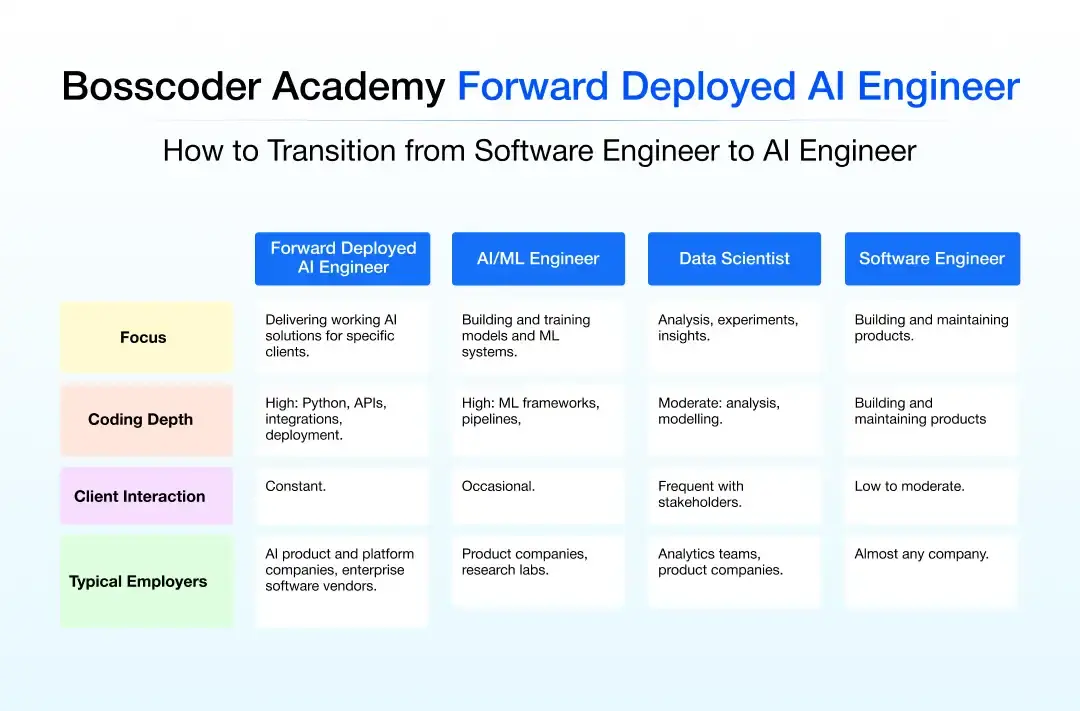
The FDE role is the most client-facing of the four, and it focuses on applying existing models rather than training new ones. If you enjoy building things and talking to the people who use them, it fits well.
Why Software Engineers Have an Edge
If you already ship backend software, you are closer than you think. Most of an FDE's work is ordinary engineering: designing services, calling APIs, handling failures, and keeping systems running. The AI component is one layer on top.
Here is what transfers directly:
- System design helps you plan how an LLM component fits into a larger architecture.
- Backend and API experience lets you integrate with client systems quickly.
- Debugging skills matter because AI systems fail in unpredictable ways, and tracing those failures is detective work.
- Production experience means you already think about latency, logging, and reliability. Many ML-first candidates are still learning these.
On the market side, hiring for AI-focused engineering roles has been growing, and engineers who combine software depth with applied AI tend to be in demand. Treat any number you see online with caution until you can trace it to a primary source.
Skills Gap: What You Have vs. What to Learn
Skills you already have
- Data structures, algorithms, and clean code [INTERNAL LINK: DSA Program for Working Professionals]
- Backend development and API design
- System design fundamentals
- Debugging, testing, and version control
- Experience running software in production
Technical skills to add
- Python for AI: async code, data handling, and the core AI libraries
- ML fundamentals: training vs. inference, evaluation metrics, embeddings, overfitting
- LLMs and prompt engineering: context windows, structured outputs, prompt design
- RAG and vector databases: chunking, retrieval, reranking
- Agents and tool use: function calling, multi-step workflows, guardrails
- Evaluation: test sets, regression checks, LLM-as-judge methods
- LLMOps and deployment: monitoring, cost tracking, versioning, CI/CD
FDE-specific soft skills
- Client communication: explaining trade-offs without jargon
- Requirement scoping: asking questions until the real problem is clear
- Handling ambiguity: making progress when data and goals are incomplete
- Presenting results: showing impact in terms the client's leadership cares about
9-Month Roadmap to Become a Forward Deployed AI Engineer
This AI engineer roadmap assumes 8-10 hours of study per week alongside a full-time job.
Months 0-3: Foundations
- Goals: Python for AI, ML basics, how LLMs work, prompt engineering, calling LLM APIs
- Key tools: Python, Jupyter, scikit-learn, an LLM API, Git
- Milestone: a small web or command-line tool that uses an LLM API with structured outputs and proper error handling
Months 3-6: Applied AI
- Goals: embeddings, RAG pipelines, vector databases, agents and tool use, evaluation basics
- Key tools: a vector database, an orchestration framework, FastAPI, Docker
- Milestone: a RAG application over a real document set, with a small evaluation set and measured retrieval quality
Months 6-9: Production and Client Readiness
- Goals: deployment, monitoring, cost control, guardrails, scoping practice, interview preparation
- Key tools: a cloud platform, CI/CD, logging and tracing tools
- Milestone: a deployed end-to-end application with monitoring, a written case study, and a mock client presentation
Portfolio Projects That Get Noticed
Hiring managers see plenty of tutorial clones. Frame each project as a client problem with a measurable outcome instead. For example: "cut average document lookup time from 10 minutes to 30 seconds, validated on 50 test queries."
- RAG chatbot over company documents. Use a realistic document set such as policies or product manuals. Measure answer accuracy and show how you handled failures.
- Workflow-automation agent. Build an agent that handles a repetitive business task, such as triaging support tickets or drafting reports, with human approval steps.
- End-to-end deployed app with evaluation and monitoring. Ship something live, track quality and cost, and document what you improved.
For each, write a one-page case study covering the problem, your approach, trade-offs, and results.
Interview Preparation
FDE interviews usually test four areas: coding, system design, LLM concepts, and client-scenario cases. Keep your DSA fundamentals sharp, practise designing AI-enabled systems, and rehearse explaining technical decisions to a non-technical person.
Sample questions to practise:
- How would you design a RAG system for a client with 100,000 internal documents, and how would you measure its quality?
- A client says their chatbot "gives wrong answers sometimes." How do you investigate?
- How do you decide between prompt engineering, retrieval, and fine-tuning for a given problem?
How Bosscoder Academy Helps You Become a Forward Deployed AI Engineer
Bosscoder Academy is built for working software engineers, so the programme maps to the roadmap above. Live, mentor-led classes cover the technical layers: DSA and system design foundations, then applied AI topics like LLMs, RAG, and agents.
Mentors review your code and architecture decisions, which is how you build the judgement client-facing work demands. Projects are structured around real problem statements, so your portfolio reads like case studies. Career support covers resume positioning, mock interviews, and referrals.
If you want to see how this fits your background, you can book a free counselling session and get a personalised view of your gaps.
Conclusion
Becoming a forward deployed AI engineer is a practical move for software engineers. You keep your engineering foundation, add applied AI skills, and learn to work closely with clients. Follow the nine-month roadmap, build client-style projects, and practise explaining your work clearly.
If you'd like guidance, book a free counselling session or download the curriculum from Bosscoder Academy to plan your next step.
Frequently Asked Questions (FAQs)
Q1. How long does the transition take?
For most working engineers, around nine months of consistent effort is realistic. It depends on your Python and ML background and how many hours you can commit each week.
Q2. Do I need to learn ML from scratch?
No. You need solid fundamentals such as embeddings, evaluation, and model limitations. Deep training expertise matters more for AI/ML engineer roles than for FDE roles.
Q3. Is FDE a good role for freshers?
It is possible but harder, since the role rewards production experience and client judgement. With 1+ years of engineering experience, you are in a stronger position.
Q4. What will I build, and how does the program support me through the transition?
You’ll work on projects framed as client problems, such as RAG systems and agent workflows, with mentors reviewing your code and design decisions. Career support includes profile positioning and mock interviews.