Database systems manage transactions in an ongoing manner, and therefore any failure that may occur during the update transaction could cause data to be inconsistent. The database recovery in DBMS refers to the process of restoring a database to a consistent state after a failure.
Understanding the recovery concepts is important for tech professionals who are studying DBMS for Data Engineering because it links transaction, ACID properties, logging, checkpoint, and database reliability.
In this blog, we will explore the major recovery concepts in DBMS, failure types, and recovery methods.
What Is Database Recovery in DBMS?
Database recovery is the process of restoring a database to a consistent state in the event of a transaction failure, failure of the system, or failure related to storage in a DBMS.
The main goals of recovery are:
- Data consistency
- Commitment of transactions
- Reversal of incomplete transactions
- Support atomicity and durability
- Minimizing the effects of a failure
Atomicity helps ensure that either a transaction is completely executed or not executed at all, while durability ensures the retention of committed transactions.
Why Is It Important to Have Recovery in DBMS?
Let’s consider a simple bank transaction:
Debit ₹5,000 from Account A and credit ₹5,000 to Account B.
This might include:
- Decreasing Account A by ₹5,000
- Increasing Account B by ₹5,000
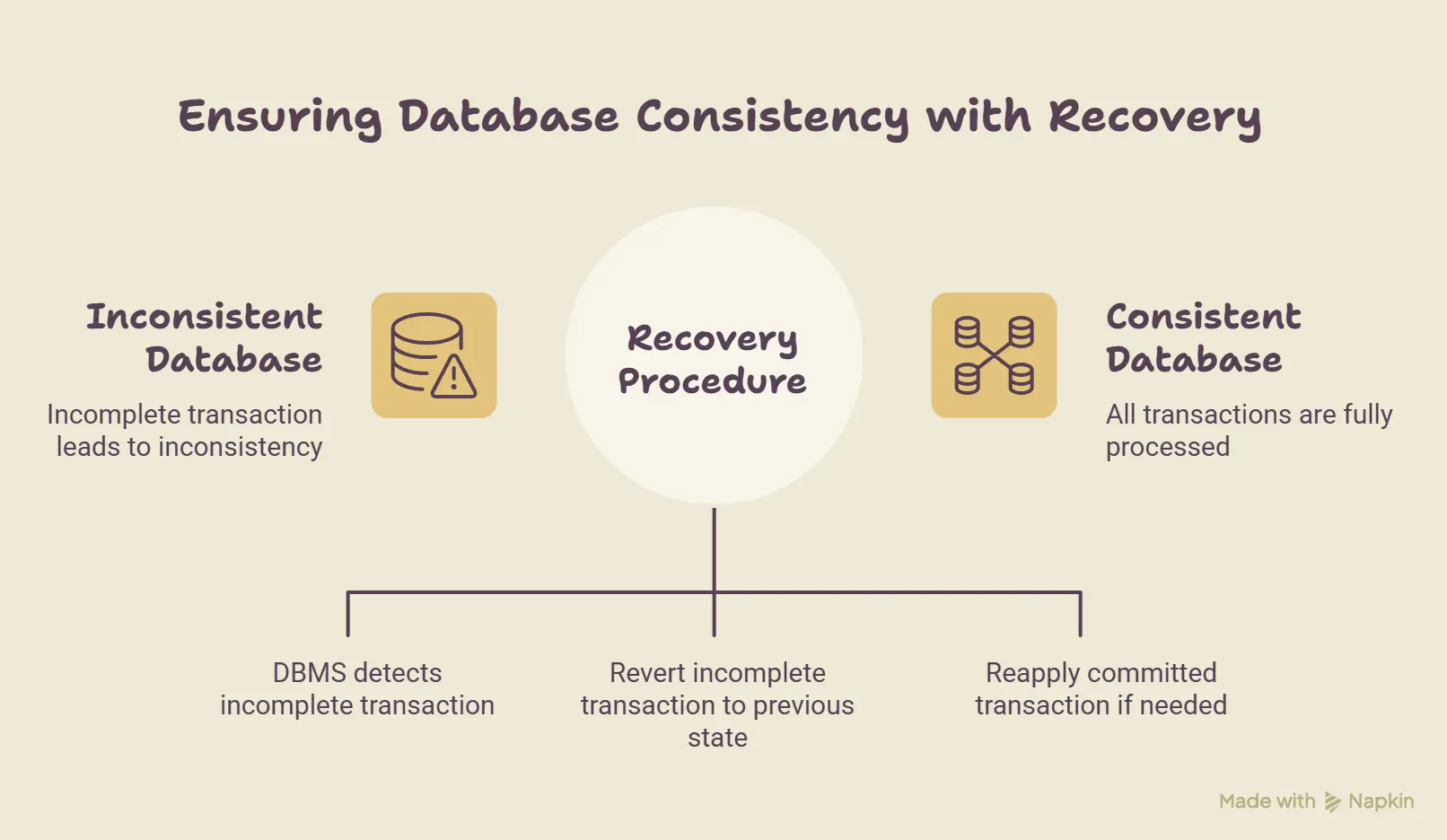
In case of failure after the first operation, the database will end up being inconsistent.
The recovery procedure will help the DBMS identify the problem and take actions, such as:
- Undo the incomplete transaction, or
- Redo a committed transaction when necessary.
This is why recovery is closely connected with transaction management and ACID properties.
Types of Failures in DBMS
In order to learn about recovery methods, it is necessary to know about possible failures.
1. Transaction Failure
Transaction can fail due to logical error, incorrect operation, or some other condition that will make its execution impossible.
2. System Crash
A power failure, operating system problem, or any hardware issue can cause a crash of DBMS while transactions are being executed.
3. Storage/Disk Failure
A disk or storage failure can result in major corruption of a database and the necessity to restore it from backups and recover it with help of transaction logs.
Key Recovery Concepts in DBMS
There are several concepts that serve as the basis for the DBMS recovery.
1. Transaction Log
A transaction log records important operations performed by transactions. The log can contain information about when a transaction starts, changes a data item, and commits.
During recovery, the DBMS uses this information to determine which changes should be undone or redone.
2. Write-Ahead Logging
In log-based recovery, changes are recorded in the log before the corresponding database modification is applied. This gives the recovery system the information it needs if a failure occurs.
3. Checkpoint
A checkpoint in DBMS marks a known consistent point in the recovery process.
Instead of examining the entire transaction log after a crash, the recovery system can start from a recent checkpoint, helping reduce recovery work.
4. Undo
Undo recovery reverses changes made by transactions that did not complete successfully.
For example, if a transaction updated several records but failed before committing, the DBMS can use the log to reverse those changes.
5. Redo
Redo recovery reapplies changes from transactions that successfully committed but whose changes may not have been completely written to the database before the failure.
In a recovery process involving concurrent transactions, committed transactions can be placed in a redo list while incomplete transactions can be placed in an undo list.

Major Database Recovery Techniques
| Recovery Technique | Purpose |
|---|---|
| Log-Based Recovery | Uses transaction logs to undo or redo changes |
| Deferred Update | Database changes are applied after the transaction reaches commit |
| Immediate Update | Database may be updated before the transaction commits |
| Checkpoint Recovery | Reduces the amount of log that needs to be processed |
| Shadow Paging | Maintains a separate version of database pages to support recovery |
Log-Based Recovery
Log-based recovery is one of the most common approaches. The DBMS maintains a log of transaction activities and uses it during recovery.
Deferred Update
With deferred update, changes are recorded in the log first and the database is updated after the transaction commits. This approach can simplify recovery because uncommitted database changes do not need to be undone.
Immediate Update
With immediate update, database changes can happen before a transaction commits. Therefore, recovery may need both undo and redo operations depending on the transaction state.
Shadow Paging
Shadow paging is another recovery approach in which changes are made separately and the actual database state is updated later. It avoids relying entirely on traditional log-based recovery.
Undo vs Redo in DBMS
The difference becomes easier to understand with a simple comparison:
| Feature | Undo | Redo |
|---|---|---|
| Main purpose | Reverse changes | Reapply changes |
| Usually applied to | Incomplete transactions | Committed transactions |
| Goal | Restore previous consistent state | Preserve committed changes |
| Recovery direction | Backward | Forward |
Importance of Database Recovery for Data Engineers
Database recovery is more than just another theoretical concept within the DBMS topic. The work of Data Engineers involves database operations, data pipeline operations, warehouse systems, distributed systems, and large data processing systems where reliability and consistency are crucial.
Knowledge of the DBMS, transactions, ACID properties, indexing, data modelling, and recovery can, therefore, provide a better foundation for Data Engineering.
For those professionals who would like to learn all these concepts systematically, the Bosscoder Academy Data Engineering Program covers DBMS, data warehousing, data modelling, ETL, Big Data, cloud technologies, system design, DSA, and GenAI as part of its structured curriculum.
Conclusion
Recovery concepts from DBMS can be used to describe how databases manage to be consistent despite any transaction failure or system crashes. Most significant concepts are transaction log, write-ahead logging, checkpoint, undo, redo, deferred update, immediate update, and shadow paging.
If you are preparing for Data Engineering interviews or want to build a foundation in Data Engineering, learning these concepts will be beneficial to you.
Frequently Asked Questions on Recovery Concepts in DBMS
Q1. What is recovery in DBMS?
The recovery in DBMS involves the restoration of a database to its consistent state after a failure while committing to complete transactions and dealing with incomplete transactions.
Q2. What are the types of recovery methods in DBMS?
Some methods are log based recovery, deferred updates, immediate updates, checkpoint recovery, and shadow paging.
Q3. What is the difference between undo and redo in DBMS?
Undo method rolls back changes made by the incomplete transactions, whereas the redo method applies the changes of the committed transactions again where necessary in recovery.
Q4. Why are checkpoints used in DBMS?
A checkpoint helps in getting a recovery point and also helps in reducing the transaction log which the DBMS has to scan after a failure.