Artificial Intelligence is no longer a futuristic concept, it is already touching the lives of people in the fields of healthcare, fintech, e-commerce, and education. In India, the hiring for AI/ML has increased manifold, with reports showing an increase of up to 54% growth in AI hiring for the year 2026, making it one of the fastest-growing domains in the field of technology.
From recommendation systems to AI copilots, the demand for skilled AI engineers is rising at scale, with over 2.9 lakh AI job openings recorded in 2026 and continuous growth expected.
However, let’s look at the reality:
The top product companies today not only look for “ML engineers” or “Gen AI developers”, they look for full-stack AI engineers who can build intelligent systems using machine learning, deep learning, and generative AI. This is because the need for AI engineers is growing faster than the supply, at a rate of 25%, especially in India, with over 2.9 lakh AI jobs already recorded for the year 2025.
This blog is designed for developers, engineers, and working professionals who want a clear, practical, and easy-to-follow roadmap to become an AI Engineer in 2026.
What Does an AI Engineer Actually Do?
An AI Engineer develops, creates, and delivers intelligent systems with the following capabilities:
→ Learn from data
→ Make predictions or decisions
→ Comprehend language, images, or patterns
→ Automate processes in the real world
In simple terms, AI Engineers take data and convert it into intelligent products.
Examples include:
- Netflix-style recommendation systems
- Fraud detection systems for banks
- AI chatbots and copilots
- Self-driving car algorithms
- Image recognition systems
Why AI Engineering Is One of the Best Careers Today
AI is one of the fastest-growing fields in tech. The demand is rising because:
→ Businesses are shifting to AI-powered products
→ Generative AI (like ChatGPT) has changed workflows
→ Companies need engineers who can build complete AI systems
As highlighted in recent industry trends, modern AI roles require combining machine learning fundamentals with generative AI capabilities, not just one skill in isolation.
This shift is creating high-paying, high-impact roles across industries.
Types of AI Roles You Can Target
AI engineering is not a single role → it’s a spectrum.
1. Machine Learning Engineer
→ Focus on training and deploying ML models
→ Works on prediction systems, recommendations, etc.
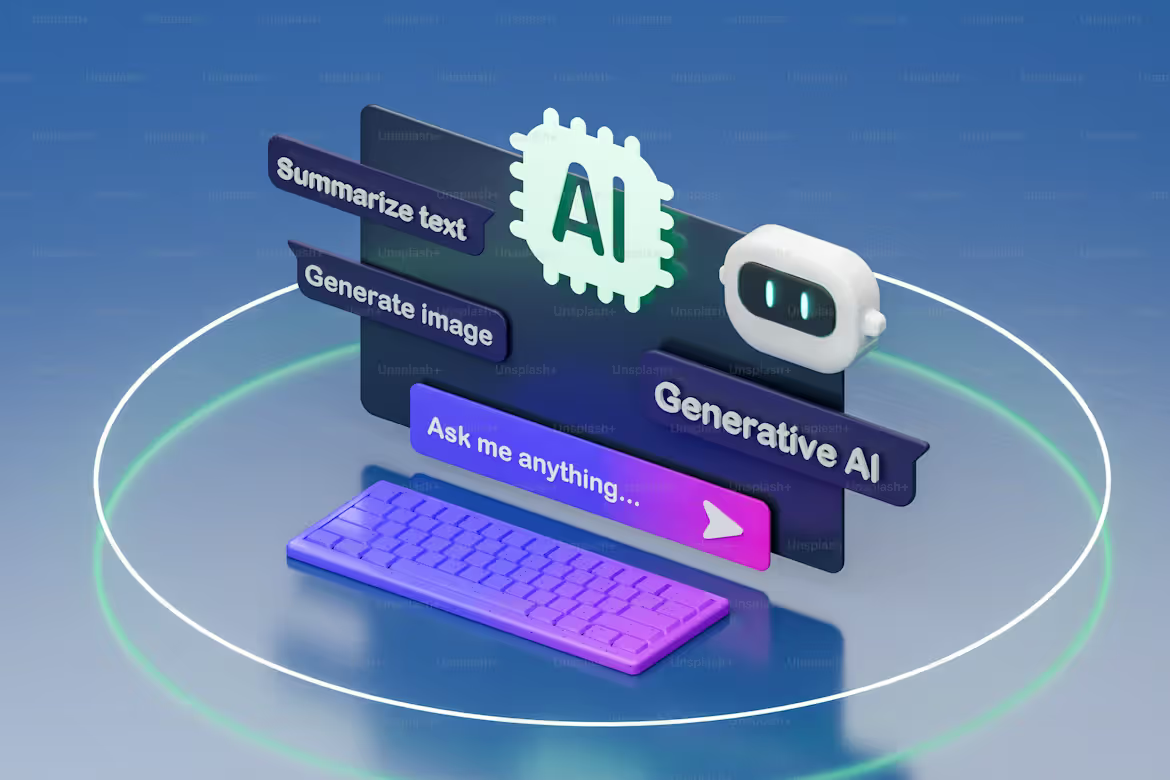
2. Generative AI Engineer
→ Builds AI apps using LLMs (chatbots, copilots)
→ Works with transformers, RAG, and AI agents
3. MLOps Engineer
→ Handles deployment, scaling, and monitoring
→ Bridges ML + DevOps
4. AI Product Engineer
→ Builds real-world AI products end-to-end
5. AI Research Engineer
→ Works on advanced algorithms and innovation
Step-by-Step Roadmap to Become an AI Engineer
This is the most practical roadmap whether you're a beginner or working professional.
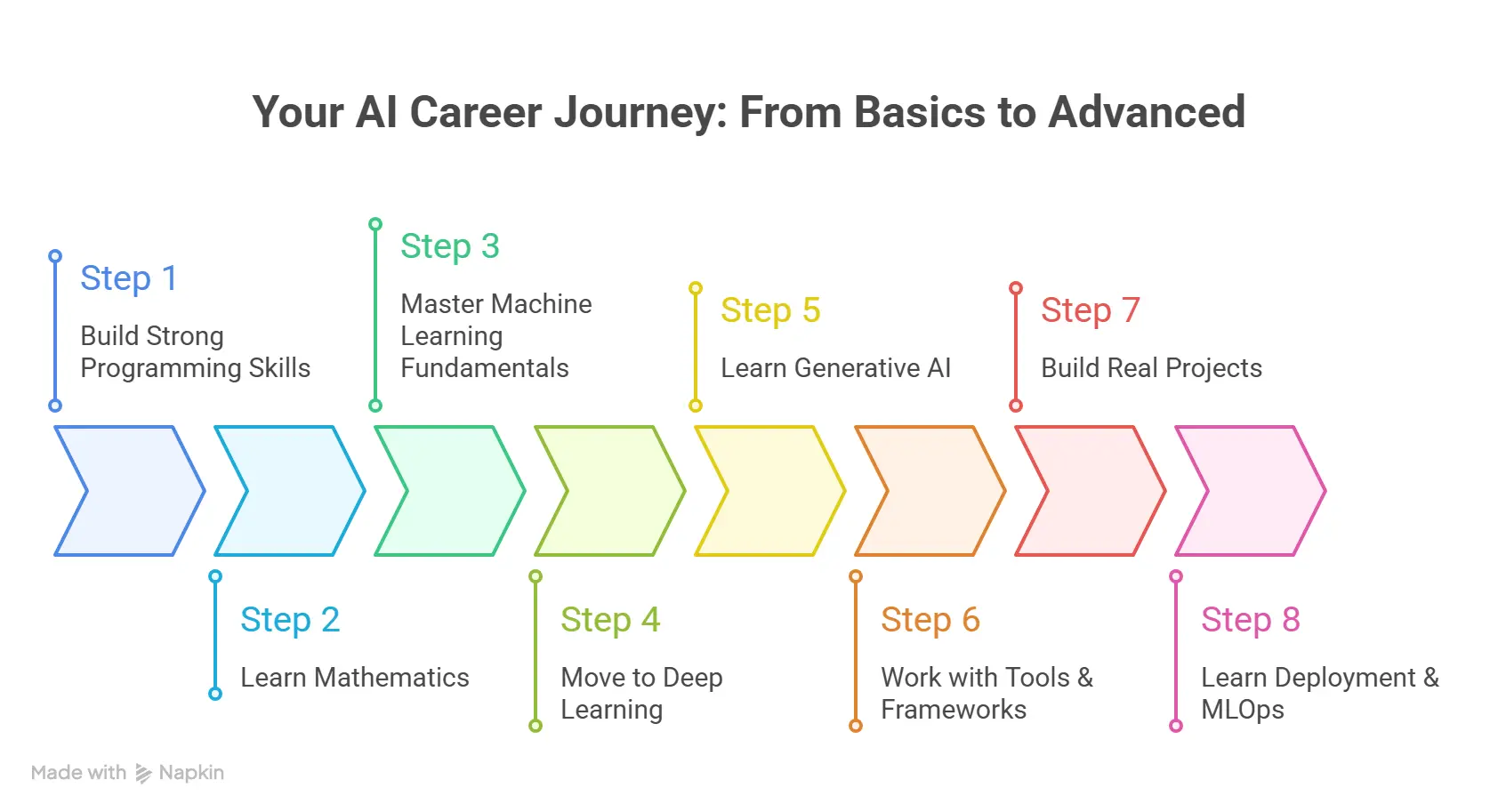
Step 1: Build Strong Programming Skills
Start with:
→ Python (must-have)
→ Data Structures & Algorithms
→ Strong understanding of OOPs concepts
Why?
Because all AI systems are ultimately production code.
Step 2: Learn Mathematics (Don’t Skip This)
You need to focus on:
→ Linear Algebra (vectors, matrices)
→ Probability & Statistics
→ Calculus (basics of optimization)
You don’t need PhD-level math but you must understand how models work internally. Next you will want to learn the fundamentals of machine learning.
Step 3: Master Machine Learning Fundamentals
After you have learnt the fundamental concepts you should master:
→ Regression & Classification
→ Decision Trees & Random Forest
→ Clustering (K-Means)
→ Model evaluation metrics
This is going to give you a good base to build upon. After you have the above fundamentals you will move onto deep learning which is the foundation of most modern AI.
Step 4: Move to Deep Learning
Understand:
- Neural Networks
- CNNs (Computer Vision)
- RNN/LSTMs (Recurrent Networks)
- Transformers (Attention Based Models)
Deep learning powers most modern AI systems.
Step 5: Learn Generative AI Knowledge (The Next Big Thing in 2026)
This is where the majority of professionals fall behind.
Concentrate on:
→ LLMs (Large Language Models)
→ Prompt Engineering
→ RAG (Retrieval Augmented Generation)
→ AI Agents
→ Fine-tuning models
These are the positions being actively recruited for by the leading technology firms.
Step 6: Gain Experience with Tools and Frameworks
Essential Tools:
→ TensorFlow or PyTorch
→ Hugging Face
→ Pandas and NumPy
→ LangChain and LlamaIndex
Tools will help you apply the knowledge gained through your studies and prepare you for employment.
Step 7: Show Your Work Through Projects (Most Important)
You must have projects to gain employment.
Examples of Projects:
→ AI Chatbot
→ Resume Analyzer
→ Recommendation System
→ Image Classifier
→ AI Agent Workflow
The quality of your GitHub repository will be more important than the quality of your resume.
Step 8: Learn Deploy and Implement of ML Operations
This is the biggest barrier to success for professionals.
Learn the following:
→ APIs (FastAPI and Flask)
→ Docker
→ Cloud Computing Services (AWS and GCP)
→ Model Deployment
Top tech companies are looking for people who can ship AI products as opposed to those who can merely train a model.
Pro Tip (Industry Insight)
Modern AI systems are no longer just models they are complete pipelines combining:
→ Data
→ ML models
→ LLMs
→ APIs
→ Deployment systems
This is why companies prefer engineers who understand the full AI stack, not just theory.
Key Skills Every AI Engineer Needs
An AI Engineer must possess both theoretical and practical capabilities to be successful. Let’s break down the two types of skills.
Technical Skills
These are the core skills required to build, train, and deploy AI systems in real-world applications:
→ Python Programming Language
→ Machine Learning Algorithms
→ Deep Learning Algorithms
→ Generative AI Tools
→ Data Manipulation
→ Evaluating Models
→ Cloud Computing
Soft Skills (Highly Underrated)
Along with technical skills, soft skills help you solve real problems and work effectively in teams.
→ Problem-solving
→ Communication
→ Critical thinking
→ Understanding business use cases
AI is not just coding → it’s about solving real problems.
Common Mistakes to Avoid
Most learners fail because they:
1. Jump directly to GenAI without ML basics
2. Focus only on theory, not projects
3. Ignore deployment
4. Don’t build a portfolio
5. Follow random tutorials without structure
6. The key is structured + practical learning.
Career Path for Working Professionals
If you're already a developer:
→ Transition is easier than you think
Follow this:
1. Strengthen Python + DSA
2. Learn ML basics
3. Move to GenAI & LLMs
4. Build production-level projects
5. Apply for AI roles
If you're a working professional looking to transition into AI, structured learning can save months of confusion. Bosscoder Academy GenAI & ML program is designed specifically to help engineers build real-world, job-ready AI systems.
How Long Does It Take to Become an AI Engineer?
The time it takes will vary depending on your current skills and consistency. However, here’s how we can accelerate your learning with an effective roadmap:
→ Beginner: 8–12 months
→ Developer: 4–6 months
→ Experienced AI Engineer: 3–5 months
Consistency is more important than speed.
Salary of AI Engineers in India (2026)
AI engineers currently rank among the highest-paid professionals working within technology. As individuals gain skill sets and more experience their respective salaries increase rapidly. Approximate salary ranges can be summarized into three categories:
→ ENTRY LEVEL: ₹8–15 LPA
→ MID LEVEL: ₹15–30 LPA
→ SENIOR LEVEL: ₹30–60+ LPA
When it comes to generative AI, salaries typically command an even higher than average premium because these types of positions are very much in demand right now.
Real-World AI Projects You Should Build
Your projects are going to be the most important part of your journey through ai. Projects allow you to take what you've learned and put it into action. Projects allow you to stand out in your interviews. To help you stand out, build:
→ AI Resume Screener
→ Chatbot like ChatGPT with RAG
→ Fraud Detection
→ Product Recommendation Engine
→ AI Search Engine
Many learners have difficulty determining project ideas and how to structure their learning. That’s where Bosscoder Academy helps by providing guided projects, 1:1 mentorship, and industry-level problem statements.
What Top Product Companies Want Today (Important Insight)
Hiring trends have changed in recent years. Companies now expect practical skills beyond just theoretical knowledge. Companies now want engineers who can:
→ Build ML models
→ Work with LLMs
→ Design AI systems
→ Deploy scalable solutions
Not just “train a model on Jupyter Notebook”
This reflects a major industry shift toward integrated AI systems instead of isolated skills.
Future of AI Engineering
AI is evolving rapidly with new technologies and use cases. Staying updated is key to long-term success in this field. The future is moving toward:
→ AI Agents
→ Autonomous workflows
→ Multimodal AI (text + image + video)
→ Explainable AI
→ AI-powered products
AI Engineers will be at the center of product innovation.
Final Roadmap Summary
Here is a simple step-by-step roadmap to guide your journey. Follow it consistently to become a job-ready AI Engineer.
1. Learn Python + DSA
2. Understand Math basics
3. Master Machine Learning
4. Learn Deep Learning
5. Move to Generative AI
6. Build projects
7. Learn deployment
8. Apply for jobs
If you're serious about becoming an AI Engineer, following a structured roadmap with 1:1 mentorship and real-world projects can accelerate your journey. Bosscoder Academy GenAI & ML program is built to help you transition into high-paying AI roles with practical experience.
Conclusion
Becoming an AI Engineer in 2026 is not about learning one tool or framework.
It’s about:
→ Understanding fundamentals
→ Building real systems
→ Staying updated with GenAI trends
→ Practicing consistently
AI is one of the most powerful career opportunities today, and those who start early with the right roadmap will have a massive advantage.
Frequently Asked Questions:
Q1. What skills are required to become an AI Engineer?
If you want to become an AI Engineer, then having skill sets such as Python programming, Machine Learning, Deep Learning and Data Management is the base foundation for becoming successful at this type of job. Understanding of Generative AI and the tools used for deploying trained AI models is very essential when applying for jobs in the field of Artificial Intelligence.
Q2. How long does it take to become an AI Engineer in India?
It usually takes around 4 to 12 months depending on your background. Developers can transition faster with consistent practice. Following a structured GenAI + ML learning path, like Bosscoder Academy GenAI & ML program, can help speed up the journey.
Q3. Is AI Engineering a good career in India in 2026?
Yes, AI Engineering is one of the fastest-growing career fields in India with high demand for skilled professionals, excellent salary potential and increased job opportunities across all industries.
Q4. Can a software developer switch to AI Engineer roles?
Yes, Software Developers can easily transition to the AI Engineer role by developing a strong understanding of machine learning, generative AI, and completing hands-on projects using these technologies. Coding experience will also assist in making the transition faster.