AI is changing quickly and it isn't only in the way that it assists professionals with their jobs but also in the way it is able to use intelligence to think, make plans, and execute on those plans all on its own.
The introduction of these two categories of AI technology: Generative AI and Agentic AI, is going to greatly impact what type of work will be available to individuals working in tech industries and technology companies.
For working professionals, especially those planning to upskill or switch into software engineering, AI, or technology-based products, it is more necessary than ever to have an understanding of these differences. Top tech companies are not just looking for professionals who can write code and complete routine tasks. They are actively recruiting engineers and creative problem solver who know how modern AI systems work, how to automate tasks and build scalable software solutions.
As a result, terms like autonomous agents, automated workflows, and AI-enabled automation appear with increasing frequency in discussions regarding recruiting, technological roadmaps and enterprise transformation plans.
However, despite the growing popularity of these technologies, many professionals still struggle to understand the actual difference between Gen AI and Agentic AI.
What is Generative AI?
Generative Artificial Intelligence is a type of AI that is capable of producing new content including text, images, video, code, or audio. It learns pattern recognition from previously available data. To provide output based on prompts received from users, Generative AI must first be trained on large datasets.
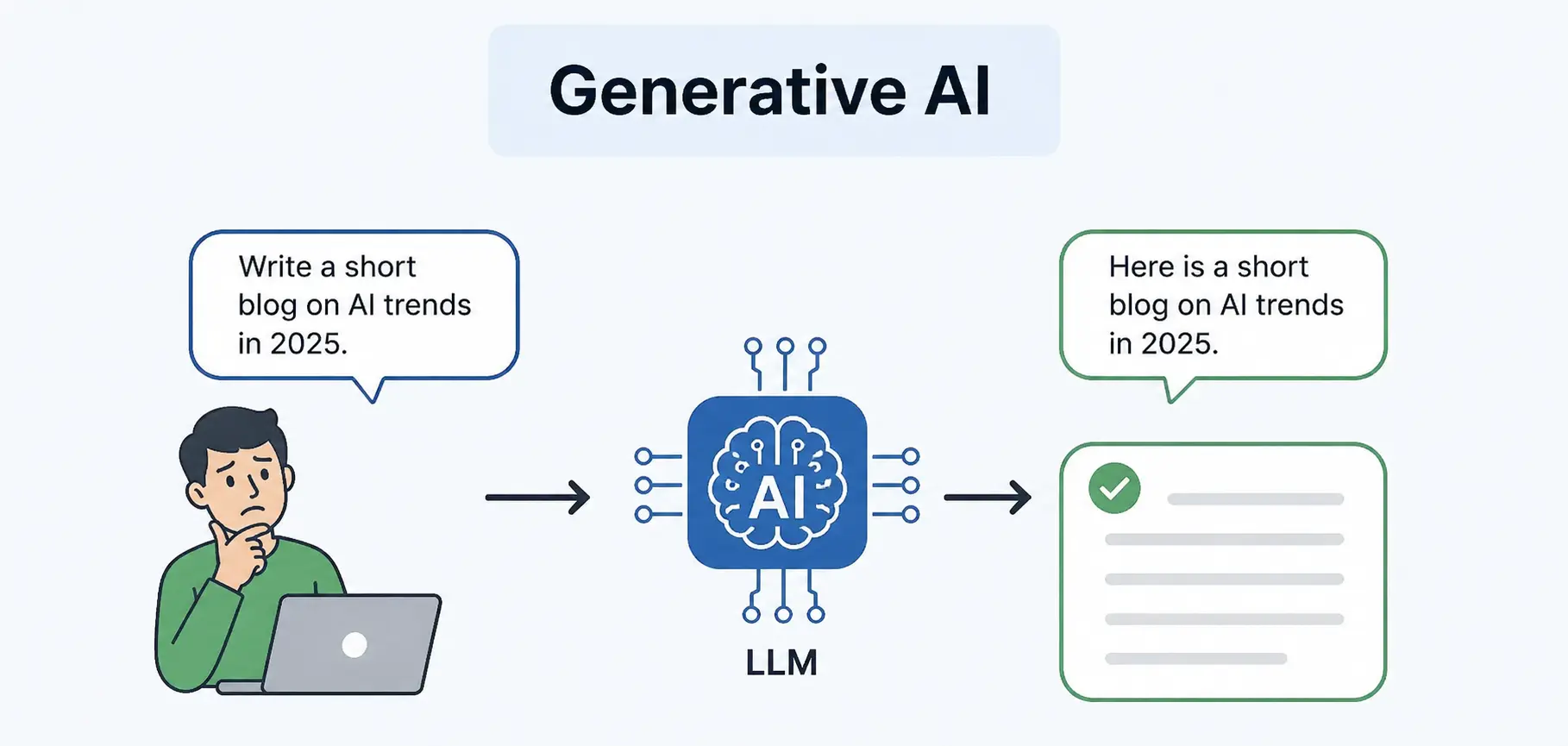
Some popular tools like, ChatGPT, Gemini, Claude, and GitHub Co-Pilot utilize Generative AI capabilities.
The best way to think about generative AI is as an advanced predictive mechanism. It takes a user's prompt as input and utilizes its trained knowledge to provide the most accurate output.
As an example, A programmer can use generative (AI) to develop their own API code while marketers can use generative (AI) to draft emails, brainstorm content ideas, and develop social media posts instantaneously.
Common Uses of Generative AI:
→ Writing Email and content
→ Generate Code for Developers
→ Developing new Images and Designs
→ Summarizing Existing Reports and Other Documents
→ Researching and Brainstorming Ideas
According to IBM, Generative AI mainly focuses on creating new outputs from prompts and training data patterns.
What is Agentic AI?
Agentic AI is the next step in the evolution of artificial intelligence. Unlike Generative AI, which generates content from prompts provided by a user, Agentic AI is a type of artificial intelligence that can autonomously pursue and accomplish an objective with limited human involvement.
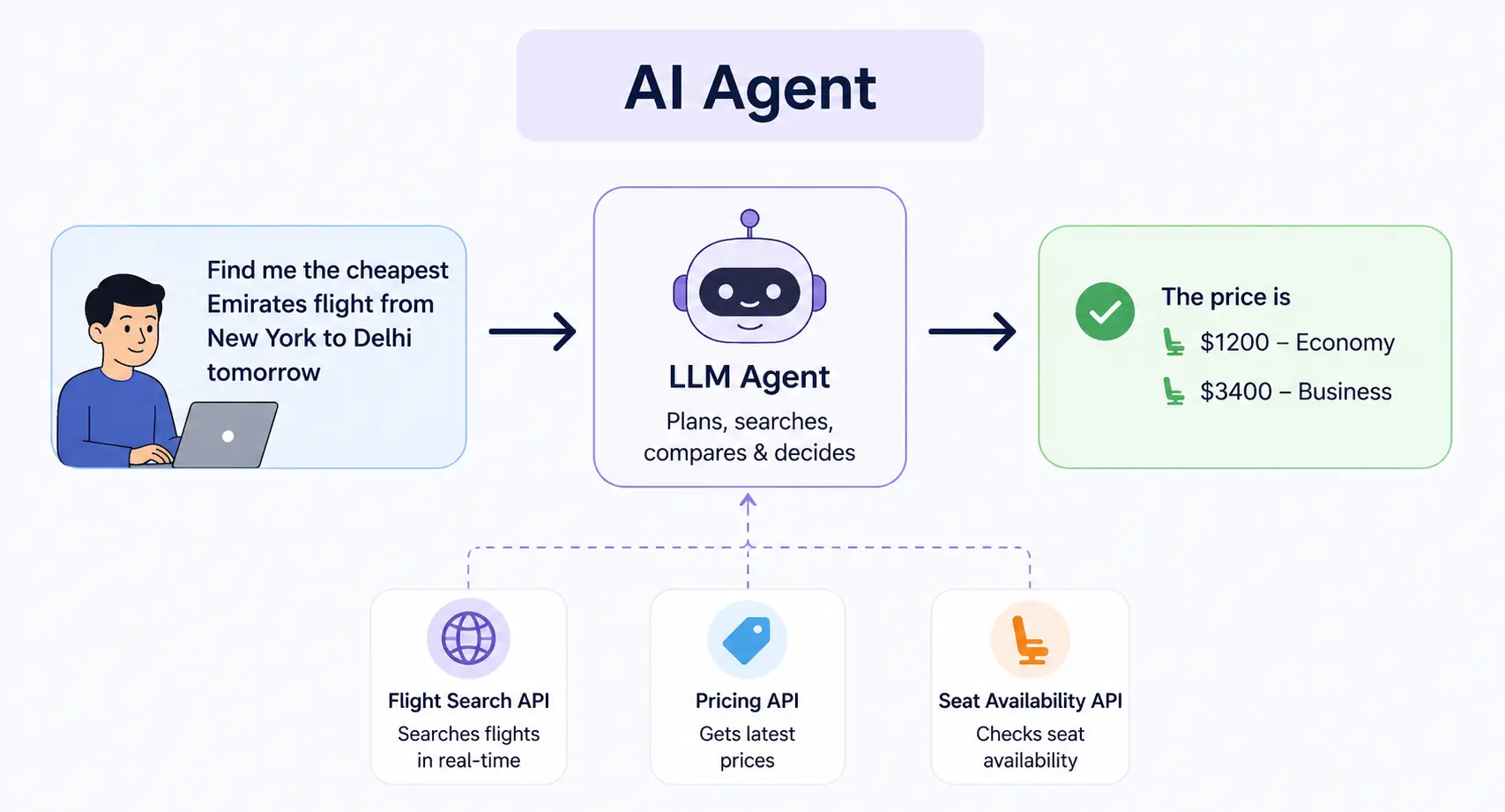
These artificial intelligence systems are capable of planning the tasks that need to be done, making decisions, identifying and solving problems, utilizing the appropriate tools required to complete the tasks, and many other activities/continuing workflows without human assistance. For this reason, Agentic AI is also referred to as "autonomous" artificial intelligence systems.
A simple way of thinking of Agentic AI is like an AI system that can generate answers and take action to achieve a goal.
For example, if a manager asks an AI system to prepare a monthly business report:
→ A Generative AI tool would summarize all of the data and create an initial draft or summarize all of the data in the monthly reports.
→ An Agentic AI tool would collect all of the data needed, assess the business performance to identify trends, prepare graphs/charts, summarize the insights from the performance assessment, and automatically send the report once completed.
The major difference in the above examples is that the Agentic AI Tool completes all of the tasks instead of just generating the content. Therefore, the Agentic AI Tool manages the entire process of preparing and sending out the monthly business report.
Key Capabilities of Agentic AI:
→ Planning & Managing Tasks
→ Decision Making Based on Data
→ Utilization of Tools & External Systems
→ Analyzing Results & Improving Workflow
→ Completion of Tasks with Minimal Human Effort
Agentic AI combines reasoning, planning, memory, and execution abilities to complete tasks independently.
The current demand from many businesses is for AIs that do much more than help with writing or producing content, they want to automate their operations and increase their efficiency through the use of AI.
For professionals in technology, learning about Agentic AI will help to prepare for the future of AI-based intelligent systems and automation of tasks using AI.
Generative AI vs Agentic AI: Key Differences
| Feature | Generative AI | Agentic AI |
|---|---|---|
| Primary Purpose | Creates content and responses | Completes goals autonomously |
| Working Style | Prompt-driven | Goal-driven |
| Human Involvement | High | Lower |
| Task Handling | Usually single-step | Multi-step workflows |
| Decision-Making | Limited | Advanced reasoning |
| Adaptability | Depends on prompts | Adapts based on context |
| Examples | ChatGPT, Copilot | AI agents, autonomous workflow systems |
Real-World Industry Use Cases
Generative AI is now being used across multiple real-world industries, and each of those industries is experiencing the impact of this technology.
Software engineers are using AI tools to help them code more efficiently and avoid duplicative code work. Marketing departments are using AI-created marketing materials and strategies. Customer service departments are using AI chat systems to respond more quickly to customers.
In addition to providing these types of benefits, Agentic AI allows for even greater advance use of AI in the future.
AI agents have been designed to carry out workflow activities such as approving or disapproving of workflows, generating reports from workflows, scheduling workflows and coordinating the work performed within workflows.
AI agents can also provide real-time monitoring for cybersecurity threats and respond to those threats faster than what can be accomplished using manual means and, AI has helped streamline patient scheduling and administrative coordination within healthcare operations.
AI agents are even used by recruitment teams to screen applications, schedule interviews, and manage the flow of candidates through the pipeline.
This shift from using AI to assist with these tasks toward automating the workflows associated with these tasks is significant because it indicates how AI is starting to evolve away from an assistant-type of tool to a workflow automation system.
The Rise of AI-Driven Career Expectations
A strong trend within the tech sector is that employers are now placing more value on workers' ability to adapt than on the knowledge of any one type of tech system.
In the past, you could build a long-term career by building your knowledge in depth of a single programming language. In today's workplace, workers have the expectation of constantly evolving their skills and knowledge so that they can be prepared to work effectively within a constantly changing tech environment.
AI tools can accelerate work, but they still require professionals who understand:
→ system design,
→ software architecture,
→ debugging,
→ workflows,
→ business logic,
→ and scalable problem-solving.
This is why structured mentorship and practical learning ecosystems are becoming increasingly important for career transitions.
Many professionals preparing for product-based roles now prefer to find opportunities to get hands-on and gain practical experience while also completing DSA exercises as well as understanding how to design systems. Platforms like Bosscoder Academy focus heavily on these aspects, which aligns well with the changing expectations of the AI-driven software industry.
Will Generative AI be Replaced by Agentic AI?
No, it won't be. A lot of times, an Agentic AI system uses a Generative AI model as a baseline to provide all necessary outputs.
In other words, Generative AI has always played a big part in the understanding of what an agent can do and how it will help create answers and solve problems.
Agentic AI merely adds additional layers of planning, memory, decision-making and execution on top of the Generative AI model.
Thus, the future for these two technologies will be more about their integration not the replacement of one another.
Generative AI will remain an extremely valuable tool for creativity and content creation.
On the other hand, Agentic AI will focus more and more on the automation of business processes and the execution of workflows.
The combination of the two technologies will significantly help shape the direction of software development, enterprise automation, and digital business operations in the future.
Final Thoughts
The discussion about Generative AI vs Agentic AI summarizes how technology continues to evolve as well.
Through Generative AI technologies, professional users have changed their approach to creating content and using software applications.
With Agentic AI and intelligent systems, the methods in which computer systems execute actions, make decisions and complete tasks without human involvement are being transformed.
Frequently Asked Questions (FAQs)
Q1. What is the main difference between Generative AI and Agentic AI?
While both technologies may be similar in nature and share a common goal of producing content, the key differentiator between them lies in their purpose. Generative AI is used primarily to generate new information or data based on user defined parameters whereas Agentic AI can autonomously generate and manipulate digital assets according to user-defined rules.
Q2. Is Agentic AI replacing Generative AI?
Not necessarily. Although Agentic AI does not replace generative AI, most Agentic systems include Generative AI as an integral component of their design. Agents will utilize generative models as a basis to execute tasks such as planning out how to complete a project or applying logic to decide what tool to use when performing a task.
Q3. Which industries are using Generative AI and Agentic AI?
Companies like Open AI, Google, Microsoft, NVIDIA, and Anthropic are leading innovation in Generative AI and Agentic AI. These top tech companies are building AI models, autonomous agents, workflow automation systems, and enterprise AI solutions used across industries.
Q4. Which skills should professionals learn for AI-driven careers?
Professionals need to develop practical engineering and problem-solving abilities. Examples of such skills include the following: software architecture, system design, debugging, automation/A-I Workflow, and developing scalable applications. These skills are becoming increasingly important as AI adoption grows across the tech industry.