A few years ago, the only way to advance in technology was by learning how to create software applications (coding). But that isn’t the case anymore.
Today, that’s changing.
Instead of developing software, companies want engineers who create the next generation of smart machines (intelligent systems). In particular, companies are looking for engineers who can automate business processes, enhance the quality of search results, and build AI-based solutions.
This shift is why many developers and tech professionals are now asking:
“What’s the best way for me to move into AI without starting at ground zero?”
The good news is you do not have to restart your career from scratch.
To transition into being an AI engineer, however, requires an effective strategy.
This blog will provide you with the information necessary to develop a successful transition plan to become an AI engineer.
A Practical Approach to Start Your AI Career
Don't follow a generic AI learning map. Instead, think of the AI Learning process in three stages:
→ Foundation
→ Specialization
→ Application
Let’s look at each stage in detail below!
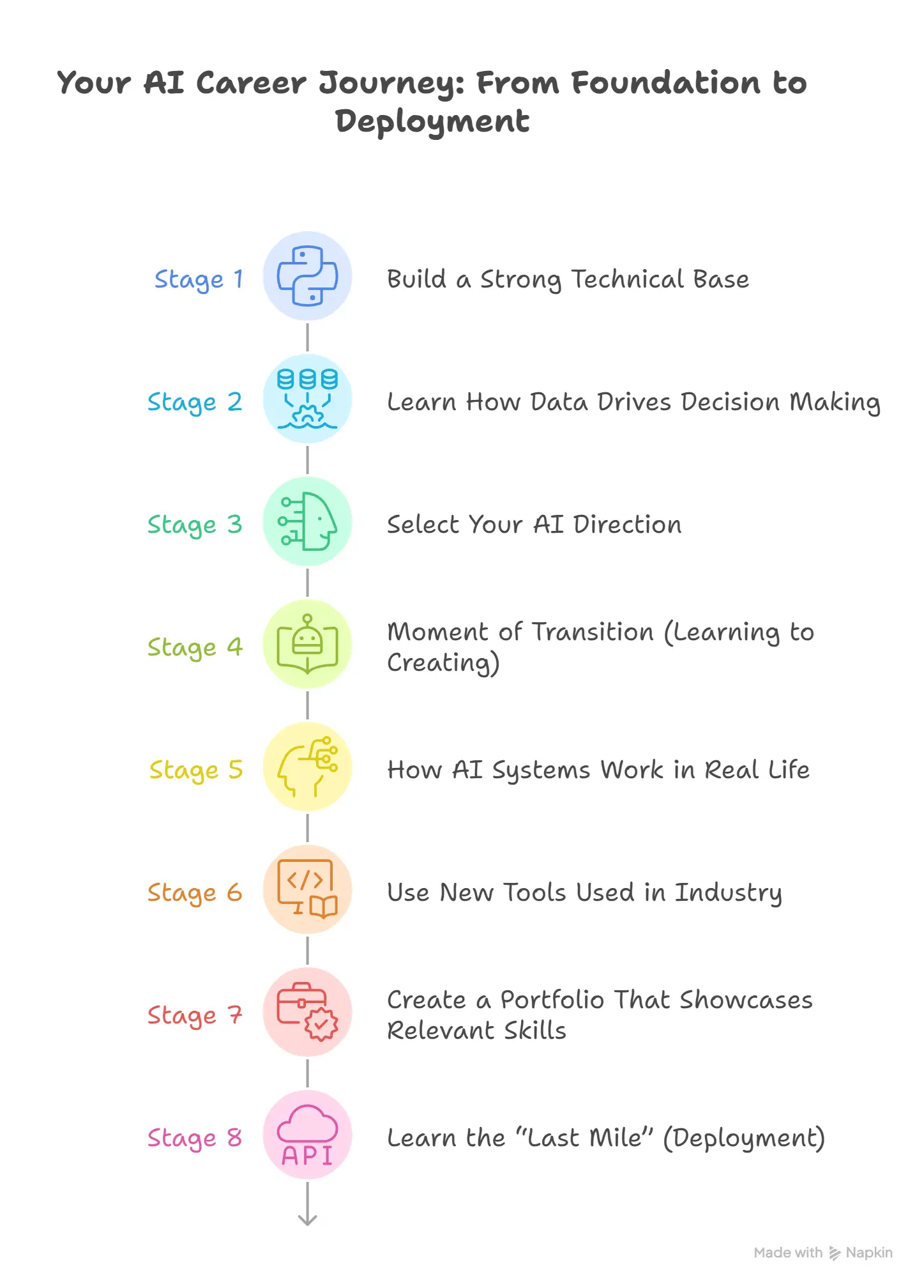
Stage 1: Build a Strong Technical Base
Before you jump into AI Tools, make sure you have a strong base going in.
Focus On:
- Python Programming (and all Core Syntax / Libraries)
- Writing clean, logical code
- Basic Data Handling (lists/arrays/datasets)
💡 Why this matters:AI is not magic → it’s code + data. Strong foundations will allow you to build on everything else later!
Stage 2: Learn How Data Drives Decision Making
AI systems work through data. Begin to understand:
- Data Collection and Cleaning
- Pattern Matching
- Predictions
Instead of memorizing algorithms, think about:
“What problem is this model helping solve?”
This will allow you to think like an engineer rather than just a learner.
Stage 3: Select Your AI Direction
AI is a big field you will not need or want to learn everything about AI.
Decide based on what interests you:
Option 1: As a Machine Learning Engineer, your focus is more on predictive systems, Recommendation Systems. Analytics.
Option 2: As a Generative AI Engineer, you will be building chatbots, co-pilots, etc. using LLMs and AI Agents.
Option 3: If you want to be AI integrating Backend Development, you will use APIs with AI Models to Build Real Product Features.
By establishing your direction early, you can avoid confusion down the road!
Stage 4. Moment of Transition (Learning to Creating)

At this stage, many professionals stop moving forward.
Move from simply learning the “what’s” of things to actually starting to do these things:
Your first builds could be:
– An easy-to-use AI-driven tool
– A chatbot using APIs
– An entry-level automation project
The rule is:
“If you can’t build it, then you don’t really understand what it is.”
Struggling to switch into AI roles? Bosscoder Academy GenAI & ML program is built to help engineers gain real-world AI skills. With guided projects and 1:1 mentorship, the transition becomes much easier.
Stage 5. How AI Systems Work in Real Life
Real-life AI is a lot different to what you see in tutorials. To understand how they work you need to know:
• Input of something (data or a user query)
• Processing of something (model or logic)
• Output of something (result or action)
Once you have that connected in your head, you can then connect it with:
• APIs
• Databases
• Back-end systems
That’s what companies want.
Stage 6. Use New Tools Used in Industry
Now you want to be using tools that companies actually use in a job:
• APIs to LLMs like an OpenAI model
• Frameworks like LangChain
• Model libraries like Hugging Face
Focus on:
• Using those tools to solve problems,
• Instead of learning those tools for the last time.
Stage 7. Create a Portfolio That Showcases Relevant Skills
A portfolio is your best asset. Instead of random projects, create:
• Applications that solve problems
• Systems that work from one end to another
• Tools that support specific use cases
Examples of good portfolios:
• AI Resume Screener
• Chatbot with a Knowledgebase
• Intelligent Search System
One strong project is worth more than 10 weak ones.
Stage 8: Learn the “Last Mile” (Deployment)
This is what separates beginners from professionals. Learn how to:
→ Prepare your project as an API
→ Deploy it to the cloud
→ Make it into a usable product
Top product companies do not hire professionals who are learning with no real projects to show, they hire those who have built products.
Where Most Professionals Go Wrong
1. Many professionals who are trying to learn AI don't succeed.
2. They jump from one topic to another, followed too many tutorials,
3. Haven't built anything yet,
4. Ignore how AI is deployed in a real word applications.
The Answer lies with Clarity and Structure.
How Bosscoder Academy Supports This Transition
Bosscoder Academy has launched its Advanced Generative AI and Machine Learning Engineering program around how AI is actually used in the tech industry and product companies.
Today, companies like Google, Amazon, Microsoft, and Netflix are not just experimenting with AI, they are using it to power real products such as recommendation systems, AI copilots, search engines, and automation tools.
The program is designed around how AI is actually used in industry:
→ Combines ML fundamentals with Generative AI
→ Focuses on building real-world systems
→ Covers tools, frameworks, and deployment
→ Includes 1:1 mentorship and structured learning
Instead of learning in isolation, professionals learn how to build complete AI applications step by step
This approach helps reduce confusion and accelerates career transition.
What Kind of Jobs Can You Get?
Once you develop AI skills, there will be a number of positions available to you:
→ Machine Learning Engineer
→ Generative AI Engineer
→ AI Product Engineer
→ MLOps Engineer
In addition to this, many of these roles are currently expanding exponentially throughout many different industries.
Final Thoughts
Starting a career in artificial intelligence does not equal starting from scratch; it represents augmenting your existing set of technical skills with new knowledge to position yourself for change in the future.
You must focus on three key areas when transitioning into a career in artificial intelligence:
→ A solid foundation of knowledge
→ Practical knowledge
→ Hands-on experience.
Frequently Asked Questions:
Q1. How to start a career in AI as a working professional?
Begin by learning Python and machine learning fundamentals, move on to learn about generative AI, and finally create actual projects to get some hands-on practice.
Q2. Can a software developer switch to AI jobs easily?
It is possible for software developers to transition to AI jobs by learning ML, generative AI, and working on real projects. Prior coding experience will allow for a quicker transition.
Q3. Which AI skills are most in demand in 2026?
The skills that will be in high demand in 2026 include Python, ML, Deep Learning, Generative AI (LLMs), and model deployment skills.
Q4. Do I need projects to get an AI job in India?
Yes, projects are very important. Companies prefer candidates who can build real AI systems over those with only theoretical knowledge.