Every day, we chat on WhatsApp, scroll social media, watch videos, listen to music, and search on Google. All these activities create huge amounts of data.
But here’s something most people don’t realize:
Nearly 80-90% of the data created today is unstructured, meaning it does not sit neatly inside rows and columns like Excel sheets.
This is exactly where Generative AI performs best.
If you’ve used tools like ChatGPT, AI image generators, or voice assistants, you’ve already seen generative AI in action. But to truly understand how generative AI works, you first need to understand what type of data it is most suitable for.
In this blog, we’ll explain everything in simple language, with examples and a clear table so anyone can understand.
What Is Generative AI?
Generative AI is a type of artificial intelligence that can create new content instead of just analyzing data.
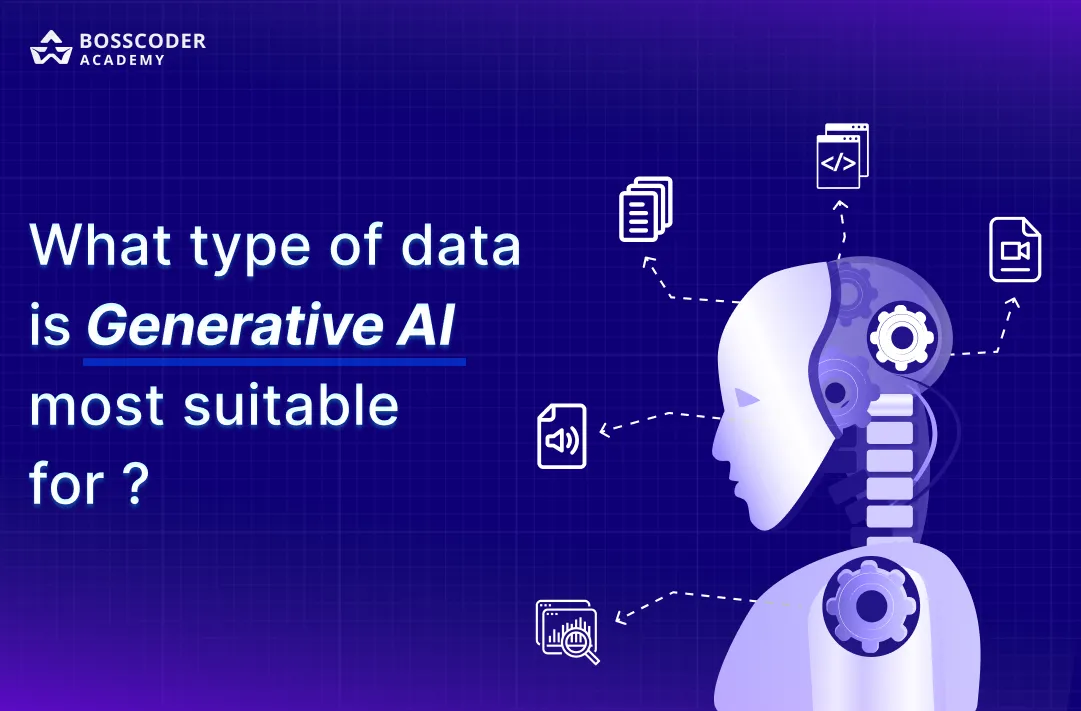
It can generate:
- Text (blogs, emails, code)
- Images (artwork, designs)
- Audio (music, speech)
- Videos (animations, clips)
Generative AI learns patterns from existing data and then uses those patterns to create new and realistic outputs.
Why Data Type Matters in Generative AI
Not all data works the same way for generative AI.
Some data helps AI create meaningful content, while other data is better for calculations or analysis only. If the wrong data type is used, the AI output can be inaccurate or useless.
That’s why choosing the right type of data is extremely important.
Types of Data Generative AI Is Most Suitable For
1. Unstructured Data (Best for Generative AI)
Unstructured data is data that does not follow a fixed format. It doesn’t fit neatly into rows and columns like an Excel sheet. Instead, it looks messy just like real human communication.
This is the most important and suitable type of data for generative AI.
Examples of unstructured data:
- Text: blogs, emails, chats, code files
- Images: photos, designs, screenshots
- Audio: voice messages, music, podcasts
- Video: reels, movies, tutorials
Generative AI models are trained to understand patterns, meaning, and context in this kind of data. That’s why they can write like humans, create images, or talk naturally.
Examples:
- Open AI uses large amounts of text data to train ChatGPT for writing, coding, and conversation.
- Google uses unstructured data (text, images, videos) in products like Google Search and Gemini.
- Meta uses images, videos, and text to train AI for Instagram and Facebook content recommendations.
Because most real-world data is unstructured, this is where generative AI creates the most value.
2. Structured Data (Limited but Useful)
Structured data is well-organized data stored in a fixed format, usually in tables with rows and columns.
Examples of structured data:
- Customer details in a database
- Sales records in Excel
- Bank transaction tables
- Product inventories
Generative AI is not mainly built for structured data, but it can still help in some cases.
Generative AI can:
- Create synthetic (fake but realistic) datasets
- Fill missing values in tables
- Generate sample data for testing systems
Real tech company examples:
- Amazon uses synthetic data to test recommendation and logistics systems.
- Microsoft uses AI-generated structured data for testing enterprise software.
- Netflix uses structured viewing data along with AI models to improve recommendations.
For pure number analysis and reports, traditional machine learning works better but generative AI is helpful for data generation and simulation.
3. Time-Series Data
Time-series data is data that is collected continuously over time. Each data point is connected to the previous one, which helps in understanding trends and patterns.
Common examples include:
- Daily stock prices
- Monthly revenue data
- Website traffic per hour
- Weather reports over years
- Machine sensor readings
Generative AI can learn from time-series data to:
- Detect patterns and seasonality
- Predict future outcomes
- Generate realistic time-based sample data
Real Examples:
- Uber uses time-series data to predict ride demand.
- Google uses it for traffic prediction in Google Maps.
- Tesla uses sensor-based time-series data to improve vehicle performance.
Generative AI is especially useful when businesses want to simulate future scenarios, not just predict numbers.

4. Multimodal Data (Advanced and Powerful)
Multimodal data means using more than one type of data together such as text, images, audio, or video to train a single AI model.
Examples of multimodal data:
- Text + image (image generation from prompts)
- Text + audio (voice assistants)
- Text + video (AI video creation)
Generative AI models trained on multimodal data can produce richer and more intelligent outputs.
Examples:
- Google uses multimodal AI in Gemini to understand text, images, and code together.
- Open AI builds models that work across text and images.
- Adobe uses multimodal AI in creative tools like Photoshop and Firefly.
Multimodal generative AI is the future which powers advanced tools used in design, education, and content creation.
Best Data Types for Generative AI
| Data Type | Examples | How Generative AI Uses It |
|---|---|---|
| Unstructured Data | Text, images, audio, video | Writing text, creating images, converting text into voice |
| Structured Data | Tables, databases | AI created data, test records, sample records |
| Time-Series Data | Stock prices, logs | Trend prediction, forecasting |
| Multimodal Data | Text + image + audio | Advanced AI tools, creating text, images, and voice together |
Why Unstructured Data Is the Most Important
Unstructured data is the most valuable type of data for generative AI because it looks just like how humans communicate in real life.
Here’s why generative AI works so well with unstructured data:
- People naturally communicate using text, images, voice, and videos, not tables
- This data has meaning, emotion, and context, which helps AI understand better
- It gives AI the freedom to create new content, not just repeat information
- It helps build AI tools that feel natural and human-like to users
That’s why most modern AI tools today are built using text, images, voice, and video data.
Real-World Uses of Generative AI Based on Data Type
Generative AI is already part of many everyday tools we use. Its use depends on the type of data it works with.
- Text data: Writing blogs, emails, ads, and code
- Image data: Creating images, designs, and illustrations
- Audio data: Powering AI voice assistants and text-to-speech tools
- Video data: Creating videos, animations, and visual effects
- Time-series data: Finding patterns and predicting future trends
All these real-world uses work well only when the right type of data is used.
Learn Generative AI the Right Way with Bosscoder Academy
At Bosscoder Academy, learning goes beyond theory. Whether you are a student, a working professional, or planning a career switch, you learn how Generative AI, Data Science, Data Engineer and Full-Stack Development are actually used in real tech companies.
The programs are designed to fit both beginners and professionals, with a strong focus on practical skills.
What You Get at Bosscoder Academy
- Industry-focused curriculum aligned with current tech roles
- Hands-on projects based on real world use cases
- 1:1 mentorship from top tech professionals from PBCs
- Career guidance for interviews, role transitions, and growth
Bosscoder Academy helps you build practical, job-ready skills that matter whether you’re upgrading your current role or preparing for your next big move.
👉 If your goal is to grow in AI or software development with confidence, Bosscoder Academy is a strong place to start.
Final Thoughts
Generative AI is most suitable for unstructured data, such as text, images, audio, and video. While it can also work with structured and time-series data, its true strength lies in creating content that feels natural, creative, and human-like.
Understanding data types is the foundation of working with generative AI whether you are a student, developer, or career switcher.
Frequently Asked Questions (FAQs)
Q1. What type of data is generative AI best suited for?
Generative AI works best with unstructured data, such as text, images, audio, and video. This type of data closely matches how humans communicate, which allows AI to create realistic content like written text, images, voice, and videos.
Q2. Can generative AI work with structured data like tables?
Yes, generative AI can work with structured data, but it is not its main strength. It is mostly used to create AI-generated sample data or fill missing values. For pure data analysis, traditional machine learning models usually perform better.
Q3. Why is unstructured data so important for generative AI?
Unstructured data is important because it contains context, meaning, and patterns found in real human communication. This helps generative AI understand language, visuals, and sounds more naturally, leading to better and more human-like results.
Q4. Do I need to learn data science to work with generative AI?
You don’t need to be a data science expert to start with generative AI. However, understanding basic data types, unstructured data, and how AI models learn from data can greatly improve your skills. Many professionals learn these concepts through structured programs and hands-on projects.