Introduction
Artificial intelligence (AI) is turning out to be a crucial skill for software developers, data analysts, and even people who wish to enter tech jobs that come with good pay. The development of intelligent models requires AI to represent knowledge in a certain manner.
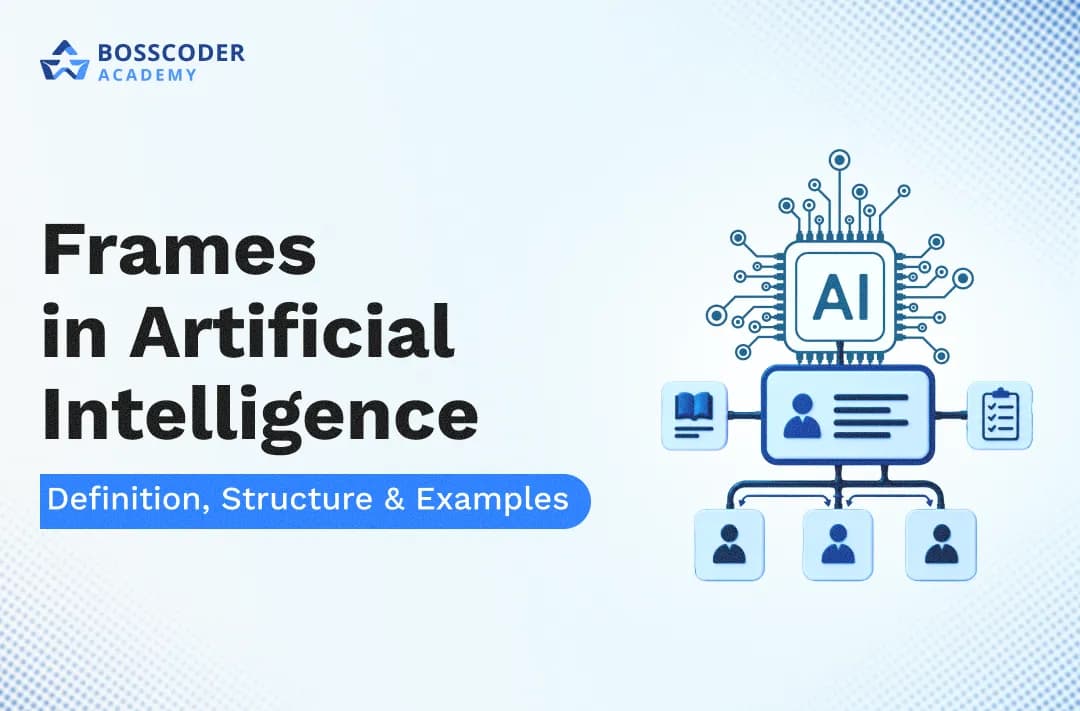
The concept of frames happens to be one of the most crucial in AI knowledge representation. It assists AI in representing knowledge regarding objects, individuals, events, and places in a well-organized manner. In addition, they assist in inheritance of information, thus increasing the efficiency of reasoning process in AI models.
Whether you are preparing for AI interviews or just want to know the basics of artificial intelligence, frames are something you should consider knowing.
This blog will help you learn everything there is to know about frames in AI.
What are Frames in AI?
Frames in AI are knowledge representation tools used to represent knowledge in a systematic way concerning an object, concept, or situation.
A frame is like a template which contains:
- Attributes (properties)
- Values
- Relationships
- Default values
- Rules (optional)
The frame may be regarded as a profile that contains all the knowledge AI has concerning a particular object.
Simple definition of Frames
Frame is a data structure used in representing knowledge representing an object or concept through attributes and their values.
Uses of Frames in AI
Frames help in:
- Organized storage of knowledge
- Representing real-life objects
- Information reuse by inheritance
- Fast reasoning
- Avoidance of duplicate information
Thus, they are used in expert systems, chatbots, recommendation systems, and intelligent assistants.
Structure of a Frame
A frame consists of slots and values for the slots.
| Component | Description |
|---|---|
| Frame Name | Name of the object/idea |
| Slots | Attributes or properties |
| Values | Information stored in each slot |
| Default Values | Default value in absence of value |
| Inheritance | Inherits properties from parent frames |
Example of Simple Frame
Frame: Car
| Slot | Value |
|---|---|
| Wheels | 4 |
| Fuel | Petrol/Electric |
| Doors | 4 |
| Engine | Present |
| Moves | Yes |
Here, all cars have similar properties in one frame.
Example of Frames in AI
Let us assume that AI is maintaining data about an employee.
Frame Parent: Person
| Slot | Value |
|---|---|
| Has Name | Yes |
| Has Age | Yes |
| Can Walk | Yes |
Frame Child: Software Engineer
| Slot | Value |
|---|---|
| Profession | Software Engineer |
| Program Language | Java, Python |
| Work Area | Software Development |
In this example, the frame “Software Engineer” will inherit everything from the “Person” frame.
This is referred to as inheritance and is the biggest strength of frames.
Working of Frames
Frames store data in a hierarchy as follows:
 Living Being
    │
 Person
    │
 Software Engineer
The process eliminates the need to duplicate common information within each frame by inheriting information from parent frames.
This makes efficient use of memory space.

Example of Real Life Application of Frames
Consider the case where an AI assistant gets the following sentence,
“Rahul is driving a car.”
Person Frame
- Name → Rahul
- Activity → Driving
Car Frame
- Wheels → 4
- Engine → Yes
- Fuel → Petrol
This allows AI to deduce that Rahul is driving a car.
Features of Frame in AI
Some major features of frames include:
- Structured Representation of Knowledge
- Information in Objects form
- Supports Inheritance
- Default Values
- Easy Information Update
- Relationship between Objects represented
These features make frames a useful tool for representing real-life knowledge.
Advantages of Frame in AI
There are many advantages of using frames in AI.
Ease in Organizing Knowledge
Information is kept in a structured manner.
Inheritance Support
Properties of parent frames can be inherited by child frames.
Avoidance of Redundancy
Common information is stored once.
Quicker Decision Making
Related information is easily accessed by AI.
Easier Maintenance
Information can be added and updated conveniently.
Disadvantages of Frame in AI
While there are many benefits of using frames, some problems associated with frames are also worth mentioning.
- Very complex knowledge is difficult to represent
- Difficult to maintain large system
- Not appropriate for uncertain or probabilistic knowledge
- Requires careful frame design
- Applications of Frames in AI
Applications of Frames in AI
Frame technology finds use in various applications of AI.
- Expert Systems
- Intelligent Tutoring System
- Chatbots
- Virtual Assistant
- Knowledge-Based Systems
- Natural Language Processing (NLP)
- Medical Diagnosis System
If you're planning to become an AI engineer, understanding concepts like frames is just one step. Explore our complete AI Engineer Roadmap to learn what to study next.
Difference between Frames and Semantic Network
| Feature | Frames | Semantic Network |
|---|---|---|
| Structure | Slot-based | Graph-based |
| Attributes Stored | Yes | Less |
| Supports Inheritanc | Yes | Yes |
| Easy to Modify | Yes | Moderate |
| Useful For | Object representation | Relationship representation |
Learn AI The Right Way
By understanding the various concepts such as AI concepts, knowledge representation, machine learning basics, etc., one can gain a lot of experience for AI and software engineering interviews.
When it comes to gaining knowledge for upskilling or to switching product-based companies, the right balance of theoretical as well as practical knowledge is very helpful. At Bosscoder Academy, learners receive structured learning paths, hands-on projects, 1:1 mentorship from experienced engineers, and interview preparation designed for real-world roles. This combination helps professionals build job-ready AI and software development skills.
Looking for a structured learning path? Explore our guide to the Top AI & ML Course for Professionals and choose the right program for your career goals.
Conclusion
The frames technique of knowledge representation is one of the fundamental methods in Artificial Intelligence. The frames organize knowledge with slots and values, provide the ability to inherit, and allow representing the world knowledge efficiently for AI.
Despite the fact that the modern AI heavily relies on machine learning and deep learning, it is still essential to understand such concepts for gaining insights in AI and developing your knowledge.
Frequently Asked Questions (FAQs)
Q1. What are frames in AI?
Frames are data structures which allow to represent knowledge about objects via slots and their values.
Q2. What is inheritance in frames?
The concept of inheritance allows a child frame to inherit properties of a parent frame.
Q3. Where are frames used?
Frames are often used in expert systems, NLP, chatbots, recommendation systems, and knowledge-based AI systems.
Q4. What is the difference between frames and semantic networks?
While frames concentrate on object representation via slots, semantic networks emphasize relations between concepts.