For students interested in engineering, AI, technology or startups, entrepreneurship does not have to begin after college.
Starting early can help students understand how real products are created: finding a problem, thinking about users, building a solution, testing it and explaining what they have created.
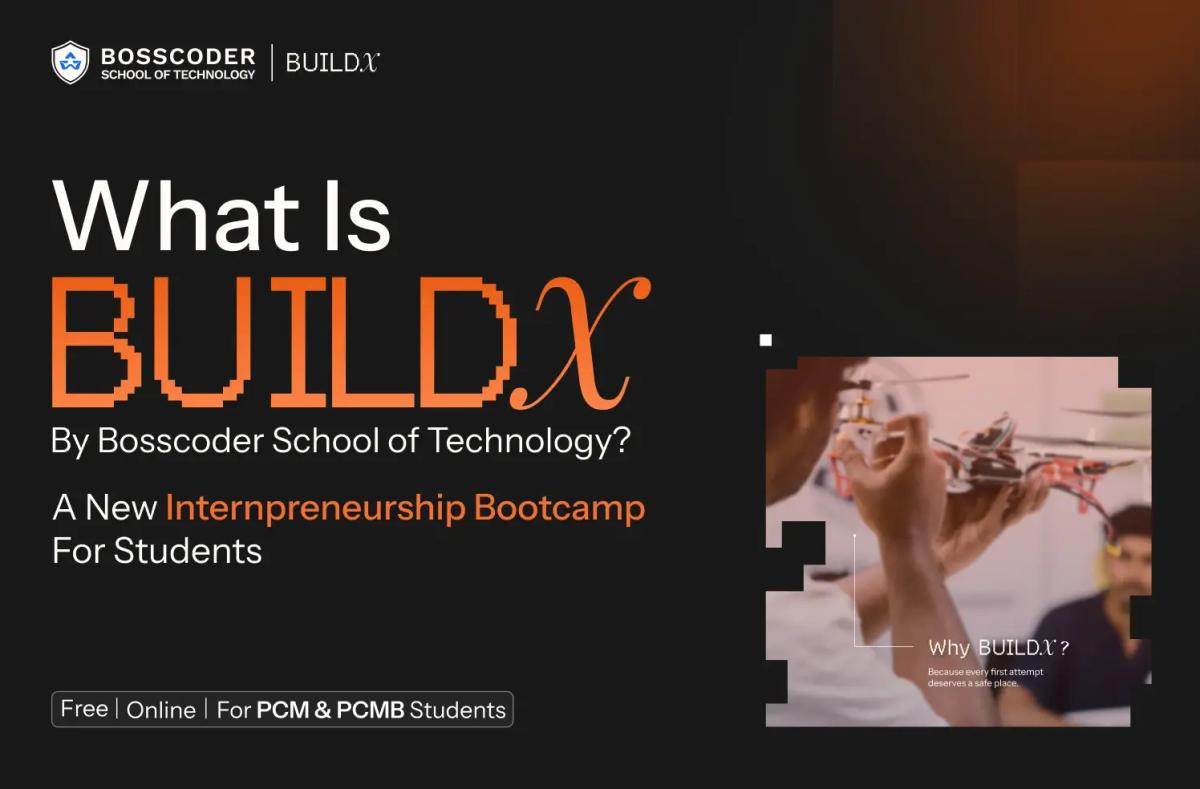
This is the idea behind BuildX by Bosscoder School of Technology. BuildX is a 5-week online Internpreneurship Bootcamp with 10 live online classes, designed for Class 12 students, droppers and 2027 engineering aspirants.
The program combines the hands-on exposure of an internship with the ownership mindset of entrepreneurship. Instead of only learning about AI, products and startups, students are expected to build, test, publish and pitch something real.
What Are Entrepreneurship Programs for Students?
Entrepreneurship programs for students are structured learning experiences that introduce young learners to problem-solving, product building and entrepreneurial thinking.
A practical program can help students explore:
- Problem discovery
- Critical thinking
- Product and MVP thinking
- AI and technology tools
- User testing
- Feedback and iteration
- Execution planning
- Pitching and storytelling
BuildX connects these skills through five stages:
IDEATE → BUILD → VALIDATE → EXECUTE → PITCH.
Why Should Future Engineers Start Building Early?
Engineering is not only about learning technical concepts. It is also about understanding problems and creating useful solutions.
For students preparing for engineering college, knowing where to start can be difficult. BuildX gives them a structured way to explore that process before college.
The program is designed for:
- Class 12 students exploring engineering pathways
- Droppers looking for experiences beyond exam preparation
- Future engineers interested in AI, coding, apps, startups or problem-solving
The program is intended for students expected to take admission into engineering colleges in 2027.
How BuildX Works as a Student Entrepreneurship Program
1. IDEATE: Start With the Problem
BuildX begins with a simple question:
What problem is worth solving?
Students work on problem discovery, critical thinking, first-principles thinking and problem statements. The goal is to understand the problem before jumping into a solution.
The output is a Problem & Opportunity Brief.
It helps students understand one of the key entrepreneurial skills: understand the problem first, then build.
2. BUILD: Turn the Idea Into an MVP
Once the problem is clear, students move into the BUILD stage.
They explore:
- Solution design
- MVP thinking
- Product design
- GenAI tools
- No-code tools
The goal is to create a functional MVP or prototype.
Students therefore get to experience what it feels like to turn an idea into something they can actually demonstrate.
3. VALIDATE: Learn From Real Users
A product is not finished just because the first version works.
Students learn about user testing, interviews, feedback analysis and iteration. They use feedback from real people to improve their product.
The planned output is a Validation Report and improved MVP.
This gives students practical exposure to an important part of product development: listening to users and improving based on what they learn.
4. EXECUTE: Take the Product Further
The EXECUTE stage focuses on what happens after building the MVP.
Students work on:
- Execution strategy
- Prioritisation
- Launch thinking
- Distribution
- Storytelling
- Public project sharing
The output is a Launch/Execution Pack and public demo.
BuildX also encourages students to turn their work into public proof through LinkedIn, YouTube and portfolio artifacts.
5. PITCH: Explain What You Built
The final stage is PITCH.
Students work on pitch decks, business models, startup economics and investor thinking before presenting their work at Demo Day.
Demo Day includes live demos, three-minute pitches, mentor questions, audience feedback, awards and reflection.
For future engineers, this provides practice in explaining what they built, who it helps and why it matters.
What Do Students Build in BuildX?
Instead of completing unrelated classroom exercises, students carry one primary project through the five-week journey.
| Stage | Main Output |
|---|---|
| IDEATE | Problem & Opportunity Brief |
| BUILD | Functional MVP |
| VALIDATE | Validation Report + Improved MVP |
| EXECUTE | Launch / Execution Pack |
| PITCH | Final Pitch + Portfolio |
This gives students a clear journey from problem → product → feedback → execution → pitch.
Want to explore the full BuildX journey? Read What Is BuildX? Bosscoder's Internpreneurship Bootcamp to learn how the program works.
What Do Students Get After Completing BuildX?
Building a product is only one part of the BuildX experience. Students can also get practical outcomes that help them showcase their work and continue exploring technology and entrepreneurship.
These include:
- Certificate of Completion
- Letter of Recommendation
- Portfolio + Public Proof of their product and pitch
- Feedback from Mentors during the process
- Paid Internship Opportunity for top performers
- Potential Seed Funding Opportunity for genuinely strong products
This means students leave BuildX with more than just a project. They will have proof of work done and the opportunity to move forward with their ideas.
Can Beginners Join BuildX?
BuildX's entrepreneurship bootcamp for students is designed for students with different starting skill levels.
The program document states that projects should feel exciting and real without requiring prior coding expertise. It also follows an AI-native approach where GenAI tools can help accelerate building while students still learn to think, verify and improve.
The registration framework includes students at no-code, beginner coding and intermediate coding levels.
So the focus is not simply on how much coding a student already knows. It is on learning through building.
What Makes BuildX Different?
BuildX is not designed as a traditional introductory business course.
Its proposed differentiator is the combination of:
Technology + Product Thinking + Entrepreneurship + Public Proof of Work
Students carry one project through the complete journey, while major concepts lead to an action, artifact or decision.
The mentor model also focuses on project guidance. Mentors are expected to ask, challenge, demonstrate, let students try, review and suggest the next step.
Frequently Asked Questions on Entrepreneurship Programs
Q1. What are the best entrepreneurship programs for students in India?
The most effective entrepreneurship courses for students should focus on practical problem solving, product making, user testing, and pitching, instead of purely theoretical approaches to business. This approach is followed by BuildX, which operates using IDEATE→ BUILD→ VALIDATE→ EXECUTE→ PITCH framework.
Q2. Is there an entrepreneurship program for Class 12 students?
Yes, BuildX is specially created for Class 12 students, dropouts, and future engineering aspirants of 2027. 5 weeks online course allows students to engage in problem solving, AI-assisted product building, validation and pitching before entering into college.
Q3. Do students need coding experience to join an entrepreneurship program?
Not necessarily. BuildX is designed so that projects do not require prior coding expertise. The program considers students at no-code, beginner coding and intermediate coding levels and uses GenAI and no-code tools to support the building process.
Q4. What can students build in an entrepreneurship bootcamp?
In BuildX, students go through five phases in their project: IDEATE, BUILD, VALIDATE, EXECUTE AND PITCH. They will work on a problem statement, functional MVP, validation report, execution plan, and finally pitch/ portfolio.