Page replacement in OS would definitely be a topic you have studied while preparing for software engineering interviews. This is one of the most frequent topics asked during the interviews conducted by product-based companies as this topic checks your knowledge of memory management and the performance of systems.
Regardless of whether you are a student trying to understand operating systems or a professional who wants to switch jobs, knowledge about page replacement algorithms will surely help you answer interview questions easily.
In this blog post, we are going to discuss page replacement, its need, some popular page replacement algorithms, and how page replacement interview questions are asked by interviewers.
Page Replacement in Operating System
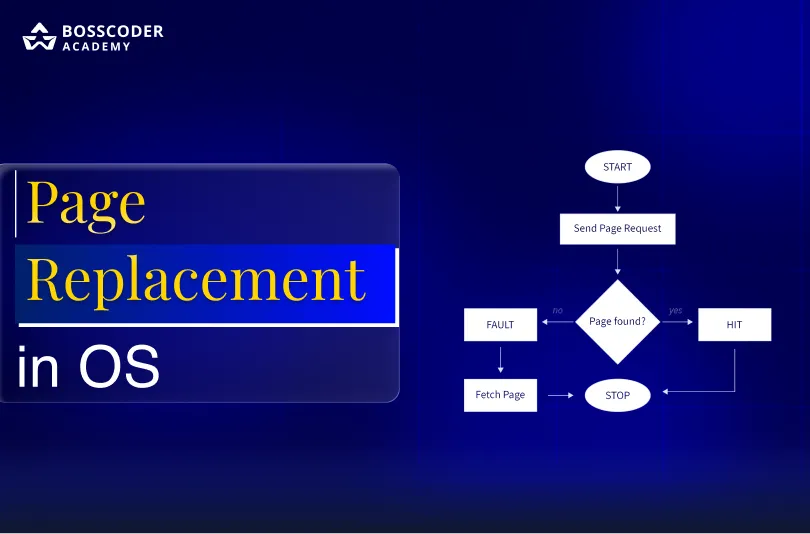
Page Replacement is a memory management scheme used by the operating system when there is no physical memory available in the computer.
If a particular process requests a new page to be placed in memory which does not exist in the memory yet, then the operating system will have to find out which of the already existing pages should be replaced to allocate space to the new page.
This is done through a Page Replacement Algorithm.
Example:
Think of a bookshelf which can accommodate only 3 books.
You want to place a fourth book on the bookshelf.
You will first have to remove a book from the shelf before adding the fourth one.
Why is Page Replacement Needed?
In modern software applications, the amount of memory required exceeds the amount of physical memory.
Rather than allocating the entire application to memory, only the necessary pages are allocated to the memory by the operating system.
When the RAM is full:
→ A new page is required.
→ No free frame exists.
→ The operating system frees a previously allocated page.
→ The required page is allocated to memory.
This helps to make efficient usage of the memory space while running different applications simultaneously.
What is a Page Fault?
Page fault is said to occur when the requested page by the CPU is not present in the memory.
When it occurs:
- The operating system verifies the existence of the requested page in the secondary storage.
- If the RAM is full, a page is selected for removal.
- The required page is allocated to memory.
- Execution resumes.
Page fault reduction is the main objective of page replacement policies.
Types of Page Replacement Algorithms
There are different algorithms that determine which page should be replaced from memory.
Some of the most popular include:
→ FIFO (First In First Out)
→ LRU (Least Recently Used)
→ Optimal Page Replacement
→ Clock (Second Chance) Algorithm
Now let us learn about them.
1. FIFO (First In First Out)
In FIFO, the page that entered memory first gets replaced. It functions similar to the queue algorithm.
Example
Memory Frames:
123A new page 4 is inserted into memory.
Since 1 entered memory first, it gets replaced using the FIFO algorithm.
Now the new memory looks like this:
2 3 4Advantages:
→ Easy to implement
→ Minimal overhead cost
→ Uses queue algorithm
Disadvantages:
→ Can replace pages that are often accessed
→ Results in page faults
→ Doesn't consider past usage of the page
2. LRU (Least Recently Used)
LRU replaces the page that has not been used for the longest time.
The assumption is that the most recently used pages have higher chances of being used again.
Example
Most recently used pages order:
2 → 3 → 1Page 2 is the least recently used page.
If page 4 comes, LRU removes page 2.
Advantages:
→ More efficient compared to FIFO
→ Fewer page replacements
→ Frequently tested in interviews
Disadvantages:
→ More difficult implementation
→ Need to track the usage of pages
3. Optimal Page Replacement
Optimal Page Replacement removes the page that won’t be used for the longest time in the future.
It results in the least number of page faults possible.
Advantages:
→ Highest efficiency
→ Benchmark for comparison against other page replacement algorithms
Disadvantages:
→ Can’t be implemented perfectly in a real OS since it’s impossible to know future memory references
4. Clock (Second Chance) Algorithm
The Clock algorithm is an enhanced algorithm based on the FIFO method.
Instead of replacing the page directly, the reference bit is checked first.
- When the bit is 0, the page is replaced.
- But if it is set to 1, the page gets a second chance.
It is easier to implement and more effective than FIFO.
Advantages:
→ More efficient than FIFO
→ Used widely in practical applications
→ Best suited for larger systems
Disadvantages:
→ A little harder than FIFO
→ May remove useful pages in certain cases
Page Replacement Algorithms Comparison Chart
| Algorithm | Easy to Implement | Performance | Practical Use |
|---|---|---|---|
| FIFO | Very Easy | Moderate | For educational purpose |
| LRU | Moderate | High | Common interview question |
| Optimal | Difficult | Best | Theoretical comparison |
| Clock | Moderate | High | Practical operating systems |
Applications of Page Replacement
Page replacement algorithms are widely used in:
→ Operating Systems
→ Virtual Memory System
→ Cloud Computing
→ Databases
→ Mobile Operating Systems
→ Virtual Machines
→ Highly Scalable Servers
A good page replacement technique will help increase efficiency of applications and increase efficient memory usage.
Interview Questions on Page Replacement
Some of the questions that you should prepare for during software engineering interview include:
- What do you mean by page replacement in an operating system?
- What is a page fault?
- What is FIFO page replacement? Give an example.
- Why is LRU better than FIFO?
- Why does Optimal Page Replacement not find use in any OS?
- What do you mean by Belady's Anomaly?
- What is a Clock (or Second Chance) Page Replacement Algorithm?
- What is the page replacement algorithm used in modern operating systems?
Knowing about these topics can help increase chances of success in interview process.
Why Software Engineers Should Learn Page Replacement
Operating Systems is still one of the major Computer Science topics to be prepared for in technical interviews.
The companies that hire Software Engineers usually test their knowledge of such concepts as:
→ Memory Management
→ Virtual Memory
→ Paging
→ Segmentation in OS
→ Deadlocks
→ Process Scheduling
→ Page Replacement Algorithms
Knowledge of the above concepts will not only help you pass the interview but also give you a deeper insight into how software works with hardware.
Learn Operating Systems the Right Way with Bosscoder Academy
Many learners spend hours watching videos randomly but find themselves unable to respond to interview questions due to lack of a proper knowledge base.
At Bosscoder Academy, Operating Systems is taught as part of a structured Software Engineering curriculum designed for aspiring and working software engineers. In addition to Operating Systems, you will learn Data Structures & Algorithms, Computer Networks, DBMS, System Design, OOPs, SQL, AI programming, and Interview Preparation Strategies.
In case you wish to transition to product based companies, you can benefit immensely from this well structured curriculum for Computer Science fundamentals along with AI skills.
Conclusion
Page Replacement In Operating System is one of the important fundamentals of memory management that should be known by every software developer.
Study of different algorithms such as FIFO, LRU, Optimal, and Clock gives a good insight into how the OS manages memory without causing any page faults.
If you are preparing yourself for interviews, then it is not enough to learn these algorithms but also get to know about the reason behind them, places where they are applied, and what are the pros and cons of using them.
Frequently Asked Questions About Page Replacement in OS
Q1. What is page replacement in an operating system?
Page replacement refers to a method of memory management applied when the physical memory (RAM) is full. In this case, the operating system replaces an existing page in memory with a new one by applying algorithms like FIFO, LRU, Optimal, or Clock. The main goal is to minimize the number of page faults.
Q2. Which page replacement algorithm is the best?
It should be noted that there is no universal algorithm for all situations.
→ The Optimal Page Replacement produces the lowest number of page faults; however, this algorithm is not practical since the computer cannot predict what pages will be accessed in the future.
→ The LRU algorithm is the most popular one, since it performs well and provides nearly the same result as the optimal one.
→ Clock (Second Chance) is often utilized in contemporary operating systems.
Q3. Why is page replacement important for software engineering interviews?
One of the most common Operating System questions in product-based company interviews relates to page replacement algorithms. It could be about explaining various types of algorithms such as FIFO, LRU, and Optimal, or calculating page faults, among others.
Q4. What is the best way to learn OS concepts for interviews?
The best way would be to learn the concepts rather than to learn the definitions of the terms. One should start learning concepts such as Paging, Segmentation, Page Replacement, Process Scheduling, Deadlocks, and Memory Management.
In Bosscoder Academy, OS concepts are learned alongside other concepts such as Data Structures & Algorithms, DBMS, Computer Networks, System Design, SQL, and many more that are associated with AI-powered software engineering interviews and job roles.