Every year, over 12 lakh students compete in JEE Main for a limited number of seats in top engineering colleges of India. If you’re aiming for JEE Main 2026, knowing the right dates, eligibility, syllabus, and strategy early can make all the difference.
Joint Entrance Examination Main also known as JEE Main is a highly competitive engineering entry test in India. Organized by the National Testing Agency (NTA), JEE Main is the selection criterion in the admission to the B.E./B.Tech, B.Arch and B.Planning programmes in the NITs, IIITs, GFTIs and is the qualifying test in JEE Advanced, which is the entry point of the IITs.
With the upcoming academic session 2026, students are eager to learn more about information regarding application forms, examination dates, syllabus, and eligibility criteria. All this and much more has been discussed in this detailed blog.
Important JEE Main Dates (2026)
Staying aware of the official JEE Main timeline is crucial, as missing any deadline can directly affect your chances of appearing for the exam.
Here’s a tentative schedule for JEE Main 2026, based on previous years’ trends:
| Event | Session 1 | Session 2 |
|---|---|---|
| Online Application | Oct 31th to November 27th, 2025 | Last week of January 2026 to February (tentative) |
| Last Date to Apply | 27th November 2025 (9:00 PM) | 1st week of March 2026 |
| Last Date for Fee Payment | 27th November 2025 (11:50 PM) | 1st week of March 2026 |
| Image Correction Window | 1st - 2nd week of December 2025 | 1st - 2nd week of March 2026 |
| Advance City Intimation Slip | 1st week of January 2026 | 3rd week of March 2026 |
| Admit Card Release | 3rd week of January 2026 (3-4 days before exam) | 3 days before exam date |
| JEE Main Exam Dates | 21st - 30th January 2026 | 2nd - 9th April 2026 |
| Answer Key / Exam Analysis | January - February 2026 | April 2026 |
| Official Answer Key Release | 1st week of February 2026 | 2nd week of April 2026 |
| Result Declaration | By 12 February 2026 | By 20 April 2026 |
| Counselling Begins | May - June 2026 | May - June 2026 |
Note: The above dates are tentative and based on previous year trends. Official dates will be confirmed by NTA
With the timeline clear, the next step is understanding how to apply correctly for JEE Main 2026.
JEE Main 2026 Application Form
The application process is completely online, and candidates must fill the form carefully to avoid errors that may cause rejection later.
Application Dates
- Session 1: October 31, 2025 – November 27, 2025
- Session 2: Registration expected to open in the last week of January 2026
How to Apply Online
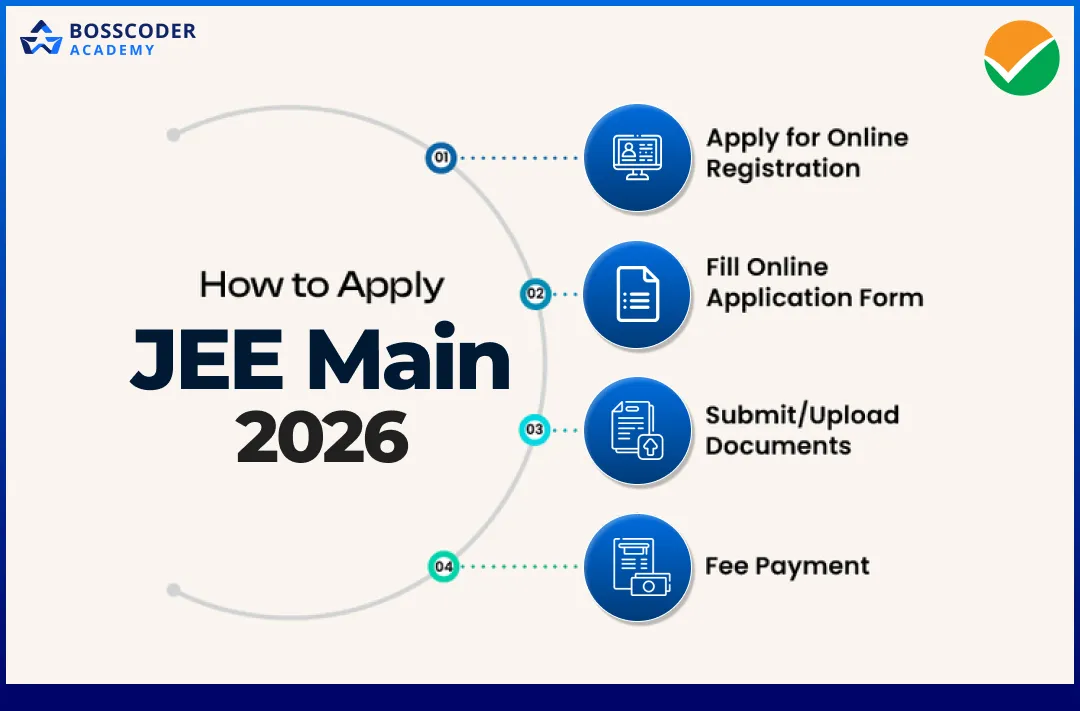
Students must apply using the official NTA JEE Main portal: https://jeemain.nta.nic.in/
Steps to complete the application:
- Registration: Enter basic personal details (name, email, mobile)
- Filling the Form: Provide academic information, exam session preference.
- Uploading Documents:
- Scanned passport-size photograph
- Signature
- Class 12 or equivalent certificates
- Fee Payment: Pay the required fee online to confirm registration.
Tip: Keep all documents ready (Aadhaar, UDID for PwD category, certificates) before starting the form to avoid last-minute rush.
Eligibility Criteria for JEE Main 2026
To apply for JEE MAIN 2026, candidates must satisfy the following requirements:
Here is what is needed to be eligible to appear for JEE Main.
- Academic Qualifications
- Candidates must have passed (Class 12 or equivalent) in 2024, 2025 or appearing in 2026 from a recognized board.
- For B.E./B.Tech, subjects must include:
- Physics
- Mathematics
- One of Chemistry/ Biology/ Biotechnology/ Technical Vocational Subjects
- Age Criteria
- There are no age restrictions for those who wish to appear in JEE Main.
- Attempts Limit
- A candidate may appear in JEE Main for three consecutive years from the year of passing their qualifying exam.
- Nationality
- Indian nationals, Foreign nationals and OCI/PIO students are eligible to apply.
- Specific document requirements vary (check official NTA notification).
Once eligibility is confirmed, aspirants should shift their focus to understanding the syllabus and exam pattern.
JEE Mains 2026 Syllabus & Exam Pattern
JEE Mains test students on core topics from Class 11 and 12. The syllabus is broadly aligned with the NCERT curriculum, ensuring that aspirants focus on foundational science and mathematics concepts.
Syllabus Structure
- Paper 1 (B.E./B.Tech)
| Subject | Content |
|---|---|
| Physics | Mechanics, Electricity & Magnetism, Optics, Modern Physics, etc. | Chemistry | Organic, Inorganic & Physical Chemistry topics |
| Mathematics | Algebra, Calculus, Coordinate Geometry, Trigonometry |
- Paper 2 (B.Arch & B.Planning)
- B.Arch: Mathematics, Aptitude Test, Drawing Test
- B.Planning: Mathematics, Aptitude, Planning Based Questions
JEE Mains 2026 Marking Scheme
JEE Mains Marking Scheme (Paper 1: B.E./B.Tech)
Understanding the marking scheme is essential to avoid unnecessary negative marking and maximize score.
| Question Type | Marks Awarded | Negative Marking |
|---|---|---|
| MCQs | +4 for correct answer | -1 for incorrect |
| Numerical Value Questions | +4 for correct answer | No negative marking |
| Unattempted | 0 | 0 |
Note: Numerical questions require careful calculation, as no options are provided.
Once scoring is understood, students naturally want to know how marks translate into ranks.
JEE Mains Marks vs Rank
While exact ranks vary each year depending on difficulty and number of candidates, the table below gives a realistic estimate:
| JEE Main Score | Rank Range (Expected ) |
|---|---|
| 300 - 280 | 1- 50 | 279 - 250 | 51-500 |
| 249 - 220 | 501- 2000 |
| 219 - 200 | 2001 - 5000 |
| 199 - 170 | 5001 - 15000 |
| 169 - 140 | 15001 - 40000 |
| 139 - 100 | 40001 -90000 |
| Below 100 | 90000+ |
Ranks vary depending on exam difficulty and number of candidates.
While rank decides college options, qualifying cut-off determines eligibility for JEE Advanced.
👉 For a more accurate estimate, students can use a JEE Main Rank Predictor after the exam.
JEE Main Cut-off Scores (Last 5 Years)
JEE Mains Qualifying Cut-off for JEE Advanced
| Year | General | OBC/NCL | SC | ST |
|---|---|---|---|---|
| 2025 | 90+ | 73+ | 51+ | 37+ |
| 2024 | 93.2 | 79.3 | 60.1 | 46.7 |
| 2023 | 90.8 | 73.6 | 51.9 | 37.2 |
| 2022 | 88.4 | 67.0 | 43.0 | 26.8 |
| 2021 | 87.9 | 68.0 | 46.0 | 34.0 |
Note: These are qualifying cut-offs in percentile, not marks, and do not represent admission cut-offs.
JEE Main Counselling Procedure
Admissions to NITs, IIITs, IITs (via JEE Advanced), and GFTIs are conducted by JoSAA (Joint Seat Allocation Authority). Similarly, many other top engineering colleges also conduct counselling based admissions, and the process is explained below.
Step-by-Step Counselling Process
Step 1: Online Registration
- Register on the JoSAA portal using JEE Main credentials.
Step 2: Choice Filling & Locking
- Select colleges and branches in order of preference.
- Lock choices before the deadline.
Step 3: Seat Allotment Rounds
- Multiple rounds based on rank, category, and availability.
- Options available:
- Freeze
- Float
- Slide
Step 4: Document Verification
Online document upload and verification.
Step 5: Fee Payment & Reporting
- Pay seat acceptance fee.
- Report to allotted institute (online/offline as applicable).
Note: Students should carefully analyze rank, cut-offs, and seat matrix before filling choices.
Now let’s look at the institutes that accept JEE Main scores.
Participating Colleges Through JEE Main
JEE Main scores are accepted by 100+ government and private institutes, including
Government Institutes
- National Institutes of Technology (NITs)
- Indian Institutes of Information Technology (IIITs)
- Government Funded Technical Institutions (GFTIs)
Private & Deemed Universities
- State engineering colleges
- Centrally aided technical institutes
- Select private universities accepting JEE Main scores
(Admission cut-offs vary by institute, branch, category, and state quota.)
Preparation Strategy
Preparing for JEE Main requires focus, direction and consistency. Here’s a proven strategy many toppers follow:
1. Understand the Syllabus Deeply
Start with the official syllabus and categorize topics into:
- Easy
- Moderate
- Difficult
Plan your study time based on topic weightage and difficulty.
2. Master Concepts with NCERT + Reference Guides
Begin with NCERT textbooks and use reference books for deeper understanding and practice.
3. Practice Previous Year Papers & Mock Tests
Regularly solve:
- Previous year JEE Main question papers
- Full-length mock tests under exam conditions
This helps you improve time management, understand the actual exam pattern, and build the right exam mindset.
To practice authentic, topic-wise questions, students can refer to JEE Main Previous Year Questions (PYQs) curated by Bosscoder School of Technology.
Conclusion
JEE Main 2026 offers aspirants a wide platform to enter premier engineering institutes in India. With application forms already open, the time to start preparation is now. Use this guide as your blueprint, augment it with quality learning resources, and stay consistent in practice.
FAQs on JEE Main 2026:
Q1. What is the last date to apply for JEE Main 2026?
The last date to apply for JEE Main 2026 Session 1 is expected to be November 27, 2025. For Session 2, the application window usually opens in January 2026. Candidates are advised to apply only through the official NTA website and avoid waiting until the last day.
Q2. Who can apply for JEE Main 2026?
Students who have passed Class 12 in 2024 or 2025, or are appearing in 2026, with Physics and Mathematics as compulsory subjects are eligible. There is no age limit, but candidates can attempt JEE Main for three consecutive years.
Q3. What is the 75% marks rule in JEE Main 2026?
To be eligible for admission to NITs, IIITs, and GFTIs, candidates must score at least 75% marks in Class 12 (65% for SC/ST) or be in the top 20 percentile of their respective board.
Note: This rule applies during counselling, not while filling the JEE Main application form.
Q4. What is the syllabus for JEE Main 2026?
The JEE Main 2026 syllabus is based on Class 11 and 12 NCERT curriculum. For B.Tech, it includes Physics, Chemistry, and Mathematics. For B.Arch and B.Planning, additional sections like Aptitude and Drawing/Planning are included.
Q5. How many students appeared for JEE Mains 2025?
Around 14.7 lakh students appeared for JEE Main 2025 across both January and April sessions.
This number represents distinct candidates, not the combined session-wise count.