Introduction:
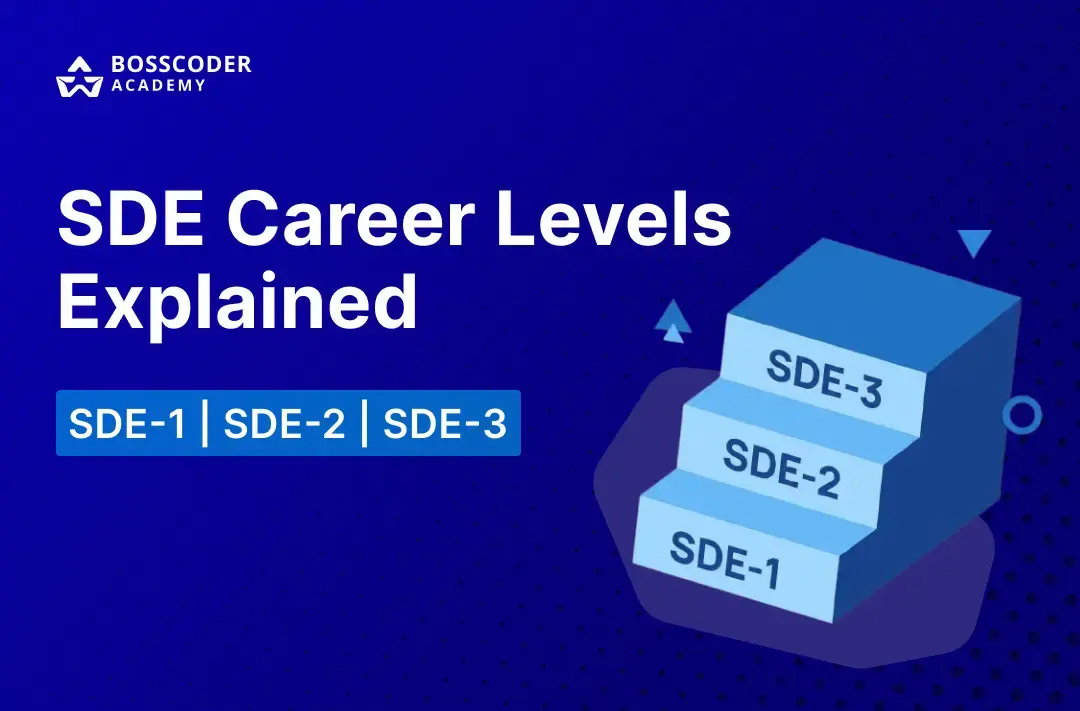
You have likely heard about the term SDE if you are preparing yourself for software engineering interview or looking forward to make your career in product-based companies. The SDE full form is Software Development Engineer, a common job title used for software development roles. Many IT companies including Amazon, Microsoft, Google, Flipkart, Atlassian and others use SDE roles like SDE-1, SDE-2 and SDE-3 which determines an engineer's job profile, salary package and experience.
In this blog post, you will get knowledge about:
- SDE full form and meaning
- Difference between SDE-1, SDE-2 and SDE-3
- Skills required
- Salary in India
- Career roadmap
- Promotion path
And many more.
What is the Full Form of SDE?
The full form of SDE is Software Development Engineer (SDE).
Many professionals search for the SDE full form before applying for software engineering jobs. Companies like Amazon, Microsoft, Google and Flipkart use the title Software Development Engineer (SDE) for software engineering roles.
A Software Development Engineer creates, tests, maintains and improves software applications and application systems used by millions of users.
In simple words, an SDE:
- Writes and tests software application code
- Finds and fixes errors in software
- Works with teammates to build software applications and new features.
- Talks with other engineers and managers to complete projects
Although many people search for the full form of SDE, understanding the different SDE levels is equally important because they determine responsibilities, salary, technical expectations, and career growth.
Understanding SDE Levels in Top Product-Based Companies
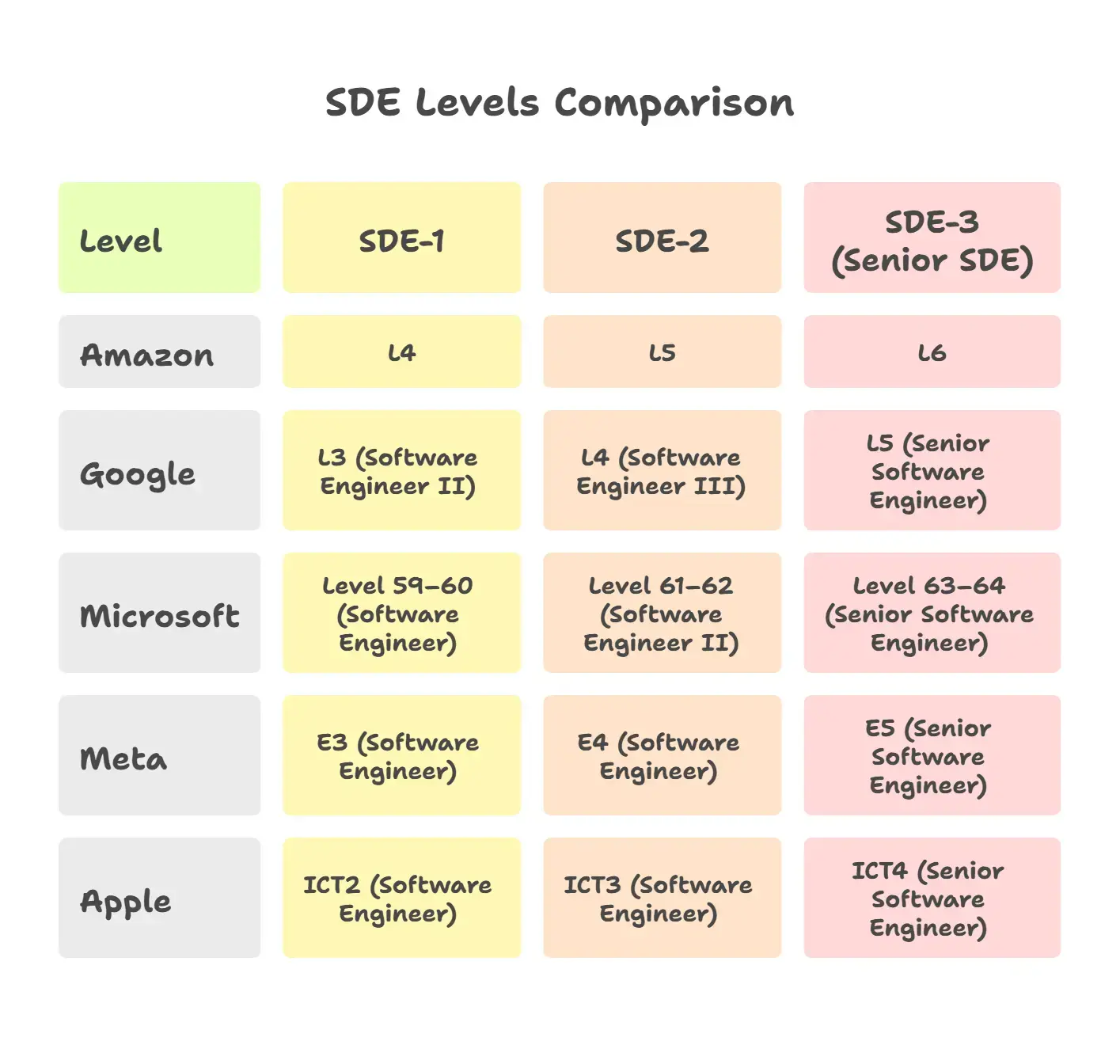
Different tech companies use different names for SDE levels, but the core expectations remain similar. For example, Amazon uses L4, L5, and L6, Google uses L3, L4, and L5, while Microsoft, Meta, and Apple follow their own level systems.
Even though the naming looks different, the structure is almost the same across companies:
- SDE-1 represents entry-level engineers
- SDE-2 represents mid-level engineers with ownership
- SDE-3 represents senior engineers with system design and leadership responsibilities
The image below shows a simple comparison of how top product-based companies map these levels.
SDE-1 (Software Development Engineer-1)
SDE-1 is the entry-level role in a software engineering career. At this stage, companies expect you to learn quickly, write clean code, and understand how real-world software development works.
You are mainly responsible for implementing features under guidance and improving your technical foundation.
What is SDE-1?
SDE-1 is an entry-level software engineering role designed for fresh graduates and early-career engineers. This is usually the first full-time job in a software engineer’s career.
Most SDE-1 engineers are freshers who have recently completed their studies and are starting their journey in the IT industry.
At this stage, the main focus is:
- Learning how real companies work
- Improving coding skills
- Understanding real projects
- Gaining industry experience
Experience Level
Most SDE-1 engineers have 0 to 2 years of experience.
They are usually:
- Fresh graduates from B.Tech, BCA, or B.Sc Computer Science
- Students from coding bootcamps
- Self-learners with strong skills and projects
Many students get SDE-1 roles through:
- Campus placements
- Off-campus drives
- Internships converted to full-time jobs
This level is the starting point of a professional software career.
Responsibilities of an SDE-1
After understanding who an SDE-1 is, let's look at what an SDE-1 actually does in daily work.
At the entry level, your main responsibility is to support the team and learn while working.
Writing Code
Writing clean, readable and maintainable code is one of the most important responsibilities of an SDE-1.
Most of the time, seniors review this code to make sure it meets company standards.
Implementing Features
You help in building parts of larger features, such as:
- Login systems
- Profile pages
- Payment modules
- APIs
- Dashboards
You usually work on clearly defined tasks given by senior engineers.
Fixing Bugs and Improving Code
SDE-1 engineers also:
- Fix small errors in existing code
- Improve slow or broken features
- Learn how to debug real systems
Learning from Seniors and Mentors
One of the most important responsibilities is learning.
You regularly:
- Ask doubts
- Attend code reviews
- Follow best practices
- Observe how seniors solve problems
This learning phase helps you prepare for higher roles like SDE-2.
SDE-1 Skills Required
To be successful as an SDE-1, certain skills are very important. These are basic building blocks of software engineering:
Good Understanding of Basics
You should understand core Computer Science concepts including Data Structures and Algorithms (DSA), Algorithms, Operating Systems, DBMS, Computer Networks and OOPs:
- Data Structures and Algorithms (DSA): Arrays, Lists, Stacks, Queues, Trees, Hash Maps
- Algorithms: Searching, Sorting, Recursion, Simple problem-solving
These help you write efficient programs.
Object-Oriented Programming (OOPS)
Basic concepts like:
- Classes and objects
- Inheritance
- Polymorphism
- Encapsulation
These are used in almost all modern programming languages like Java, Python, or C++.
One or More Programming Languages
Popular programming languages for becoming an SDE include:
Learning one or more programming languages deeply is more valuable than learning many languages superficially.
Basic Fundamentals
These include:
- How programs run
- How memory works
- Control flow (if-else, loops)
- Debugging and fixing errors
Every company expects these skills before you join as SDE-1.
What SDE-1 Usually Does in a Team
At this level, a typical SDE-1 engineer may:
- Write code for simple features
- Fix small bugs in the code
- Write unit tests (test small parts of your code)
- Review code with teammates
- Learn from seniors and ask questions
You are part of a development team, and you grow by doing real work and gaining feedback.
How to Become an SDE-1 in India
Now that you know what an SDE-1 does, let’s see how you can become one in India.
Most companies in India prefer candidates with:
- B.Tech / BE (CS, IT, AI, Data, etc.)
- BCA / B.Sc Computer Science
- MCA (in some cases)
However, many companies now also hire skilled candidates from:
- Coding bootcamps
- Online programs
- Self-learning backgrounds like web developers looking to switch into Software Development Engineer roles
- Industry-aligned curriculum like Bosscoder School of Technology (BST) provides that focus on practical skills and real projects.
Note: Strong coding skills, problem-solving ability and projects matter more than just having a degree in many product-based companies.
6-Month Preparation Plan for SDE-1 (Simple Roadmap)
If you are serious about becoming an SDE-1, you can prepare in 6 months with the right guidance and regular practice.
Here is a simple roadmap you can follow:
Month 1-2: Build Strong Foundations
In the first two months, focus on learning the foundation.
- Learn one programming language (Java / Python / C++)
- Understand basic DSA (arrays, strings, recursion, sorting)
- Practice easy problems daily on coding platforms
This stage is very important because strong basics make learning advanced topics easier later.
Month 3-4: Intermediate Level Skills
Now, start improving your problem-solving and coding depth.
- Solve medium-level DSA questions
- Learn OOPs concepts (classes, objects, inheritance, etc.)
- Build small projects like a to-do app, quiz app, or mini website
At this stage, many students start feeling more confident in coding.
Month 5: Projects + Revision
This month is for strengthening your profile.
- Create 2–3 good projects for your resume
- Revise DSA and core subjects
- Improve your coding speed and accuracy
Strong projects help recruiters understand your practical skills.
Month 6: Interview Preparation
In the final month, focus fully on placements and interviews.
- Attend mock interviews
- Prepare a clean and professional resume
- Practice company-wise questions
- Prepare multiple mock interview questions
This helps you stay confident during real interviews.
How Bosscoder Can Help in This Journey
Following this plan alone is possible, but many students struggle with direction and consistency.
Programs like Bosscoder Academy’s 6-month industry-focused program are designed around this same roadmap. They provide:
- Structured learning from basics to advanced
- Regular DSA practice and 1:1 mentorship
- Real projects and interview preparation
- Guidance from experienced engineers
For students who want proper guidance and a clear path, such programs can save time and help avoid common mistakes.
With regular practice and the right support, many students are able to crack SDE-1 roles within 6 months.
SDE-2 (Software Development Engineer-2)
After working as an SDE-1 for some time, engineers move to the SDE-2 level. At this stage, companies expect you to work more independently and take more responsibility.
What is SDE-2?
An SDE-2 is a mid-level SDE who can handle tasks without constant supervision.
- Usually has 2 to 4 years of experience
- Has already worked on real production systems
- Can solve problems on their own
- Understands how large applications work
SDE-2 engineers are trusted to deliver quality work regularly. Many SDE-2 engineers reach this level after:
- 1.5 to 2 years as SDE-1
- Consistent performance
- Strong technical growth
Promotion depends more on skills and impact, not just years.
Skills Required for SDE-2
The skills required for an SDE-2 are significantly higher than those expected from an SDE-1 because engineers are expected to own features independently.
Strong Problem-Solving (DSA)
- Able to solve medium to hard DSA problems
- Good understanding of arrays, strings, trees, graphs, DP, etc.
- Can write optimized code
- Knows how to choose the right approach
At this stage, you should not just solve problems, you should solve them efficiently.
Good Programming Skills
- Writes clean and readable code
- Follows proper coding standards
- Uses meaningful variable and function names
- Avoids unnecessary complexity
Companies prefer engineers whose code is easy to understand and maintain.
Debugging & Troubleshooting Skills
- Finds bugs in complex systems
- Uses logs and debugging tools
- Fixes performance issues
- Handles production errors
An SDE-2 should be able to solve issues even when no one else is available.
System Design Knowledge
- Knows how applications are structured
- Understands databases, APIs, servers
- Can design small systems
- Thinks about scalability and load
You don’t need to be an expert yet, but you should understand the foundation of how system works.
Knowledge of Tools & Technologies
- Git and version control
- CI/CD basics
- Cloud basics (AWS/GCP/Azure)
- Monitoring tools
These tools help in top tech & product based company work.
Communication & Team Skills
- Explains ideas clearly
- Asks questions when stuck
- Gives feedback politely
- Works well in a team
Strong communication skills help Software Development Engineers explain technical ideas, participate in code reviews and collaborate effectively with cross-functional teams.
Note: With regular practice and the right guidance (like structured programs from Bosscoder Academy), many engineers in India can prepare for SDE-2 within 6-12 months after becoming SDE-1.
Responsibilities of SDE-2
At the SDE-2 level, you are expected to work independently, responsibly, and confidently. Companies trust you with important tasks and expect quality work.
Building and Owning Features
An SDE-2 is responsible for building complete features from start to finish.
- Designs small modules
- Writes backend/frontend code
- Connects APIs and databases
- Tests before deployment
You don’t just write code, you make sure the feature works properly in real use.
Taking Responsibility for Work
At this stage, you are expected to take full ownership of your tasks.
- Completes work on time
- Fixes bugs after release
- Improves code quality
- Handles issues without waiting for seniors
Companies expect SDE-2 engineers to be reliable and self-driven.
Supporting and Guiding Junior Developers
SDE-2 engineers also collaborate with cross-functional teams including product managers, QA engineers, designers and DevOps engineers to successfully deliver software features. And
- Helps SDE-1 understand tasks
- Reviews their code
- Shares learning resources
- Guides in problem-solving
This shows leadership and prepares you for senior roles.
Maintaining System Quality and Stability
SDE-2 engineers help keep company systems stable and fast.
- Fixes production bugs
- Improves performance
- Refactors old code
- Prevents future issues
Your work directly affects users and business results.
Moving from SDE-1 to SDE-2
To reach SDE-2, you must improve your technical skills and start working more independently. Focus on these three main areas.
Improve Your Coding & Technical Skills
- Practice medium and hard DSA questions
- Revise core topics (Arrays, Trees, Graphs, DP)
- Learn System Design basics
- Understand design patterns
- Write clean and optimized code
Try to solve 2–3 coding problems daily.
Build Strong Projects & Work Independently
Your work should show maturity and ownership.
- Build real-world projects
- Use GitHub properly
- Deploy your applications
- Debug problems on your own
- Learn from documentation and online resources
This proves that you can handle tasks without constant help.
Prepare for Interviews & Improve Communication
Good technical skills + good communication = faster growth.
- Practice mock interviews
- Revise important DSA topics
- Prepare company-wise questions
- Learn to explain your solutions clearly
- Improve teamwork and communication
Companies prefer engineers who can code well and work well with others.
SDE-3 (Software Development Engineer-3)?
After proving strong ownership and technical depth as an SDE-2, engineers move to the SDE-3 level. At this stage, companies want you to lead technical decisions, design scalable systems, and guide other engineers.
You are not just responsible for completing features you are responsible for building reliable systems and influencing technical direction.
What is SDE-3?
An SDE-3 is a Senior SDE who leads technical decisions and builds scalable systems.
At this level, you are not just coding, you are designing architecture and guiding the team.
- Usually has 5 to 8+ years of experience
- Has strong experience with scalable production systems
- Leads technical design discussions
- Makes important architecture decisions
- Mentors multiple engineers
SDE-3 engineers are trusted to design and maintain large software systems that directly impact millions of users.
Many software engineers reach this level after:
- 2–3 years as SDE-2
- Strong ownership and consistent impact
- Knows how software applications and application systems are structured and scaled.
- Leadership qualities
Promotion depends on technical depth, system impact, and leadership not just years of experience. SDEs work on complex software products that serve large numbers of users.
Skills Required for SDE-3
The skills required for an SDE-3 include advanced system design, software architecture and technical leadership.
You should be able to design large systems and guide others.
Advanced Problem-Solving & Technical Depth
- Solves complex engineering problems
- Strong in DSA and real-world problem solving
- Understands trade-offs and optimization
- Makes performance improvements
At this stage, you focus more on system-level thinking than just coding questions.
Advanced System Design & Architecture
- Designs large-scale systems
- Understands distributed systems
- Works with microservices architecture
- Handles scalability, caching, load balancing
- Makes high-level design (HLD) decisions
You should be able to design systems that handle millions of users.
Strong Coding & Code Quality Leadership
- Writes production-level clean code
- Sets coding standards for the team
- Reviews complex pull requests
- Improves system reliability
Your code becomes a reference for others.
Production & Performance Ownership
- Handles critical production issues
- Improves system performance
- Reduces downtime
- Ensures system stability
SDE-3 engineers protect the company’s core systems.
Technical Leadership & Mentorship
- Guides SDE-1 and SDE-2 engineers
- Leads design discussions
- Helps in hiring interviews
- Shares knowledge with the team
You are seen as a technical leader, even without being a manager.
Responsibilities of SDE-3
At this level, companies trust you with high-impact projects and long-term technical vision.
Designing and Leading Large Features
- Breaks complex projects into modules
- Creates system architecture
- Reviews technical decisions
- Ensures scalability from day one
You think about long-term impact, not just delivery.
Driving Technical Strategy
- Chooses tech stack
- Improves engineering practices
- Introduces better design patterns
- Optimizes infrastructure
Your decisions affect the whole team.
Mentoring & Team Growth
- Supports junior and mid-level engineers
- Conducts technical reviews
- Encourages best practices
- Builds a strong engineering culture
Strong teams are built by strong senior engineers.
Moving from SDE-2 to SDE-3
Moving from SDE-2 to SDE-3 is a big step in a software engineering career. At the SDE-2 level, you are known for working independently and delivering features. But at the SDE-3 level, you are expected to lead technically, design scalable systems, and influence important engineering decisions.
The focus shifts from “completing tasks” to “building systems and guiding teams.” Your impact becomes broader, and your decisions start affecting multiple engineers and business outcomes.
To successfully move from SDE-2 to SDE-3, you should mainly focus on:
- Advanced System Design → Design scalable, reliable, and high-performance systems.
- Architecture Thinking → Make long-term technical decisions, not short-term fixes.
- Ownership of Complex Projects → Handle large, high-impact features end-to-end.
- Technical Leadership → Mentor junior engineers and lead design discussions.
- Business Understanding → Think about how technical decisions affect users and growth.
At this stage, companies promote engineers based on technical depth, leadership, and real impact, not just experience.
In simple words, SDE-2 proves you can work independently.
SDE-3 proves you can lead technically and build systems that scale.
To make this transition faster and more structured, having the right guidance matters. Programs like Bosscoder Academy’s Evolve Program focus on advanced system design, real-world architecture thinking, and leadership-level problem solving skills that are essential for moving from SDE-2 to SDE-3.
SDE-1 vs SDE-2 vs SDE-3: Main Differences Explained
As engineers gain experience, their responsibilities, technical depth, and leadership expectations increase. SDE-1 usually grows into SDE-2, and SDE-2 grows into SDE-3 based on skills, impact, and performance not just years.
Below is a simple comparison to clearly understand the difference:
| Area | SDE-1 | SDE-2 | SDE-3 |
|---|---|---|---|
| Experience | 0-2 years | 2-4 years | 5+ years |
| Main Focus | Learning & coding | Mid-level Engineer | Senior Software Engineer |
| Problem Solving | Solves simple tasks | Solves complex features | Solves large system problems |
| System Design Skills | Basic understanding | Can design small systems | Designs scalable systems |
| Work Responsibility | Works under guidance | Works independently | Leads projects |
| Ownership | Task-level ownership | Feature-level ownership | System-level ownership |
| Leadership | Learns from seniors | Mentors juniors | Guides team & makes technical decisions |
| Career Growth Level | Entry-level | Mid-level | Senior-level |
Simple Summary
- SDE-1 → Focus on coding, learning, and building strong fundamentals.
- SDE-2 → Focus on ownership, debugging, and designing small systems.
- SDE-3 → Focus on scalable system design, technical leadership, and high impact.
As you move from SDE-1 to SDE-3, your salary, responsibility, and impact in the company increase.
Understanding these SDE levels helps you plan your career growth in software engineering and prepare for promotions in top tech companies.
SDE Levels Salary Comparison
In this section, we’ll see how salaries differ for SDE-1, SDE-2, and SDE-3 roles in India, especially in product-based companies.
Salaries can vary widely depending on the company, location (e.g., Bengaluru, Hyderabad), negotiation skills, stock/equity, and performance. The ranges below are approximate averages based on real compensation data from salary platforms in 2025–2026
Average SDE Salary in India (SDE-1 to SDE-3)
| SDE Level | Salary Range (₹ LPA) | Experience Level |
|---|---|---|
| SDE-1 (Junior Software Engineer) | ₹8 - ₹20 LPA | 0–2 years (Entry-level, strong coding & DSA focus) |
| SDE-2 (Mid-Level Engineer) | ₹15 - ₹40 LPA | 2–4 years (Feature ownership & system design basics) |
| SDE-3 (Senior Software Engineer) | ₹30 – ₹60+ LPA | 5+ years (System design, architecture & leadership) |
Average Salaries at Top Product Companies in India
In India, software engineer salaries vary widely based on company, experience, skill level, and offer components like base salary, bonus, and stock options.
Here’s a simple view of how salaries are distributed across SDE-1, SDE-2, and SDE-3 roles in top product
| Company | SDE-1 | SDE-2 | SDE-3 |
|---|---|---|---|
| Amazon | ~₹15–22 LPA | ~₹40–55 LPA | ~₹80 LPA–₹1.3 Cr |
| ~₹25–35 LPA | ~₹45–60 LPA | ~₹60–90+ LPA | |
| Microsoft | ~₹18–28 LPA | ~₹35–50 LPA | ~₹45–80 LPA |
| Meta (Facebook) | ~₹25–35 LPA | ~₹45–65 LPA | ~₹60–90 LPA |
| Uber | ~₹30–38 LPA | ~₹45–60 LPA | ~₹70–95 LPA |
| Flipkart | ~₹18–30 LPA | ~₹25–40 LPA | ~₹40–60 LPA |
| Atlassian | ~₹30–42 LPA | ~₹35–48 LPA | ~₹45–60 LPA |
These numbers are approximate averages based on reported compensation data and trends in Ambition Box/professional salary reports. Actual offers may vary based on bonuses, stock units (RSUs), and interview negotiations.
How to Become a Software Development Engineer (SDE) at MAANG Companies
After understanding SDE-1, SDE-2, and SDE-3 levels, many engineers aim to work at MAANG companies (Meta, Amazon, Apple, Netflix, Google). These top product-based companies offer high salaries, strong career growth, and global exposure.
To become a Software Development Engineer (SDE) at MAANG, you need strong fundamentals and consistent practice.
Here’s what you should focus on:
- Data Structures and Algorithms (DSA) → Practice coding regularly. Most MAANG interviews focus on problem-solving skills.
- Core Computer Science Subjects → Be clear with OS, DBMS, OOPS, and Computer Networks.
- System Design → Important for SDE-2 and SDE-3 roles. Learn how large systems are built and scaled.
- Projects → Build real-world applications and showcase them on GitHub.
- Communication Skills → Interviews also test clarity of thinking and teamwork ability.
Getting into MAANG requires preparation, patience, and proper guidance. With the right roadmap, it is achievable.
Final Thoughts
Every Software Development Engineer (SDE) progresses through different stages including SDE-1, SDE-2 and SDE-3 based on technical skills, ownership and leadership.
As you move from entry-level to senior roles, your responsibilities increase from writing code and learning basics to owning features, designing systems, and leading technical decisions.
With more experience comes more impact and better salary opportunities, especially in top product-based and MAANG companies. But reaching these levels requires strong coding skills, good system design knowledge, clear understanding of core computer science subjects like operating system, DBMS, OOPs and computer networks are heavily asked during interviews., and good communication.
Whether you are trying to switch to tech or an experienced software engineer, understanding SDE levels helps you plan your long-term career, focus on strong fundamentals and regular practice. With the right guidance from platforms like Bosscoder Academy, you can prepare in a structured way and move closer to your goal of working at top tech companies.
Frequently Asked Questions (FAQs)
Q1. How to prepare for SDE interviews in MAANG companies?
Focus on practicing coding problems daily, revise core CS subjects, learn system design basics, build real projects, and practice mock interviews.
Q2. What skills are required to become an SDE?
To become an SDE, you need strong Data Structures and Algorithms (DSA) and Algorithms (DSA), good knowledge of OOPS, DBMS, Operating Systems, and basic System Design. Communication and problem-solving skills are also important.
Q3. What is the difference between Software Engineer and SDE?
In most companies, Software Engineer (SWE) and SDE mean almost the same thing. SDE is just a specific title used by companies like Amazon and Microsoft. The responsibilities are similar like writing code, building systems, and solving technical problems.
Q4. Is Google L3 an entry-level role?
Yes, Google L3 is generally considered an entry-level SDE role. Fresh graduates or engineers with 0-2 years of experience are typically hired at this level.