The application of AI is fast becoming significant in the tech sector. In the India Skills Report 2026 as stated by Business Standard, above 40% of the Indian IT and gig workers are currently using AI applications in automation and analytics. The India Skills Report 2026 further forecasts that the number of Indian AI talent pool will be at 12.5 lakh professionals by 2027.
As far as students who are getting ready to join this technology sector, this shows the increasing significance of AI. Nevertheless, the knowledge of using AI technologies is not the only thing that matters in the learning process. The understanding of practical problems and development of solutions and products is also essential.
That's what BuildX at Bosscoder School of Technology stands for.
Hands-on sessions introduce students to AI, problem-solving, product thinking, and entrepreneurship. Whether creating an AI assistant or exploring problems and designing products, BuildX helps students to apply their learning rather than just learning the theory behind it.
What Is BuildX by Bosscoder School of Technology?
BuildX is a hands-on learning experience for class 11 & 12 students interested in AI, technology, entrepreneurship, problem-solving, and product building.
Learning does not just involve attending lectures and learning concepts. It requires that learners put into practice what they have learned through assignments, discussions, experimentation, and product building activities.
Through the process, students have the opportunity to:
- Find out problems around them
- Look for potential opportunities
- Know users and understand their needs
- Use AI to come up with practical solutions
- Structure their product ideas
- Collaborate with other students
- Learn from each other and share their learning
- Improve on their ideas based on feedback
The ultimate objective is to make them feel comfortable with building and experimenting with technology and not just using it.
To know more about the program in general, you can read What Is BuildX by Bosscoder School of Technology?
Starting With a Founder Mindset
The BuildX journey started on 19 September 2026 through a Founder Mindset session conducted by Rajat Garg, Co-founder of Bosscoder Academy and Bosscoder School of Technology.
The main focus of the session was on how the students could see opportunities and problems from different angles.
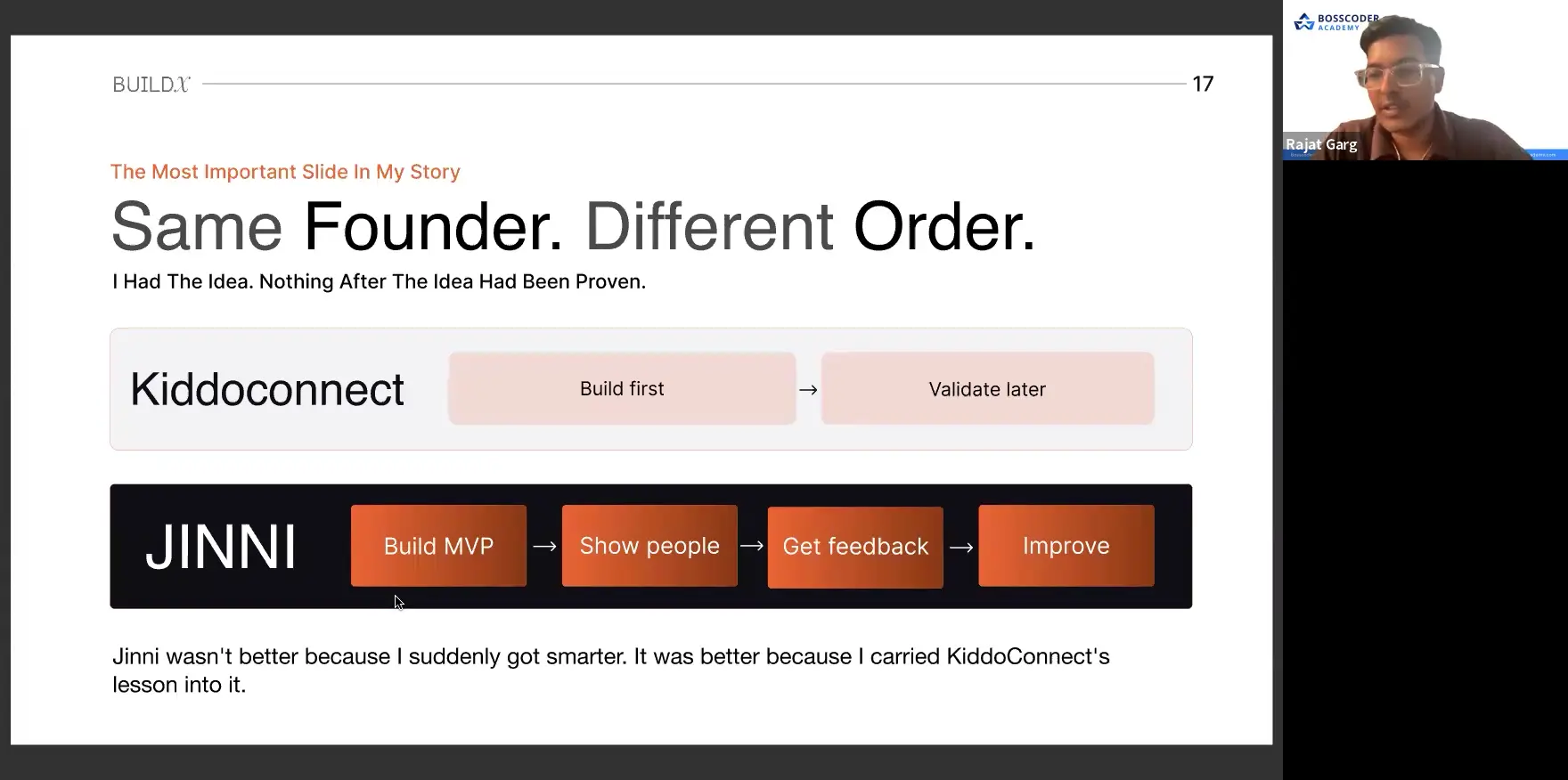
The idea was not to think about the product that should be built instantly but to analyze the situation and identify where there are problems and opportunities exist.
Some of the topics discussed were:
- Taking ownership
- Finding opportunities
- Going beyond traditional career opportunities
- Creating an entrepreneurial mindset
- Looking at everyday problems differently
- Difference between consumer vs creator mentality
This created the foundation for the sessions that followed.
An important takeaway from this process is that usually, a good product is born out of a problem and not a technology.
Learning AI Through Practical Building
AI is becoming increasingly accessible however, using an AI software and building an application with AI involve two separate processes.
On 25 September 2026, BuildX conducted a “Build Your Own ChatGPT” masterclass by Piyush Goyal, Data Engineer at Google and a BuildX instructor.
Instead of just talking about how AI assistants operate, students were given an opportunity to develop their own AI-powered assistants that could engage in conversation based on the data and context given by the user.
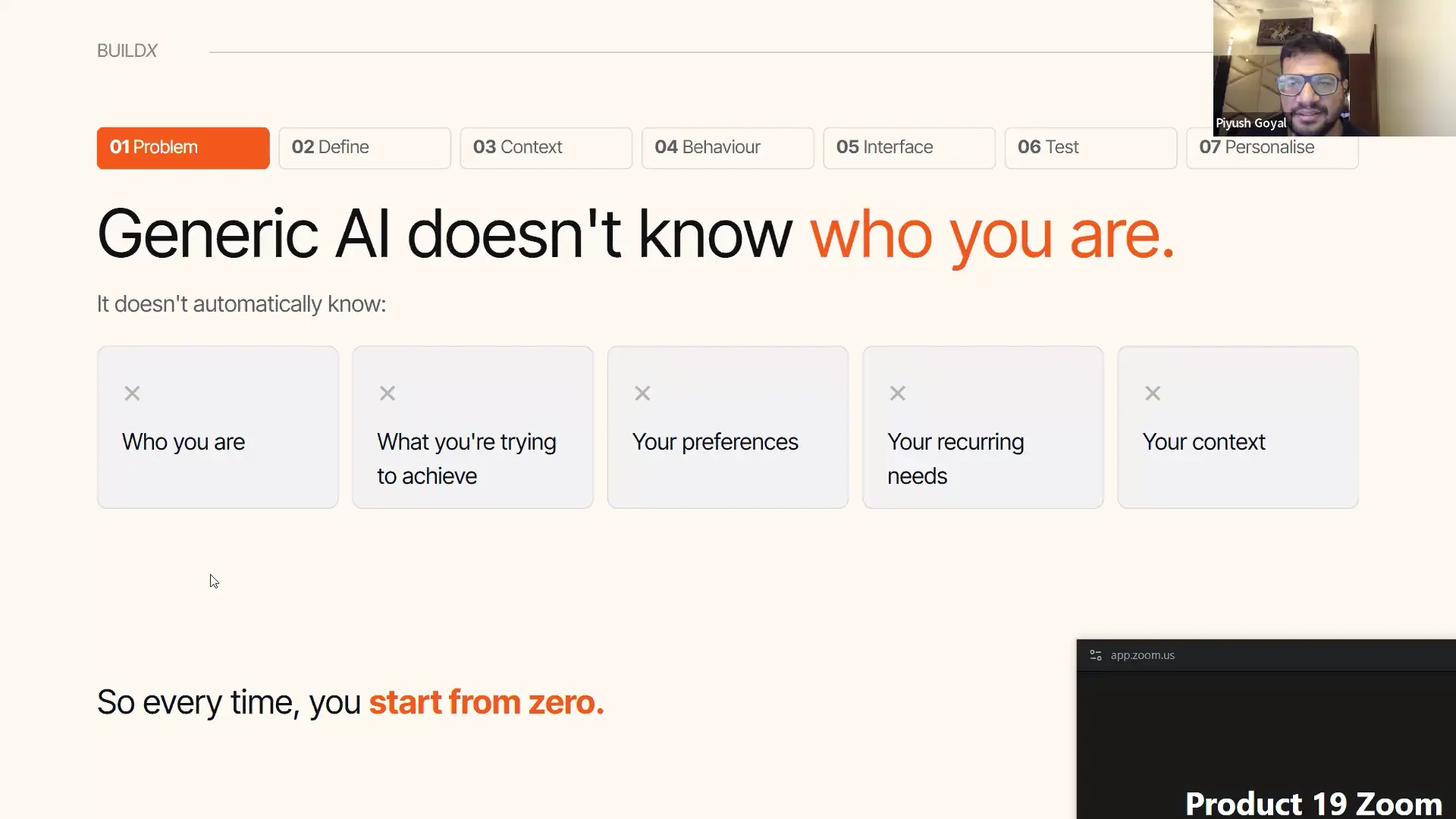
In this way, it became more practical to learn about AI.
Instead of imagining how the AI models can be used as tools to generate content or answer questions, the students could see how an AI model can turn into a product.
Problem Solving Before Product Building
One of the most important parts of building a product is understanding which problem is actually worth solving.
In a BuildX session held on 27 September 2026, problem-solving and idea generation skills were discussed. In this session, the discussion went far away from what to build, and instead concentrated on the identification of the actual problem.
Practical concepts such as:
- 5 Whys
- Issues Trees
- MECE
- Root cause analysis
- Problem decomposition
- Problem reframing
- Understanding users
Some of the questions that were encouraged for students to ask are:
- Who really faces this problem?
- What really happens?
- Why it happens?
- What is the root cause of this problem?
- How often does it happen?
- How big is the problem?
- What supports your observation?
With this session, students learn one of the essential components of product thinking, the first solution that comes to mind is not always the right one.
Before building any product, it is necessary to understand the problem first.
The Problem Hunt Assignment
The next step was Assignment 02, called “The Problem Hunt,” with a deadline of 6 October 2026.
The aim was intentionally different from a regular technical project. Students were supposed not to come up with a solution right away.
Students were required to:
- Identify a problem around them.
- Discover who experiences the problem.
- Interview three individuals experiencing the problem.
- Use the 5 Whys technique.
- Develop an issue tree.
- Reframe the problem.
- Identify what else needs to be researched.
- Publish their results on LinkedIn.
The problems should include cases that are slow, costly, confusing, repetitive, manual, stressful, or unreliable.
The activity aimed at prompting students to progress from assumption-based approach to evidence-based one.
Instead of just saying “I have an idea”, students had to find out whether there really exists such problem, who experiences the problem, and what causes the problem.
This is an important part of the BuildX learning experience because students get to apply problem-solving frameworks to situations outside a traditional classroom exercise.
Building in Public Through LinkedIn
Another part of the BuildX experience is building in public.
Students were asked to share their ideas, discoveries, learning, and progress through LinkedIn, instead of waiting until everything was perfected.
By doing so, students gain a number of useful skills for the future:
- Expressing their ideas clearly
- Documenting their learning
- Getting used to sharing unfinished work
- Receiving feedback
- Gaining confidence
- Creating their first professional identity
This is not about getting any engagement. This is more about getting used to talking about what you do, why you do it, and how much you learned during the process.
If you are into entrepreneurship, you get additional value here since this can serve as proof of your efforts.
From Problem Discovery to Product Thinking
Having spent some time identifying problems, the students started thinking about potential products.
Product Blueprint Session was held on 2 October 2026. It dealt with transforming a problem to a product concept.
Students explored areas such as:
- Identifying the target user
- Identifying the problem
- Coming up with a solution
- Identifying the core product
- Identifying key features
- Prioritizing features
- Understanding MVPs
- Product structure based on user problem
Thus, students learned to combine problem-solving activities with the following stage of product building.
Rather than creating a product just because they liked the idea, students were supposed to think about the user, the problem, key features and MVPs.
You can also explore entrepreneurship programs for students in India to understand how early hands-on experiences can help students explore product building and entrepreneurship.
Learning With Other Students
BuildX is more than just instructor-led classes.
Through the community, there are opportunities for students to ask questions, brainstorm, exchange resources, get feedback, and network with other students interested in AI, technology, entrepreneurship, startups, and products.
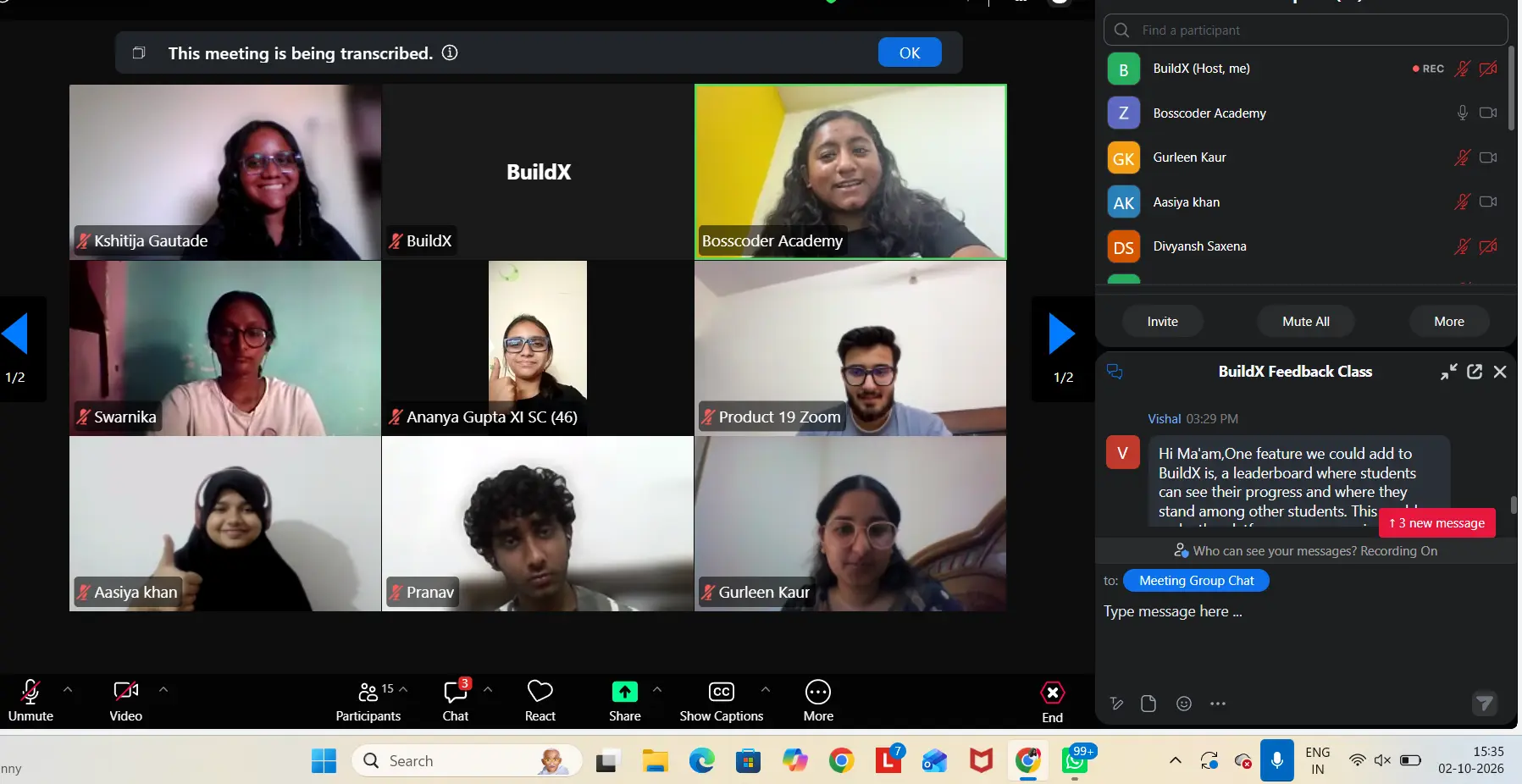
The community allows for places for general interaction, brainstorming, questions, networking, and collaboration.
This can become an important part of the learning experience.
There is a chance to learn from each other's questions, methods, experiments, and ideas. One person who begins with a very simple idea might find another person interested in working on that particular idea.
In terms of students' learning, this makes a collaborative learning environment through building process.
What Comes Next in the BuildX Journey?
The BuildX journey is still going on.
So far, the sessions have covered mindset development, building AI, finding problems, conducting research, and product thinking. Future stages will cover bringing these ideas closer to being transformed into real products.
Building and Validation
Now, attention will be paid to building an MVP and validating that it solves the problem found before.
Product Feedback
Students will receive feedback that can help them identify gaps and make better decisions on products.
Go-to-Market and Discoverability
It is not enough to build a product.
Students will also have to figure out who needs their product, how can this target audience find their product, and how their product reaches early users.
Pitch Preparation
Students will have to prepare a pitch on the problem, target user, insight, solution, product, value, and future direction.
Pitch Day
The trip will eventually lead to students giving their presentations on what they created and why they did it.
This transforms the presentation into something beyond just a regular assignment in class. This includes their identified problem, the product, the feedback they got, and what they learned.
What Can Students Learn Through BuildX?
The main lesson learned from the BuildX session is probably not a specific tool for AI or product design framework.
Instead, it is the approach to thinking before building.
Students are taught to analyze their surroundings, find problems, talk to people, collect data, find the reason behind the problem, and finally think of what can be built.
Along the way, they get exposure to several skills:
- Problem-solving
- AI and technology
- Product thinking
- Communication
- Collaboration
- Research
- Experimentation
- Presentation
It is also what makes the BuildX experience at Bosscoder School of Technology more than just a collection of individual sessions.
These sessions are held together by a practical question: can students apply something that they have observed, understand it, design a solution and share their learning?
The journey is far from over, but the students have already begun to shift from studying building to actually practicing it.
For a related look at the broader BuildX internpreneurship bootcamp, see BuildX: Internpreneurship Bootcamp for Students.
Final Thoughts
Technology is developing rapidly, and AI is becoming a part of daily learning and work processes. For students, the knowledge of how to apply such technologies becomes increasingly valuable. However, the ability to think critically and build with the help of technology is also highly valuable.
BuildX sessions that are held at Bosscoder School of Technology provide this experience through various exercises, projects involving AI, research of problems, product thinking, collaboration, and presentations.
This process is not about having a perfect idea on the first day but about the experience of what can happen to an idea after it was questioned, examined, developed, and created.
This is where students start forming a builder's mindset: not only about how technology works but how they can make something with its help.
Frequently Asked Questions (FAQs)
Q1. What do students learn in the BuildX sessions at Bosscoder School of Technology?
Students learn about AI, problem-solving, entrepreneurship, and product thinking through hands-on sessions. The BuildX experience involves creating an AI-driven assistant, discovering real-world problems, using frameworks like 5 Whys and Issue Trees, and creating product blueprints.
Q2. How do BuildX sessions help students identify real-world problems?
Students are taught to look into the problem before coming up with a solution. In the Problem Hunt activity, students discover a problem, talk to three individuals facing the problem, use the 5 Whys framework, build an Issue Tree, and define the problem.
Q3. What is the Build Your Own ChatGPT masterclass in BuildX?
The Build Your Own ChatGPT masterclass is meant to help students learn about making an AI-based assistant that uses information and context provided by the user. The session, held by Piyush Goyal on 25 September 2026, will teach students how AI can be used to make useful products.
Q4. How do students turn their ideas into products through BuildX?
The students first identify the problem, conduct research on it, understand the target user and also determine the solution that can be implemented. During the Product Blueprint session, they will learn how to identify important features, prioritize them, and also learn about MVPs. The following stages involve building, validating, and presenting the product.