You've been on the same tech stack for three years. Maybe longer. You ship features, fix bugs, and get decent reviews, but the interesting design decisions happen in meetings you're not invited to. Then you try a system design round at a product company and freeze. Or you open LeetCode after a long gap and your DSA instincts feel rusty. Add GenAI to the mix, with every team suddenly talking about LLMs and RAG, and it's easy to feel like you're falling behind. We built the Bosscoder Evolve Program for exactly this moment.
What Is the Bosscoder Academy Evolve Program?
Evolve is our upskilling program for senior engineers. It's built to get experienced developers ready for the kind of roles where you own systems, make architectural calls, and bring AI into real products without breaking them.
We didn't design it around hype. Our view is simple: GenAI is a practical extension of engineering, not a replacement for fundamentals. Companies aren't asking every engineer to train models from scratch. They want people who can add intelligence to an existing backend, improve search or recommendations, automate workflows, and weigh cost, accuracy, latency and safety before shipping anything.
So Evolve covers four things together:
- Problem solving and DSA, so you're interview-ready again
- System design (SQL, LLD and HLD), grounded in real production systems
- LLM, RAG and agent systems, built and evaluated the way production demands
- A specialization track, either Forward Deployed AI Engineering, Full Stack/Backend, or both
The goal is to move you toward SDE-3, Architect, or FDE Lead roles, the kind of path that stays relevant as software keeps changing.
Who Is the Evolve Program For?
Evolve is built for software engineers with 6+ years of experience. If you've spent that long building things and feel your growth has flattened, you're who we had in mind.
It fits you well if:
- You're an experienced developer at a services company or a small team and want to move into a product-based company.
- You're already at a product company but keep getting stuck in system design rounds, or you want to step up to a senior or lead role.
- You've been writing backend or full-stack code for years but haven't had a reason to build anything with LLMs, RAG or agents.
- You want structure. You've tried to prepare on your own, jumped between random resources, and lost momentum.
Evolve Curriculum Breakdown
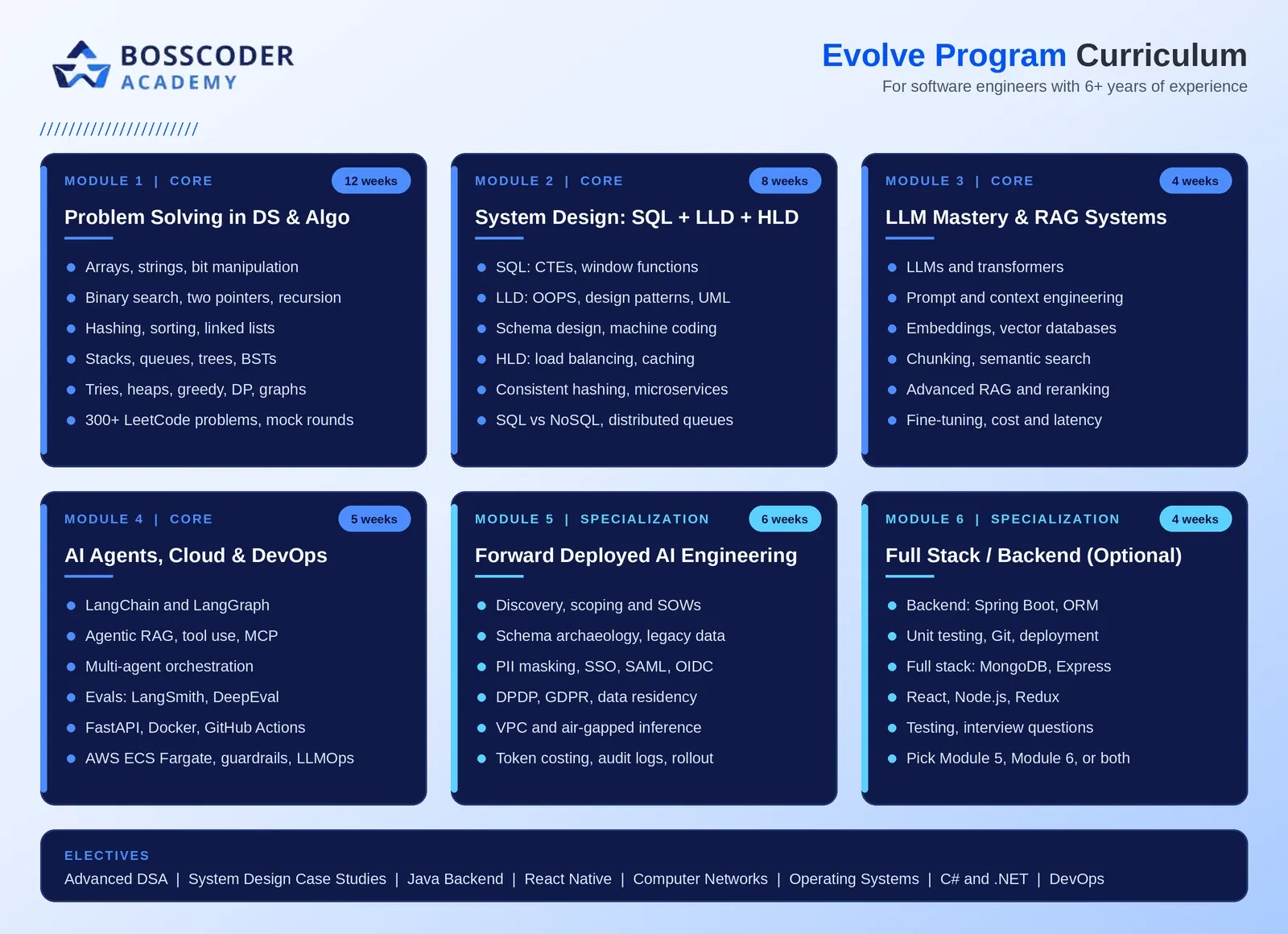
Here's how the Bosscoder Academy Evolve Program is laid out. Modules 1 to 4 are the core and run in order. Modules 5 and 6 are specializations, so you pick one or take both. If you want to go deeper, there are electives on top.
Module 1: Problem Solving in DS & Algo (12 weeks)
Let's be real. Strong DSA is still the gate at most top product companies, even at senior levels. This module is about rebuilding that muscle without treating it like a college exam.
Here's what you cover.
Linear DSA
- 1D and 2D arrays
- Strings
- Number systems and maths
- Bit manipulation
- Binary search
- Two pointers
- Recursion
- Hashing
- Sorting
- Linked lists
- Stacks and queues
Non-linear DSA
- Trees, binary trees and BSTs
- Tries and heaps
- Greedy algorithms
- Dynamic programming
- Graphs
What does that look like in practice?
- A LeetCode mastery track of 300+ curated problems, mapped to patterns that come up in interviews at Amazon, Microsoft, Google and Flipkart
- Company-wise interview sets grouped by role level (SDE-2 and Senior), so you see how expectations shift after six-plus years of experience
- Mock DSA rounds with live problem-solving and feedback from engineers who've cracked these interviews themselves
Module 2: System Design, SQL + LLD + HLD (8 weeks)
This is the module that stops you from freezing in design rounds. It brings three things together so you can design real backend systems end to end.
SQL goes well beyond SELECT statements. The aim is production-grade SQL based on the data-access patterns you'd see in feed generation, messaging, recommendations and analytics.
- Joins, sorting and grouping, aggregation
- CTEs and recursive CTEs
- Subqueries
- Advanced string functions
- Windowing functions
Low Level Design is where you learn how to structure code so it doesn't turn into a mess six months later.
- OOPS
- Design patterns
- UML diagrams
- Schema design
- Design problems
- Machine coding
High Level Design is about making clear trade-offs around scalability, reliability, consistency and performance, then defending them out loud. That last part matters more than most people expect.
- Distributed systems
- Load balancing
- Consistent hashing
- Caching
- Transactions
- SQL vs NoSQL
- Microservices
- Distributed queues
- Designing real-life systems
Module 3: LLM Mastery & RAG Systems (4 weeks)
Every team is adding LLMs these days, and someone has to decide how. This module moves you out of the "just prompting" phase and into the architecting phase.
You learn how LLMs and transformers actually work and where they break. Here's what you cover.
- LLMs and transformers
- Prompt engineering techniques
- Context engineering
- Embeddings and vector databases
- Chunking and semantic search
- Advanced RAG and reranking
- Enterprise-level RAG systems
- LLM APIs and fine-tuning
- Cost and latency optimization
- Build vs buy decisions
The real skill here is judgment. When should you just prompt? When do you need RAG? When is fine-tuning worth the cost? By the end, you should be able to answer those questions and defend your choice in a design review.
Module 4: AI Agents, Cloud & DevOps (5 weeks)
A demo agent is easy to build. One that survives production isn't. This module is about the second kind.
Here's the stack and what you cover.
Agents
- Agentic AI workflows
- LangChain and LangGraph
- Agentic RAG systems
- Tool use and function calling
- MCP integration
- Multi-agent orchestration
- Failure recovery and retries
Evals and observability
- Evals and LLM-as-judge
- LangSmith tracing and dashboards
- DeepEval and PromptFoo in CI
Shipping
- FastAPI and streaming endpoints
- Docker and Docker Compose
- GitHub Actions CI/CD
- AWS: ECS Fargate, ECR, RDS
- Guardrails and PII scrubbing
- LLMOps for non-deterministic AI
It turns "it seems to work" into proof. This module is also the base for the FDE track.
Module 5: Forward Deployed AI Engineering (6 weeks)
Forward Deployed Engineering is about taking AI from a client's vague request all the way to production. It's less about writing code in isolation and more about leading delivery.
Here's what you cover, grouped by stage of an engagement.
Discovery and scoping
- Discovery and problem framing
- Engagement artefacts and SOWs
- Scoping under constraints
- Defending your design to stakeholders and a client's own architects
Data and security
- Schema archaeology
- Data access in legacy systems
- PII identification and masking
- SSO, SAML and OIDC access
- DPDP, GDPR and data residency
Deployment and delivery
- VPC and air-gapped inference
- Inference serving and SLAs
- Token economics and costing
- Staged rollout and monitoring
- Audit logs and model cards
- Human-in-the-loop gates
- Incident response
Module 6: Full Stack / Backend Specialization (4 weeks, optional)
Senior engineers are expected to own systems end to end. In this optional module you choose a track based on your career goals.
Backend with Spring Boot
- Spring Boot and application architecture
- ORM
- Unit testing
- Git
- Deployment
- Project interview questions
Full stack with MERN
- MongoDB
- Express.js
- React
- Node.js
- Redux
- Testing
- Git and deployment
- Interview questions
You can pick Module 5, Module 6, or both.
Electives
If you want to go deeper, you can add electives.
- Advanced DSA: segment trees, string pattern matching, advanced DP and graph problems
- System Design Case Studies: Hotstar streaming, a chess game website, a rate limiter, a parking lot, Netflix and WhatsApp Web frontend design
- Backend Specialization in Java: Spring Boot, JPA, REST APIs with Postman
- Mobile Development: React Native (Expo) and Firebase
- Computer Networks
- Operating Systems
- C# and .NET
- DevOps
How Mentorship Works in Practice
Learning alone is hard. Learning with people who've been where you want to go is a lot easier.
Every Evolve learner gets 1:1 mentorship. These are personal sessions with mentors who've worked at top tech companies. You bring your doubts, get straight answers, go through mock interviews, and get feedback that tells you what to fix and how. We built it this way because every engineer comes from a different background, and a six-year Java developer at a services firm needs something different from a nine-year full-stack engineer at a product company.
Alongside that, all classes are live, taught by instructors who've worked at top tech companies. We keep batch sizes optimal so you can get doubts cleared in real time instead of watching a recording and hoping for the best. After every class you get assignments to reinforce what you learned, and if you get stuck there's 24×7 doubt support.
You'll learn from people like these:
- Geetika Gupta, SDE III at Amazon. Focused on backend and full-stack development.
- Nikhil Maheshwari, Lead SDE at Jio. Has led initiatives in data engineering and system design.
- Ashish Prasad, Microsoft. Covers object-oriented design and the software development lifecycle.
- Baldev, with experience in distributed systems, data platforms and GenAI integration. Mentors on backend design and distributed computing.
- Hitesh Ahuja, a senior software engineer. Helps with mock interviews, system design and career strategy.
Our learners say the same thing in different words: the consistency helped. Pranshika Singla credits live practice and her mentor for getting her through four Amazon rounds. Akash Tyagi says structured DSA and system design sessions plus mock interviews gave his Amazon prep a direction. His move was from EY to Amazon.
And there's the community. You'll be learning alongside other ambitious engineers through group discussions and collaborative sessions, which is more useful than it sounds when you're juggling a full-time job.
Projects and Portfolio
You don't get hired on certificates. You get hired on what you can show and explain. So Evolve is project-heavy, and the projects line up with each module.
DSA projects.
The LeetCode Mastery Track has you solve 300+ curated problems mapped to patterns asked at Amazon, Microsoft, Google and Flipkart. Company-wise interview sets (MAANG) are grouped by role level, and mock interview simulations give you live feedback on your thought process from senior engineers who've cracked these companies.
System design projects.
You design systems at real-world scale:
- Hotstar-like video streaming platform,
- Amazon-style order management system,
- WhatsApp-like messaging system,
- Cab booking system at Uber/Ola scale,
- Parking lot management system,
- Scalable social media platform.
Each one comes with a focus, such as HLD and scalability, LLD with retries, or queues, WebSockets and fault tolerance.
Full stack projects.
You build apps like:
- TaskFlow (a Trello-style Kanban board),
- ShopSphere (a full-stack e-commerce platform with an admin dashboard),
- EventBook (an event booking platform),
Backend-focused builds like:
- HireHub
- ExpenseTracker API.
The stack is React.js, Node.js/Express.js and MongoDB.
Applied GenAI projects.
- InterviewAI
Generates personalized interview questions and scores your answers.
- ResumeAI
Analyzes uploaded resumes and produces ATS scores and suggestions.
- Nexus
An AI customer support SaaS with live agent chat, a RAG-based chatbot and ticket dashboards.
Forward Deployed AI projects.
- DocuAssist
It lets users chat with their own documents through RAG-based semantic search with source-cited answers.
- Discovery Engagement project,
You turn a vague business ask into a signed, estimated project scope.
- Data Excavation,
You reverse-engineer an undocumented legacy system and build a clean sync pipeline using Debezium, RapidFuzz and SQLAlchemy.
Picture what that does for your next interview. Instead of saying you've "read about" RAG, you can walk through how you chunked documents, handled retrieval, and measured answer quality. That's a very different conversation.
Career Support and Growth Path
Once you're interview-ready, our recruitment team steps in. We handle this in three steps.
Profile building.
We help you build a resume that's ATS-friendly and tuned with the right keywords, optimize your LinkedIn so recruiters can find you, and point you toward curated job profiles. We also teach you how to apply on your own, including how to write cold emails that get replies (subject, hook, proof, fit, call to action), follow up smartly, and use a simple tracker to stay organized.
Referrals.
Our placed alumni at leading companies give direct referrals, and you can talk to them and learn from their paths. Mentors and instructors also support you with on-demand mock interviews, specific feedback on what's going wrong, and a clear plan for what to fix and when you're ready. We also share hiring requirements from different companies.
Company tie-ups.
We have 500+ hiring partnerships with product companies and fast-growing startups. We circulate your profile for matching roles, help fast-track screenings, host exclusive drives, and keep routing you to new openings until you land an offer. That includes salary negotiation support, which a lot of experienced engineers underestimate.
Ready to Evolve Your Engineering Career?
If you've been feeling that your growth has flattened, the answer usually isn't another random playlist of tutorials. It's a structured path, live teaching and people who've made the move before you. If Evolve sounds like the right next step, talk to our team and we'll help you figure out whether it fits where you want to go.
Frequently Asked Questions (FAQs)
Q1. Who should join the Evolve Program?
Software engineers with 6+ years of experience who want to move into senior roles like SDE-3, Architect or FDE Lead, switch into a product-based company, or add production-level GenAI skills to their backend or full-stack background.
Q2. Do I need prior AI or GenAI experience?
No. The LLM module starts with how LLMs and transformers work, then builds toward RAG, agents and production systems. What matters is that you've got solid engineering experience.
Q3. Are the classes live or recorded?
Live. All classes are taught live by instructors with experience at top tech companies, and you can ask your doubts in real time. Our learners also mention going back to recorded lectures and notes later.
Q4. What kind of placement support will I get?
Resume building, LinkedIn optimization, guidance on applying, referrals through our alumni network, mock interviews with mentors, and access to our 400+ hiring partnerships.