Most people who want to move into DevOps hit the same wall. They spend months on tool tutorials and can explain what a Dockerfile is, but not how a pipeline, a cluster and a monitoring stack fit together. With no clear career path, it’s hard to know what to learn next.
Who This Course Is For?
This is a DevOps course for working professionals who want to move into DevOps, Cloud or Platform Engineering. It’s a good fit if you are:
- A backend developer who wants to own systems, not just ship features
- A QA or test engineer looking for a path into infrastructure and automation
- A SysAdmin or support engineer who wants to move beyond shift-based work
- An engineer who already writes Dockerfiles and debugs deployments but has no structured foundation
Curriculum Breakdown: Module by Module
Bosscoder Academy DevOps program runs in eight modules, moving from foundations to production infrastructure to AI platforms.
Module 1: Linux, Git & Engineering Foundations (4 weeks)
You start with the file system, permissions, processes, Bash scripting, cron, systemd and networking basics (SSH, DNS, ports, firewalls). The Git half covers branching, rebasing, pull requests and code review, plus HTTP/REST, YAML and JSON.
Module 2: Containerization with Docker (4 weeks)
Topics are containers vs VMs, namespaces and cgroups, images, layers and Dockerfile best practices. You then move to multi-stage builds, image optimization, Docker Compose, registries (ECR), image scanning and debugging.
Module 3: CI/CD & Automation (5 weeks)
You build pipelines with GitHub Actions and Jenkins, and learn automated testing, artifact management and deployment strategies (blue-green, canary, rolling). The project is a CI/CD pipeline with blue-green deployment on AWS ECS.
Module 4: Kubernetes & Cloud (8 weeks)
This is the longest module. Kubernetes runs from core to advanced: architecture, Pods, Deployments, Services, Ingress, RBAC, Helm, Operators, autoscaling, storage and networking. The cloud half covers AWS, GCP and Azure, managed Kubernetes (EKS, GKE, AKS) and Terraform.
Module 5: GitOps & Observability (5 weeks)
You learn GitOps principles and ArgoCD (sync, drift detection, rollbacks), progressive delivery and an introduction to Flux. Observability covers Prometheus, PromQL, Grafana, AlertManager and Loki, along with SLIs, SLOs, error budgets and incident response.
Module 6: DevSecOps (4 weeks)
Topics include shift-left security, OWASP risks, threat modeling and secrets management with HashiCorp Vault. Pipeline security covers SAST, DAST, Trivy, SonarQube and policy as code with OPA.
Module 7: MLOps & AI Infrastructure (6 weeks)
You learn the ML lifecycle, experiment tracking with MLflow, model registries and feature stores. Serving covers FastAPI, BentoML and Kubeflow, GPU Kubernetes and LLM deployment with vLLM and Triton.
Module 8: Internal Developer Platform & Career Prep (4 weeks)
The final module covers platform engineering concepts and Backstage (service catalog and templates). It also includes self-service infrastructure and golden paths, DevOps/SRE interview and system design prep, and resume, GitHub and LinkedIn optimization.
Hands-On Projects: A DevOps Course With Projects You Can Show
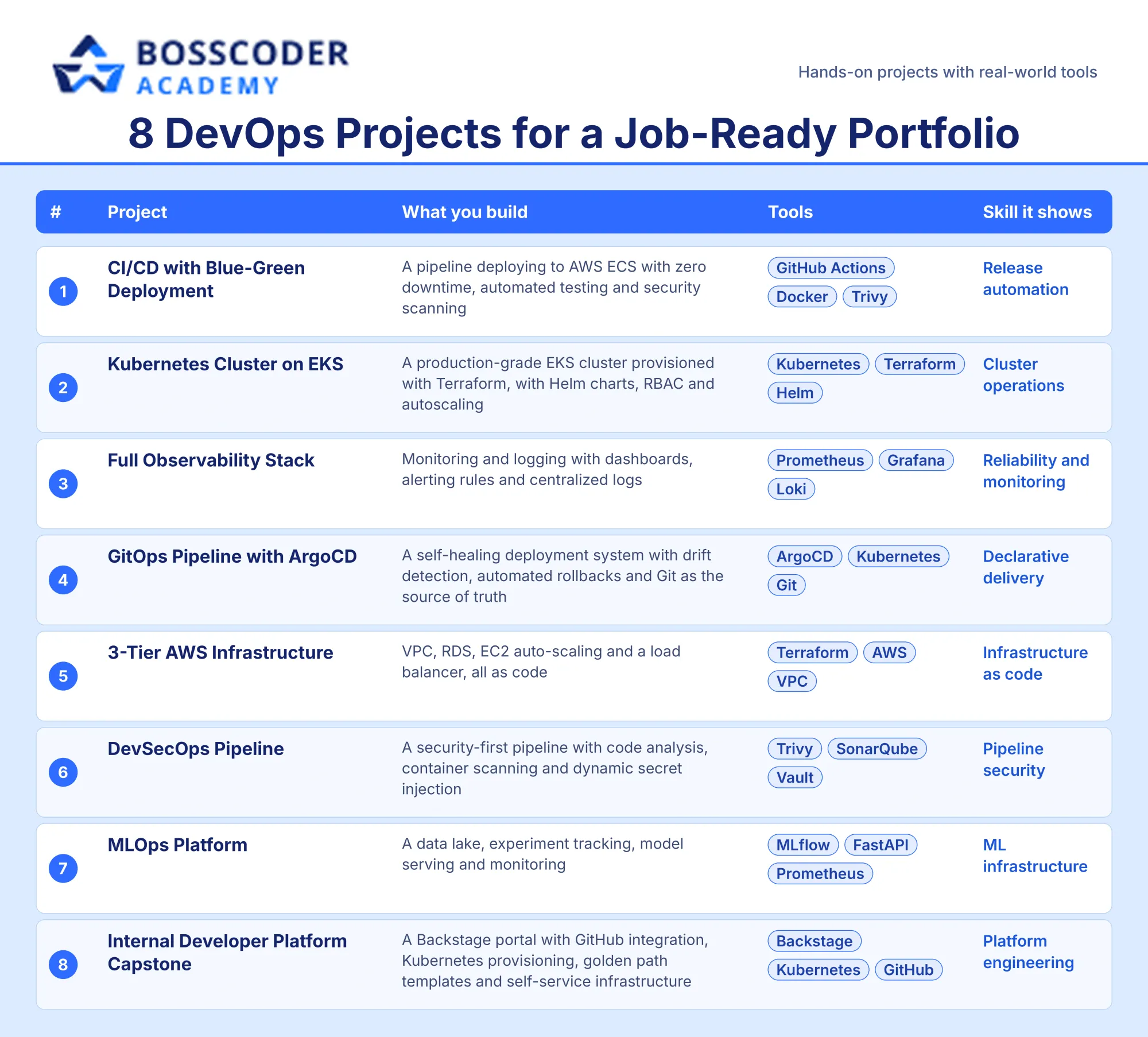
Projects are where most DevOps learning either becomes real or falls apart. Our program includes eight. Here is what you build and the skill each one demonstrates.
1. CI/CD with Blue-Green Deployment
Build a pipeline that deploys to AWS ECS with zero downtime, automated testing and security scanning. Shows release automation.
Tools: GitHub Actions, Docker, Trivy
2. Kubernetes Cluster on EKS
Build a production-grade EKS cluster provisioned with Terraform, with Helm charts, RBAC and autoscaling. Shows cluster operations.
Tools: Kubernetes, Terraform, Helm
3. Full Observability Stack
Set up monitoring and logging with dashboards, alerting rules and centralized logs. Shows reliability and monitoring skills.
Tools: Prometheus, Grafana, Loki
4. GitOps Pipeline with ArgoCD
Build a self-healing deployment system with drift detection, automated rollbacks and Git as the source of truth. Shows declarative delivery.
Tools: ArgoCD, Kubernetes, Git
5. 3-Tier AWS Infrastructure
Build a VPC, RDS, EC2 auto-scaling and a load balancer, all as code. Shows infrastructure as code.
Tools: Terraform, AWS, VPC
6. DevSecOps Pipeline
Build a security-first pipeline with code analysis, container scanning and dynamic secret injection. Shows pipeline security.
Tools: Trivy, SonarQube, Vault
7. MLOps Platform
Build a data lake with experiment tracking, model serving and monitoring. Shows ML infrastructure skills.
Tools: MLflow, FastAPI, Prometheus
8. Internal Developer Platform Capstone
Build a Backstage portal with GitHub integration, Kubernetes provisioning, golden path templates and self-service infrastructure. Shows platform engineering.
Tools: Backstage, Kubernetes, GitHub
Together, these projects give you something concrete to put on a resume and talk through in interviews.
Mentorship: How Bosscoder Academy DevOps Mentorship Program Works
In our program, mentorship means structured 1:1 sessions with working professionals from product-based companies. It is not an open-ended chat group. It has three parts:
- A goal-setting session at the start. You and your mentor define where you want to go, and that becomes your roadmap for the program.
- A 1:1 session after every module. When you complete a module, you sit down with a mentor to review where you stand before moving on.
- Guidance during placement. Mentors help you prepare for the questions asked in interviews and point you toward what is relevant in the industry right now.
This runs alongside live classes with labs and projects. Mentorship is where the guidance becomes personal to your background.
Meet the Mentors
- Ashish Prasad: SDE II (AI Infra) at Microsoft, with 10+ years of experience
- Vikas Sharma: Cloud Specialist at Microsoft, with 8+ years of experience and an NIT Allahabad degree
- Akshat Gupta: Kubernetes Expert at Arcesium, with 5+ years of experience
- Geetika Gupta: SDE III at Amazon, with 10+ years of experience
- Rajat Garg: Bosscoder co-founder and ex-Microsoft engineer who worked on PowerPoint’s web services, with 6+ years of experience
Career Support: Our 5-Step Placement Process
This is Bosscoder Academy DevOps career support process, and it is built around readiness, not a fixed date. Bosscoder Academy provides 100% Placement Assistance not a guarantee.
Step 1: Batch Eligibility
After four months, learners become eligible for the placement process. Joining is optional, and it’s up to you. The process is also recurring for life, so you can join whenever you feel ready.
Step 2: Placement Assessment
Our placement team tests you on everything you’ve learned in the course up to the point you join.
Step 3: Mock Interview
The placement team schedules a mock interview with you. This shows whether you are ready to go into the placement process or need more preparation first.
Step 4: Placement Cohort
You then move into the placement cohort, where you get access to job opportunities, more mock interview practice and profile optimization.
Step 5: Placement
Placement happens in one of three ways:
- Referrals, directly or indirectly from 400+ tie up companies
- Placement through mentors
- Placement through self. You apply on your own, and once you are shortlisted, we help you schedule a mentor session or mock interview.
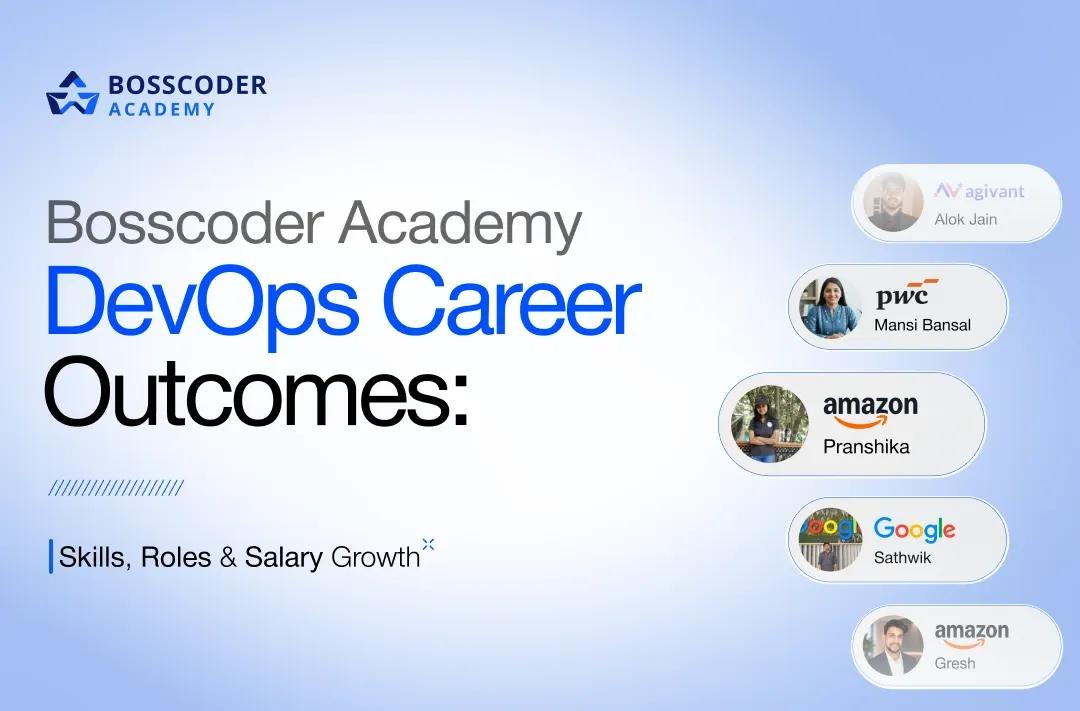
Bosscoder’s performance was independently assessed by B2K Analytics. 91% of learners transitioned to better roles during the evaluation period, with a 20 LPA average package, a 104% average salary hike and a 99 LPA highest package. For DevOps roles specifically graduates typically move into positions paying ₹12 to 30 LPA (DevOps and Cloud) or ₹20 to 45 LPA (Platform and MLOps), depending on prior experience. Treat these as typical ranges, not promises.
Verdict
In this Bosscoder Academy DevOps course review, the strengths are the program’s breadth, its project-heavy structure, a mentorship and placement model built around your readiness, and NASSCOM certification. This Bosscoder Academy DevOps course review comes down to one question: do you want a structured, guided path into DevOps, or are you happy to build one yourself?
If you want structure, the program has a lot going for it. It takes you from Linux and Git to Kubernetes, Terraform, GitOps, DevSecOps and MLOps in nine months. You build eight projects along the way, and the capstone is a working Internal Developer Platform. Mentorship is built into the program. You start with a goal-setting session, you have a 1:1 session after every module, and mentors who work at product companies guide your interview preparation. The five-step placement process is based on readiness rather than a fixed deadline, and you can join it whenever you feel prepared. The program also includes NASSCOM certification and Lifetime Success Portal access.
Frequently Asked Questions (FAQs)
Q1. Is the Bosscoder Academy DevOps course good for working professionals?
It is designed for working professionals such as software engineers, sysadmins and QA or test engineers moving into DevOps, Cloud or Platform Engineering. The program runs nine months with live classes.
Q2. Do I need prior DevOps or cloud experience?
Not specifically. A technical background helps you hit the ground running, and the program builds on your existing skills. It starts with Linux, Git and Docker before moving to Kubernetes, cloud infrastructure and AI/ML platform engineering, so you progress step by step instead of starting with advanced topics.
Q3. How long is Bosscoder Academy DevOps course and what does it cover?
The program runs nine months across eight modules: Linux and Git, Docker, CI/CD, Kubernetes and cloud, GitOps and observability, DevSecOps, MLOps and AI infrastructure, and internal developer platforms with career prep. Learners build eight projects along the way.
Q4. How does Bosscoder Academy mentorship work in the DevOps program?
Every learner has a goal-setting session at the start, which produces a roadmap. After each module, they have a 1:1 session with a mentor, who is a working professional at a product-based company. Mentors also guide placement preparation, including interview questions and industry-relevant skills.
Q5. How does Bosscoder Academy placement support work after the course?
Placement has five steps: batch eligibility after four months, a placement assessment, a mock interview, the placement cohort, and placement through referrals, mentors or self-applications. Joining is optional, and the process stays open for life. It’s support, not a job guarantee.