Introduction
If you work in QA, support, or system administration, or you're a developer with one to three years of experience, you've probably noticed infrastructure roles pulling ahead. Choosing a DevOps course with placement support is one way to make that switch with structure instead of guesswork.
This post covers what Bosscoder Academy's DevOps, Cloud & AI Platform Engineering program teaches, the roles it prepares you for, and what salary growth realistically looks like.
Why DevOps and Platform Roles Are Worth Considering in 2026
DevOps is no longer a back-office function. Teams now run pipelines, Kubernetes clusters, and increasingly, the infrastructure that serves ML models and LLMs in production.
Several job titles that are common today, including Platform Engineer, SRE, and MLOps Engineer, were rare in Indian hiring a few years ago. Industry analysts have also predicted that most large engineering organisations will set up dedicated platform engineering teams by 2026.
For working professionals, this matters for one reason: these roles reward hands-on systems knowledge more than seniority. A QA engineer who already writes automation scripts or a sysadmin who manages Linux servers has a real head start.
What You'll Learn: Skills Covered Module by Module
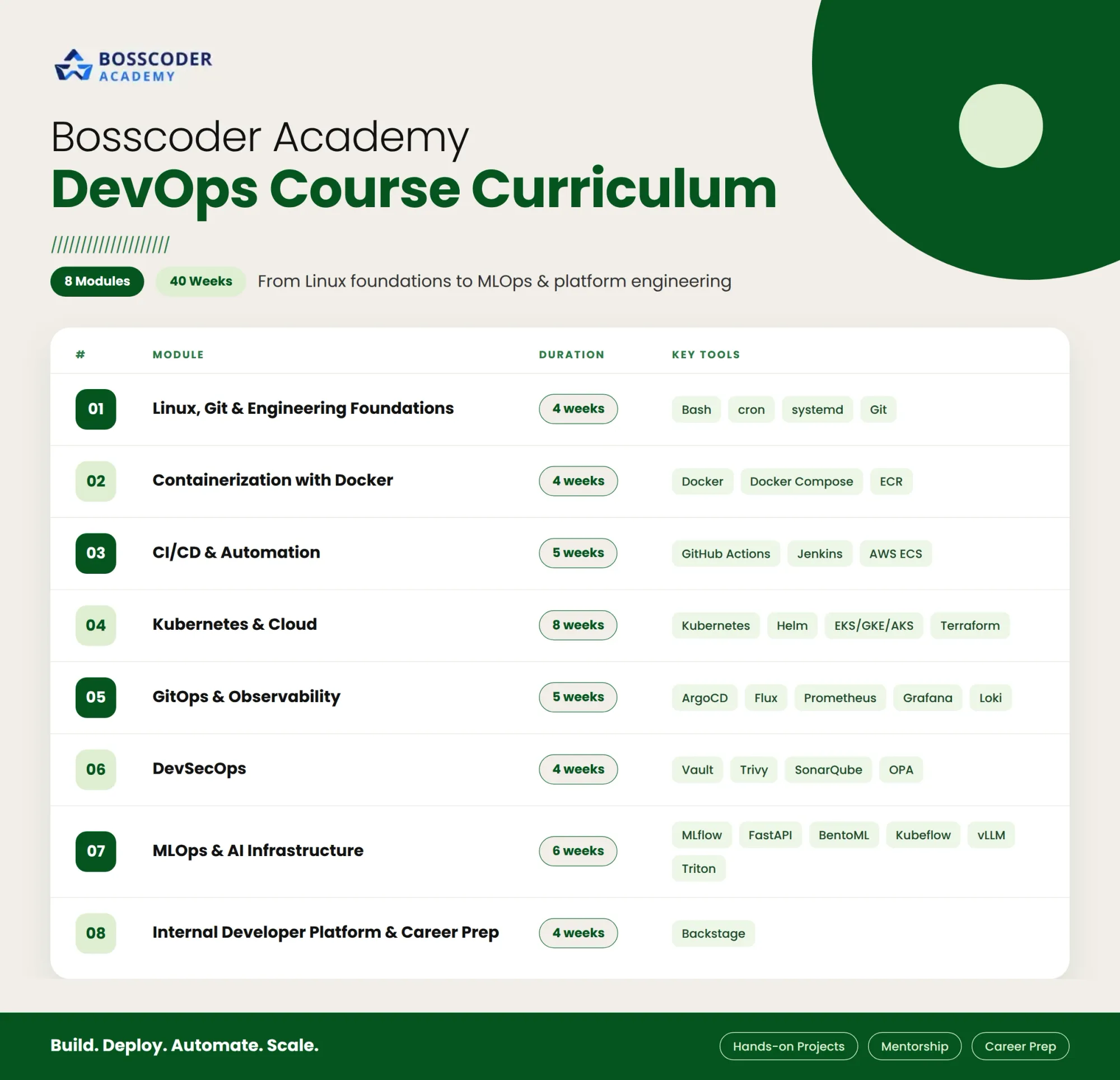
The program runs for 9 months across 8 modules, with live learning and production-style projects.
What stands out in this curriculum
- It goes beyond CI/CD basics. Many DevOps courses stop at Jenkins and a single cloud. This one covers Terraform across clouds, GitOps, and a dedicated security module.
- MLOps is a full module, not a bonus lecture. Six weeks on model serving, GPU Kubernetes, and LLM deployment tools like vLLM and Triton is unusual for a DevOps program.
- Projects are spread across the program. Learners build 8 projects, with each listed at 12 to 16 hours of build time.
Job Roles This Program Targets
The program is built around four role tracks. Here's what each one actually involves day to day.
DevOps Engineer
You build and maintain CI/CD pipelines, containerize applications, and automate cloud deployments. This is the most common entry point for people moving from QA, support, or backend development.
Platform Engineer / SRE
You own the systems other engineers build on: Kubernetes clusters, internal tooling, and the monitoring and alerting that keep products running. SRE roles add a strong focus on reliability targets and incident response.
Cloud Engineer / Architect
You provision and manage infrastructure as code using tools like Terraform, with attention to cost, security, and resilience across AWS, GCP, or Azure. Architect-level roles usually require several years of hands-on cloud experience.
MLOps / AI Platform Engineer
You deploy and monitor ML models and LLMs in production, often on GPU clusters. This role sits between data science and infrastructure, and it's one of the newer specialisations in the market.
Salary Ranges for Target Roles
Graduates typically move into roles paying ₹12 to 30 LPA (DevOps/Cloud) or ₹15 to 30 LPA (Platform/MLOps), depending on prior experience.
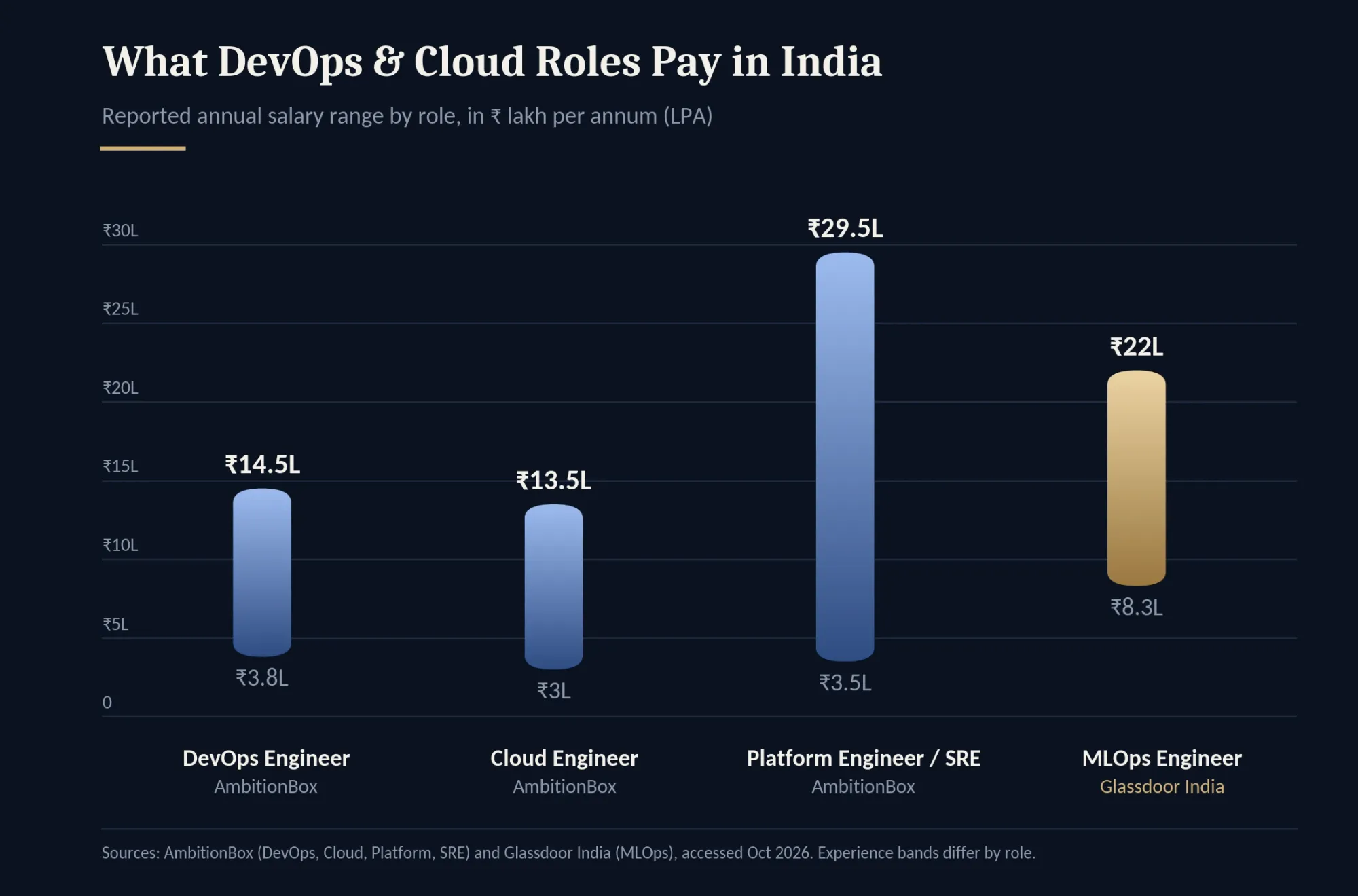
What actually drives your salary jump
A course doesn't set your salary. These factors do:
- Your current experience. Someone with 4 years in sysadmin work will typically negotiate a higher package than someone with 1 year in support.
- Project depth. Interviewers ask you to walk through real architecture decisions. A deployed EKS cluster you can explain beats a list of tools on a resume.
- Target company type. Product companies and GCCs generally pay more than service companies for the same title.
Bosscoder's Placement Support: What's Included
A DevOps course with placement support is only as useful as the support itself. , Bosscoder's placement process has three parts:
- Profile building
- Resume optimized to highlight project work
- LinkedIn optimized for recruiter visibility
- Curated roles matched to your profile, with application guidance
- Referrals
- Access to an alumni network across product companies
- Mentors and instructors referring high-performing learners
- Real-time sharing of relevant openings
- Company tie-ups
- 500+ hiring partnerships across tech companies
The placement support as "end-to-end, until placed." Note that this is ongoing support, not a job guarantee.
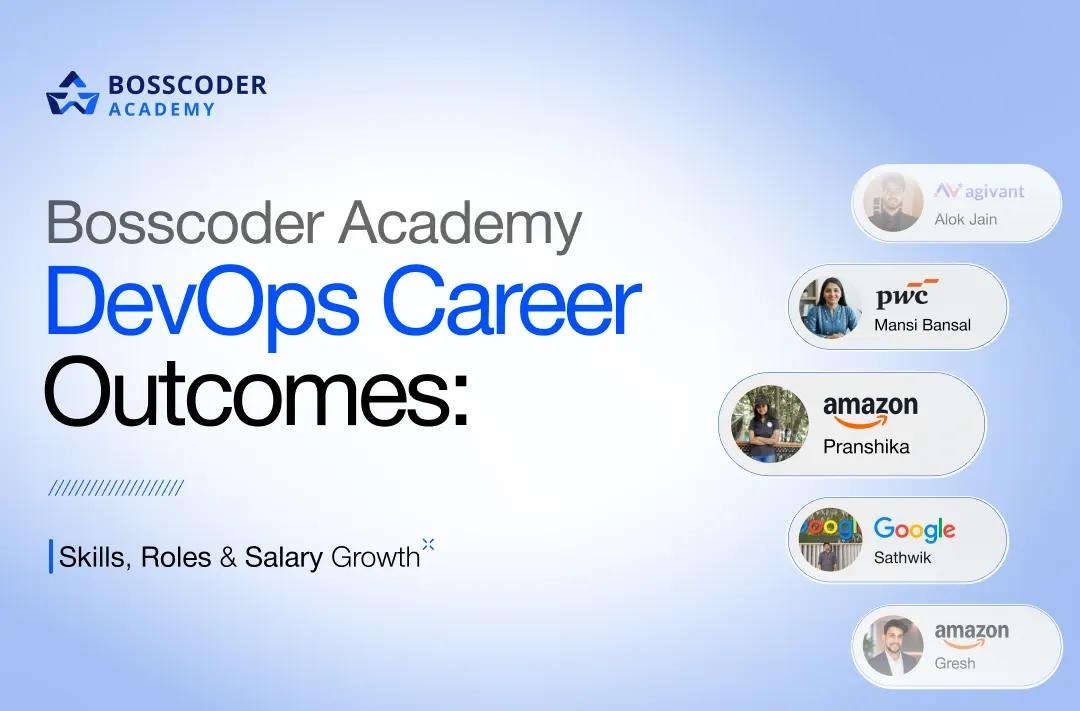
Bosscoder alumni across programs work at companies including Google, Amazon, Microsoft, Adobe, Flipkart, JP Morgan, and American Express.
Who Should Join Bosscoder DevOps Course
Being honest here saves everyone time.
This program is a strong fit if you are:
- A QA or test engineer who already writes automation and wants to own pipelines
- A sysadmin or support engineer looking to move away from shift work into engineering roles
- A backend developer (roughly 1 to 3+ years) who wants to own infrastructure, not just ship features
- Someone already writing Dockerfiles or debugging deployments without a structured foundation
Conclusion
A DevOps career switch works best when you have three things: a structured path through the tools, real projects you can defend in interviews, and support when you start applying. Bosscoder's program covers all three, with an unusually deep focus on Kubernetes, GitOps, DevSecOps, and MLOps.
It's not a shortcut. It's a 9-month commitment best suited to working professionals who already have some technical footing and want to move into higher-ownership infrastructure roles.
Frequently Asked Questions (FAQs)
Q1. Does Bosscoder Academy's DevOps course include placement support?
Yes. The program includes profile building (resume, LinkedIn, curated roles), referrals through alumni and mentors, and access to 500+ hiring partnerships. Bosscoder describes this support as continuing until you're placed. It is support, not a job guarantee, so outcomes still depend on your effort, experience, and interview performance.
Q2. How long does it take to complete the Bosscoder DevOps course?
The program runs for 9 months across 8 modules, totalling about 40 weeks. Modules range from 4 weeks (Linux, Docker, DevSecOps, Platform Engineering) to 8 weeks (Kubernetes & Cloud). Classes are live, and learners complete 8 hands-on projects, including a final capstone building an internal developer platform with Backstage
Q3. Does the course cover MLOps and AI infrastructure?
Yes. Module 7 is a 6-week deep dive into MLOps, covering MLflow experiment tracking, model registries, feature stores, model serving with FastAPI and BentoML, GPU scheduling on Kubernetes, and LLM deployment with vLLM and Triton. Learners build an end-to-end MLOps platform as the module project.
Q4. Can a QA or support engineer switch to a DevOps role?
Yes, and it's one of the most common transitions. QA engineers already understand testing and automation, while support engineers know how production systems fail. Both map well to CI/CD and observability work. You'll need to build Linux, cloud, and Kubernetes skills, ideally backed by deployed projects you can explain in interviews.