Operating System (OS) is one of the key topics in software engineering interviews. No matter whether you are preparing for Amazon, Microsoft, Google, Walmart Global Tech, Adobe, Atlassian, or even any other growing start-up, studying Deadlock Avoidance in OS will be helpful to you in cracking those technical interviews.
Professionals may be familiar with the concept of deadlocks but face difficulty explaining how the operating system avoids them. The interviewers often question about Banker's Algorithm, safe state, unsafe state, and resource allocation to test the problem-solving ability.
This blog covers all aspects of Deadlock Avoidance in Operating Systems through easy-to-understand language along with examples, interview tips, and FAQs.
Deadlock in Operating Systems
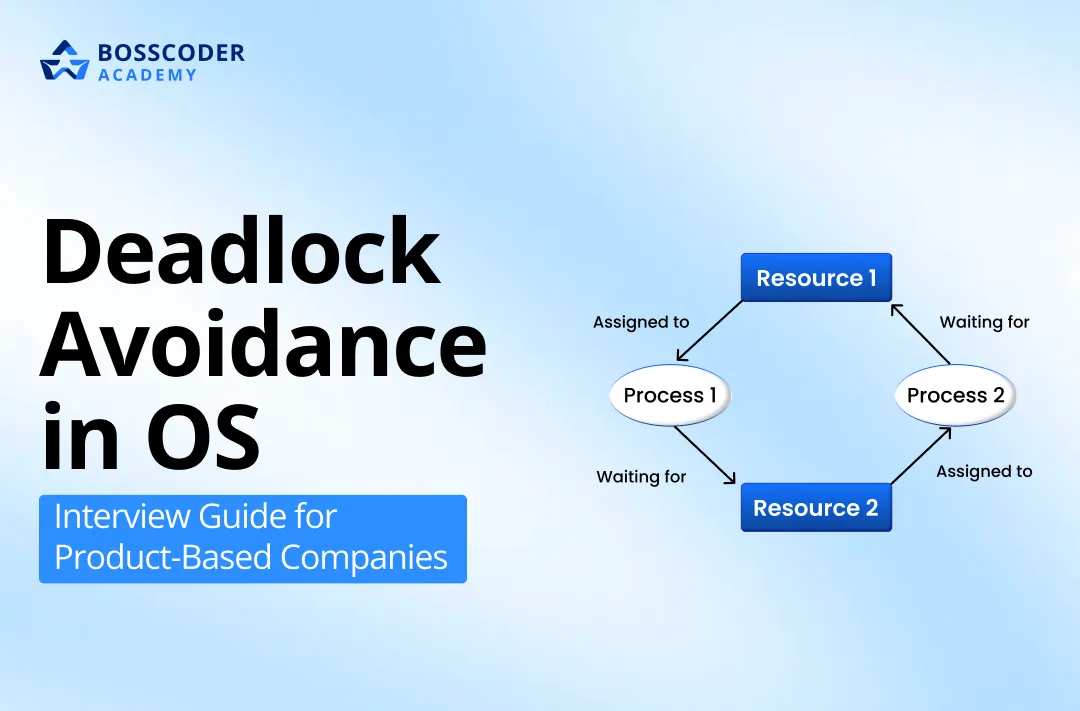
A deadlock occurs when two or more processes are waiting for resources occupied by each other, and none of them can proceed with execution.
Example
Consider two students using shared resources:
→ Student A has a printer but requires a scanner.
→ Student B has a scanner but requires the printer.
Both will wait infinitely.
In the operating system, processes will wait indefinitely for resources too.
Deadlock Avoidance in OS
Deadlock avoidance is a method of allocating resources such that before allocating the requested resource, the operating system verifies its requirement.
How easy it sounds!
Just allocate resources if the state of the system is still safe after allocating.
But in case of any possibility of deadlocks from allocating that resource request, the operating system denies its request.
Unlike deadlock prevention, deadlock avoidance makes decisions dynamically based on the current state of the system.
Why is Deadlock Avoidance Important?
Deadlock avoidance allows the operating system to:
→ Prevent processes from being permanently trapped
→ Increase system stability
→ Achieve efficient utilization of resources
→ Avoid application crashes
→ Ensure efficient execution of several applications
This technique has become even more relevant today with regard to distributed systems, cloud computing, databases, and advanced operating systems.
Understanding how an operating system manages hardware resources is equally important. Read Which of the Following is Abstracted by an Operating System? to strengthen your OS fundamentals.
Safe State V/S Unsafe State
These two terms should be known for interviews.
Safe State
The system is said to be in a safe state when all processes can run and terminate normally without facing any issues due to available resources.
Even if all the processes use the maximum amount of their resources, there exists an execution sequence through which all of them can be completed.
Unsafe State
An unsafe state doesn't imply that a deadlock situation has occurred.
It only means that there may occur situations where the processes will face a deadlock situation due to future resource requests.
Interview Tip: All deadlocks are unsafe states, however, not all unsafe states can be classified as deadlocks.
This concept is usually asked in the Operating Systems interview.

How Does Deadlock Avoidance Work?
Steps followed by the operating system include:
- A process makes a request for a resource.
- The operating system tests whether the request will make the system safe.
- If the system is still safe after the request, then the request is fulfilled.
- In case the request makes the system unsafe, it is deferred until there are enough resources.
This step is taken by the operating system in every allocation.
Banker’s Algorithm
The Banker’s Algorithm is the most widely used deadlock avoidance algorithm in Operating Systems.
The algorithm was invented by Edsger W. Dijkstra and is a commonly asked question in coding/systems interviews.
The algorithm functions in a way that is similar to a bank providing loans.
A bank provides a loan as long as it has enough money to provide to other customers.
Likewise, the operating system allocates resources only when all processes are guaranteed to finish.
Data Used in Banker's Algorithm
The algorithm maintains four important values.
Four important values are used in the algorithm.
| Term | Meaning |
|---|---|
| Available | Currently available resources |
| Maximum | Maximum requirements of a process |
| Allocation | Resources already assigned |
| Need | Remaining resources needed |
Formula:
Need = Maximum – AllocationInterviewers often ask candidates to calculate the Need Matrix during OS interviews.
Steps for Banker’s Algorithm
Banker’s algorithm works as follows:
- Compute Need matrix.
- Select a process with its remaining needs that can be satisfied.
- Temporary allocation of resources.
- Release resources once the process completes.
- Continue until all processes complete.
- In case there is no process which could proceed, the system becomes unsafe.
Example of Banker’s Algorithm
Say:
Number of Available Resources = 3
| Process | Need |
|---|---|
| P1 | 2 |
| P2 | 1 |
| P3 | 4 |
The operating system then performs the following:
→ P2
→ Releases resources
→ Performs P1
→ Releases resources
→ And finally, performs P3
As all processes complete with success, the system is always in a safe state.
Advantages of Deadlock Avoidance
They are as follows:
→ Avoids deadlocks from happening beforehand
→ Effective utilization of resources
→ Makes the system reliable
→ Ensures smooth performance of processes
→ Avoids wasteful waiting
Limitations of Deadlock Avoidance
Though having its advantages, it has some disadvantages as well.
→ Each process needs to declare its maximum requirement of resources beforehand.
→ Safety checks consume additional overhead continuously.
→ Not suitable for unpredictable resource use systems.
→ Difficult to implement in very large distributed systems.
Deadlock Avoidance vs Deadlock Prevention
| Feature | Deadlock Avoidance | Deadlock Prevention |
|---|---|---|
| Decision | Dynamic | Static |
| Resource Check | Before allocation | Removal of Deadlock Conditions |
| Flexibility | High | Lower |
| Utilization of System | Better | Can Be Lower |
| Complexity | Higher | Simpler |
OS Interview Preparation Tips for Product-Based Company Interviews
The study of Operating System is not merely about learning and remembering theoretical definitions,candidates should have the ability to define and explain theoretical concepts in practice.
While preparing for OS Interviews:
- Give preference to basic concepts before learning advanced ones.
- Try to understand the concept behind algorithms rather than following a procedure.
- Learn safe state and Banker's Algorithm.
- Go through concepts of process scheduling, synchronization, memory management, and deadlocks.
- Solve interview questions asked in previous product-based company interviews.
If you aim to switch into companies such as Amazon, Microsoft, Walmart, Adobe, and many other topmost product-based companies, gaining expertise in Operating Systems besides DSA, System Design, and Low-Level Design can help you perform better in your interviews.
At Bosscoder Academy, working professionals learn these interview-focused fundamentals through structured roadmaps, live sessions, mock interviews, and mentorship from experienced engineers. Instead of only learning theory, the curriculum focuses on applying concepts to real interview scenarios, helping learners build confidence for product-based company interviews.
Want to practice more OS concepts? Explore our Operating System Interview Questions covering deadlocks, process scheduling, memory management, synchronization, and more.
Final Thoughts
Deadlock avoidance is one of the most crucial topics in Operating Systems for software engineering interviews. You need to understand the concepts of safe states, unsafe states, and Banker's Algorithm in order to answer the questions asked and solve problems in interviews.
Rather than trying to mug up the definitions, try to get an understanding of how the operating system decides whether allocating the resources is safe or not.
Operating Systems along with DSA and System Design is a good combination to prepare for interviews.
Ready to test your Operating System knowledge? Take our Operating System MCQ Test and practice interview-focused questions on deadlocks, memory management, scheduling, and more.
Frequently Asked Questions on Deadlock Avoidance in OS
Q1. Explain deadlock avoidance in an operating system?
Deadlock avoidance is a concept where an operating system allocates resources when the allocation is done in such a way that the system stays in a safe state.
Q2. Difference between deadlock prevention and deadlock avoidance?
In deadlock prevention, one or more conditions for a deadlock are removed. But in deadlock avoidance, the operating system sees if granting the resource request will make the system in a safe state or not.
Q3. Why is Banker's Algorithm used in deadlock avoidance?
The Banker's Algorithm is used to see if the resource request can be safely granted. It will make sure that the system is in a safe state to avoid deadlock.
Q4. Is deadlock avoidance important in product-based company interviews?
Yes. Deadlock avoidance is an important OS topic which interviewers in product-based companies usually ask questions on. They ask about safe state, unsafe state, Banker's Algorithm, and practical deadlock.