While studying Database Management Systems (DBMS), most professionals tend to study about entities, relationships, normalization, and SQL queries. One topic that often comes up in software engineering interviews is Aggregation in DBMS.
Aggregation helps represent situations where a relationship itself is involved in another relationship. Although the idea may sound difficult, but once understood through an example, it is very easy.
For those students of computer science who want to prepare themselves for exams or professionals who wish to make a shift to a product-based company, this concept will surely help you solidify your fundamentals of DBMS.
The following section will cover:
- What Aggregation in DBMS is
- What is the need of Aggregation
- Types of Aggregation
- Examples from the real world
- Advantages and limitations
- Applications
- Popular interview questions
New to database concepts? Start with our blog on What is a DBMS to understand the fundamentals before exploring advanced topics like aggregation and ER models.
Let's get started.
Aggregation in DBMS
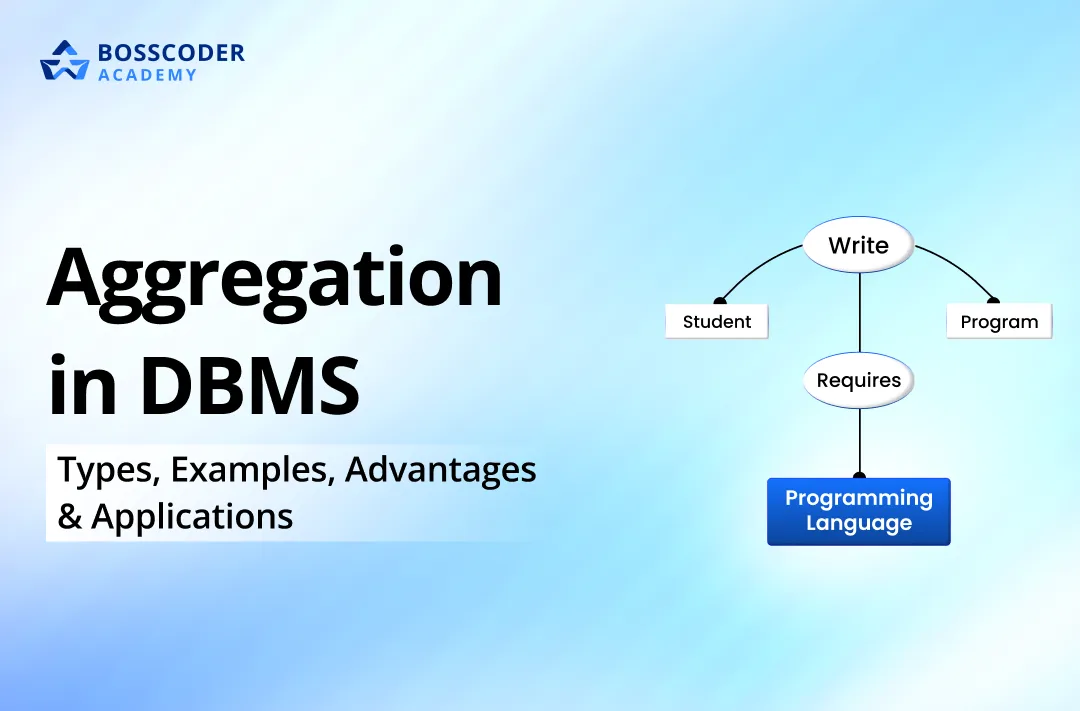
The concept of Aggregation in DBMS is a form of abstraction methodology applied in the Entity Relationship (ER) Model. It involves considering the relationship between entities as an entity in order to enable it to be involved in a relationship.
In other words:
Instead of forming relationships between entities only, aggregation enables relationship to form a relationship with another entity.
It is normally employed when one relationship is dependent upon another relationship.
Simplified Definition
Aggregation in DBMS is a method whereby a relationship set is considered an entity set.
Why do we require Aggregation in DBMS?
There are some cases where entities and relationships are not sufficient enough to represent certain situations.
Let us consider an example here:
- Employee works on Project.
- Manager supervises work done by the employee in the project.
Here, manager does not supervise the employee nor he supervises the project alone.
Manager supervises the relationship between Employee and Project.
Aggregation allows modeling of this situation in the best way possible.
In the absence of aggregation, ER diagram would look vague and meaningless.
Real Life Example of Aggregation in DBMS
Take the example of a software company.
- Entities
- Employee
- Project
- Manager
Relationship
Employee → Works On → Project
Now let's assume the following case
Manager → Monitors → (Employee Works On Project)
In this case, "Works On" is treated as one single entity through aggregation.
Types of Aggregation in DBMS
Aggregations are usually categorized according to their usage in the following ways.
1. Simple Aggregation
Simple aggregation is the most popular type of aggregation.
There is a relation between two entities, which is combined to make one entity.
Example
Employee → Works On → Project
Manager oversees this relation.
2. Nested Aggregation
In case of more complicated database systems, one aggregation can be included in another aggregation.
This forms different levels of abstractions.
Usually nested aggregation is employed in large scale enterprise systems.
Components of Aggregation
Aggregation consists of basically three components.
Entities
Entity objects such as:
- Employee
- Student
- Customer
- Product
Relationships
Relationships between entities.
Examples:
- Purchases
- Works On
- Enrolls
- Owns
Aggregated Entity
The relationship itself is taken as an entity in a new relationship.
Example of Aggregation in DBMS
Let us consider a database for a university.
- Entities
- Student
- Course
- Professor
Relationship
Student → Enrolls In → Course
Here,
The professor evaluates the enrollments of the student.
Not connecting professor to Student/Course individually but the professor evaluates the enrollment relationship itself.
Aggregation vs Generalization in DBMS
| Aggregation | Generalization |
|---|---|
| Shows a relationship as an entity | Groups several entities to form a parent entity |
| Focuses on relationships | Focuses on inheritance |
| Done for abstraction of relations | Done for creating hierarchies |
| Resolves issues related to relations | Resolves issues related to classifications |
Advantages of Aggregation in DBMS
There are many advantages of aggregation in database management systems.
Effective Representation
It represents a complex scenario in business efficiently.
Efficient Database Design
Relations get represented in a much better way.
Easy Maintenance
Database designs become easier to maintain.
High Degree of Abstraction
The process of aggregation provides data abstraction.
Effective for Real Projects
Enterprise applications often require aggregation to model real-world workflows correctly.
After learning aggregation, explore BCNF in DBMS to understand how database normalization improves data consistency and reduces redundancy.
Limitations of Aggregation
Even as aggregation is useful, it has some limitations.
- Complexes ER diagrams slightly.
- Beginners might find it hard to comprehend at first.
- Not necessary for small databases.
- Too much aggregation makes the diagram harder to read.
Applications of Aggregation in DBMS
Aggregation is commonly applied in all industries.
Banking Systems
To illustrate the approval of loans, customers, and bank staff.
E-commerce Websites
To model customers, their orders, and product delivery.
Hospital Management Systems
For representing doctors dealing with patients in certain departments.
University Management Systems
For illustrating students' enrollment, courses, professors, and evaluations.
Project Management Software
For representing employees working in projects managed by managers.
Aggregation in SQL
Aggregation is another term that is often heard in SQL.
But the aggregation functions in SQL differ from aggregation in ER model.
SQL aggregation is about summarizing data using some functions.
Some common aggregation functions in SQL include:
- COUNT()
- SUM()
- AVG()
- MAX()
- MIN()
Example
SELECT AVG(Salary)
FROM Employees;
It will give the average salary of all the employees.
Note:
- Aggregation in DBMS (ER Model) = Relationship abstraction
- Aggregation in SQL = Data summarization
Such questions are often asked in interviews.
Aggregation in DBMS Interview Questions
Following are some commonly asked interview questions.
1. What is aggregation in DBMS?
Aggregation is a technique of abstraction where a relationship is considered as an entity that can form a relationship itself.
2. Why do we use aggregation?
It helps in representing real-life situations which consist of relationships between relationships.
3. What is the difference between aggregation and generalization?
Aggregation represents relationship, while generalization represents inheritance between entities.
4. Is aggregation different from SQL aggregate functions?
Yes, it is. Aggregation in DBMS belongs to the ER model, whereas SQL aggregate functions represent summarizing data.
Ready to test your DBMS knowledge? Take our DBMS MCQ Test and practice interview-focused questions on ER models, normalization, transactions, SQL, and more.
Common Mistakes Made by Learners
Learners usually get confused between aggregation and other DBMS concepts.
Do not make these mistakes:
- Get confused between aggregation and SQL aggregate functions.
- Confusion between aggregation and other concepts like composition or generalization.
- Use of aggregation where a relationship would be enough.
- Ignoring real-life situations while making ER diagrams.
How to Learn DBMS Concepts for Product-Based Company Interviews
Learning definitions alone isn't enough if you're preparing for technical interviews.
Top product-based companies check the candidate's capability to implement DBMS concepts in practical scenarios. Apart from aggregation, some other important concepts include:
- ER diagrams & Database design
- Normalization
- Transaction Management & ACID properties
- Indexing
- Join
- SQL Optimization
- Concurrency Control
At Bosscoder Academy, working professionals learn DBMS concepts along with System Design, SQL, DSA, and interviews through a well-designed learning path. Instead of memorizing concepts, learners build the practical understanding needed to solve interview problems and perform confidently in software engineering interviews at leading product-based companies.
Want to strengthen your DBMS interview preparation? Read our blog on Serializability in DBMS to understand transaction consistency and concurrency control.
Conclusion
Aggregation in the Database Management System is an essential topic that helps in enhancing the modeling of the complex relationship in the ER diagram by considering the relationship as an entity itself.
Whether it is the preparation for the exam in university or preparation for software engineering interview questions, learning about aggregation will help you in solving conceptual questions easily.
Learn about aggregation with SQL, normalization, indexing, and system design to be ready for database interviews.
Frequently Asked Questions (FAQs)
Q1. What is aggregation in DBMS with an example?
Aggregation in DBMS is an abstraction approach where a relationship is considered as an entity. Example - When an employee works on a project, and a manager manages this task, then “Works On” relationship is aggregated and managed by the manager, not the individual entities.
Q2. What is the difference between aggregation and SQL aggregate functions?
Aggregation in DBMS is related to the ER model whereas SQL aggregate functions such as COUNT, SUM, and AVG are functions which are used for summarizing the data in the database.
Q3. Why do we need aggregation in DBMS?
Aggregation is needed in DBMS because of its role in accurate modeling of complex real-world relationships, better design of ER diagrams and making large database system more understandable.
Q4. Is aggregation in DBMS useful for software engineering interviews?
Yes. This is one of the common DBMS concepts in the interviews for software engineers at product-based organizations. Understanding it alongside ER diagrams, normalization, and SQL can improve your interview performance.