There has been an increase in demand for Data Engineers over the last few years.
Every application today is generating huge amounts of data and we are doing this on a real-time basis every day like movies on Netflix, rides through Uber, ordering food via Swiggy, shopping at Amazon and so on with each having thousands of data points generated every second.
However, if all of these data points were generated into "raw data" there would be no way to have any use for them.
Thus someone will have to collect all these data points, organize them, transfer them between systems and get them to the Analysts, Business Teams and AI Models.
That’s where Data Engineers fill the gap in helping with the above processes.
With the ever-increasing number of top tech companies investing in Data Driven Decision Making with the use of AI Systems, the field of Data Engineering has emerged as one of the most valuable career options within the tech industry.
For professionals who are currently working in tech positions, learning Data Engineering can be quite difficult since there are literally hundreds of options available on the internet for tools, courses, tutorials and so on.
In this blog, we will look at the Bosscoder Academy’s Data Engineering Program Curriculum, Mentorship Model, Projects Completed within the Program and Placement Support to determine how the Bosscoder Academy Data Engineering Program assists people with growing their Data Engineer Skill Sets.
Why Data Engineering Is Becoming One of the Most Important Tech Roles
Consider Netflix. When you watch a show on Netflix, here is what they track about your viewing activity:
→ What show are you watching
→ When you paused your viewing session
→ The device you’re using to access Netflix
→ How long you watched the episode
→ What you searched for next
All this user activity data is passed through various data pipeline layers before it’s sent to the analytics teams and recommendation systems that use that information to provide recommendations to viewers.
Now consider Uber. Each trip taken by an Uber driver generates the following data:
→ GPS location updates for each trip
→ Information about the driver of the vehicle
→ Various trip-related events throughout the ride
→ Trip-related payment data
This type of information needs to be processed as close to real time as possible.
Now think about how quickly Amazon processes:
→ Customer product searches
→ Customer product purchases
→ Updates to inventory
→ Customer product reviews
→ Product recommendation data
It is critically important that all data infrastructure be reliable on a large scale.
Finally, think of Spotify.
Spotify processes billions of listening events and analyzes those events to create features such as “Discover Weekly” and personalized recommendations for each of its listening users.
Behind all these systems are Data Engineers who design and support the infrastructure that provides access to and use of data.
Bosscoder Academy’s Data Engineering Program
The Bosscoder Academy Data Engineering Program is a structured 8-month online learning program designed for working professionals who want to transition into Data Engineering or strengthen their data skills while continuing their jobs.
Data Engineering Program is built around practical concepts found within the Data Engineering domain, such as:
- SQL
- Python
- Data Storage Options
- Data Model Design
- ETL (Extract, Transform, Load) Processes
- Big Data Systems
- Cloud Services
- Data Engineering System Design
- GenAI Fundamentals
The primary goal of the data engineering program is to help learners acquire important industry skill sets using a structured program with clear objectives, rather than relying on random data resources.
Understanding the Curriculum
One of the biggest challenges in learning Data Engineering is deciding what to learn first.
Should you learn SQL first? Or How about Python?
Or, Spark? Or Cloud? Or Data Warehousing?
Most professionals spend time watching YouTube videos or reading documentation without having a proper roadmap.
The curriculum of Bosscoder attempts to solve this problem with organized, structured learning modules.
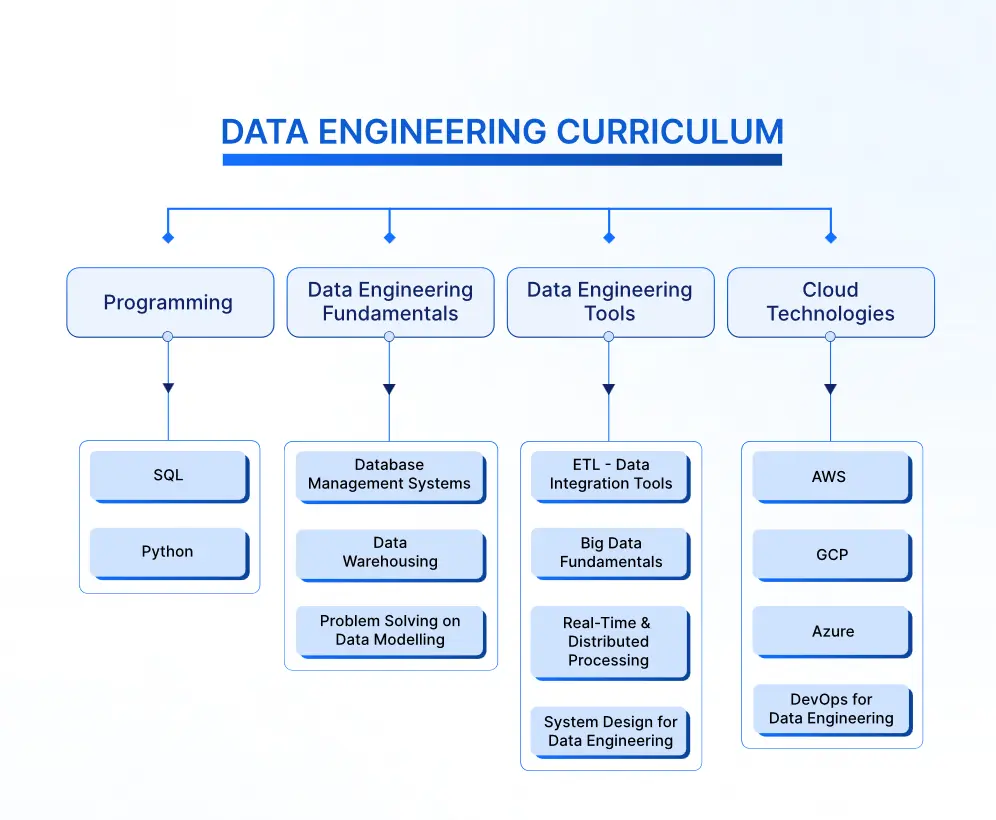
Module 1: SQL and Python
All Data Engineers start with the fundamental building blocks of Data Engineering.
The starting place for the curriculum will be:
SQL
SQL will be used throughout your entire Data Engineer career.
Example Of SQL Use In Data Engineering:
A Data Engineer would need to write a SQL query to get the number of customers that placed an order last week.
Python
Companies like Netflix, Spotify, and Airbnb use Python extensively within their data systems.
Python can be used for:
→ Data Processing
→ Automation
→ ETL Pipelines
→ Data Validation
→ Workflow Orchestration
Module 2: Data Engineering Fundamentals
When using this module, you will learn your data engineering skills in-depth and the basics of data management.
Some of all of the responsibilities of the types of databases that you will work with are:
→ Database Management Systems
Knowing the ways in which data is currently stored and accessed within your organization, and how best to achieve that.
→ Data Warehousing
Understanding the difference between analytical systems versus transactional databases.
Examples include:
→ Snowflake
→ Amazon Redshift
→ BigQuery
→ Data Modeling
The way in which you create structures that can be used fastest for reporting and analytics is called data modeling
All of these concepts relate directly with one another and are the building blocks of your data platform today.
Module 3: Data Engineering Tools
The technologies typically utilized in the deployment of a data engineering project will be covered in this module.
Topics that will be covered include:
ETL Systems
Extraction-Transformation-Loading
An example of how an ETL system would work is eCommerce companies that could collect data from their website, mobile application and their payment processing systems and combine all three into a single warehouse.
Big Data Fundamentals
When volumes of data increase so much that they exceed the capacity of traditional systems, concepts and definitions associated with that data are introduced in this section.
Real-Time Processing
Real-time data processing is necessary for applications like Uber and Swiggy where business decisions are based on a live event. This module will provide an understanding of how a real-time processing system would be constructed.
Data Engineering System Design
As engineers get better with time, they begin to create systems instead of just maintaining ones that already exist.
This module will present engineers with topics like:
- Building a scalable pipeline
- Data architecture
- Distributed systems
- Reliability considerations
Example:
If you had to design a data pipeline capable of processing millions of Swiggy orders per day....
Questions like the one above can often be asked during interviews at product-based companies.
Module 4: Cloud Technologies
The majority of today's Data Engineering infrastructures are deployed on the cloud.
The following three Cloud providers are referenced: AWS, Google Cloud Platform (GCP) and Microsoft Azure
An example of how a startup could implement a complete Cloud Infrastructure would be to use AWS S3 for storage, Spark for processing and a Cloud Warehouse for analytics.
Data engineers today must be proficient in cloud architecture as it has become a critical skill for the profession.
Important Add-ons
The Data Engineering industry is evolving rapidly. Today, top tech companies are not only looking for professionals who can build and manage data pipelines but also engineers who understand how modern AI systems interact with data infrastructure.
To help learners stay aligned with current industry demands and future technology trends, Bosscoder Academy has included a few advanced modules as important add-ons to the Data Engineering Program.
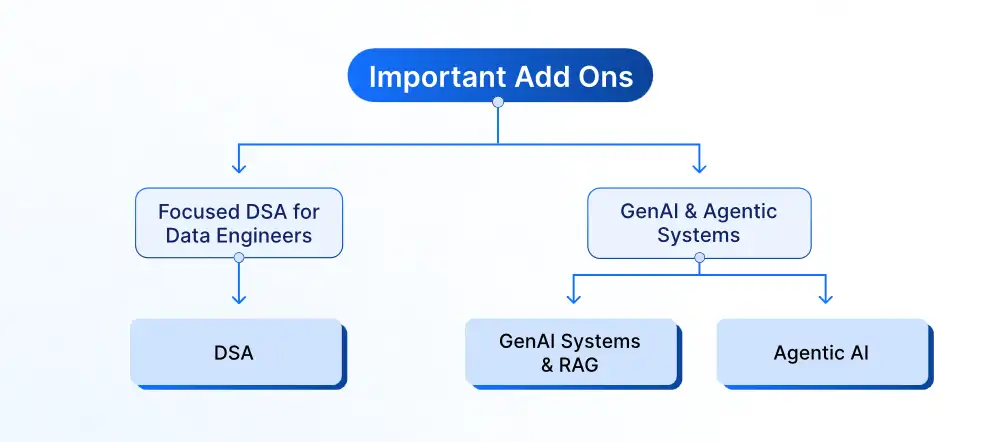
Focused DSA for Data Engineers
Data Engineering interviews at leading product-based companies often evaluate problem-solving ability and coding fundamentals alongside data-specific concepts. To help learners prepare effectively, the program includes a focused DSA module tailored for Data Engineering roles.
Key topics include:
→ Arrays & Strings
→ Hashing
→ Sliding Window
→ Two Pointers
→ Stack & Queue
→ Basic Trees & Graphs
Rather than covering every advanced DSA topic, the focus is on the patterns and concepts most commonly asked in Data Engineering interviews and useful for building efficient data processing solutions.
GenAI & Agentic Systems
As AI applications continue to scale, the demand for Data Engineers who understand AI infrastructure is growing significantly. Modern AI systems depend heavily on efficient data pipelines, vector databases, retrieval systems, and scalable data architectures.
To help learners stay ahead of this shift, the curriculum includes exposure to:
- Large Language Models (LLMs)
- Prompt Engineering
- Retrieval-Augmented Generation (RAG)
- Vector Databases
- Agentic AI concepts
These topics provide a foundational understanding of how AI-powered applications are built and how Data Engineering supports modern AI ecosystems.
Want a detailed breakdown of the learning roadmap? Explore the Bosscoder Academy Data Engineering Program Curriculum Explained guide to understand what you'll learn and how the curriculum is structured step by step.
Mentorship Support
While having a structured curriculum is certainly beneficial but having someone else provide guidance can be just as valuable.
The program also provides 1:1 mentorship support for every learners to engage with experienced professionals who worked at top product based companies for:
- Guidance about career
- Learning strategies
- Mock interviews
- Review progress
- 1:1 project guidance
For many working professionals receiving 1:1 mentorship has made it easier to know what to do and keep progress consistent throughout their learning experience.
Industry Projects and Practical Learning
Theoretical knowledge about Data Engineering won’t give you enough experience to succeed as an engineer thus, we also implement a range of practical implementation-based assignments and projects throughout the course.
Rather than just learning about data engineering concepts and theory, you will work on developing real production systems for:
→ Ingesting data
→ Transforming data
→ Building pipelines
→ Creating data warehouses
→ Deploying to the cloud
Some of the industry-inspired projects covered as part of the program include:
→ Tesla Vehicle Telemetry ETL Pipeline
→ Airbnb Booking Data Transformation with DBT
→ Uber Ride Data Batch Processing with Hadoop
→ Goldman Sachs Stock Market Data Analysis
→ Walmart Sales Analytics Dashboard with SQL
These projects are designed to simulate real-world Data Engineering workflows, helping you build production-style systems and gain practical experience that is highly valued by top tech companies.
Placement Support and Interview Preparation
Many professionals enroll in upskilling courses and programs seeking to improve their careers.
The Bosscoder Data Engineering Program offers the following to learners to help with their career advancement:
→ Resume & LinkedIn Profile Optimization
→ Mock Interviews & Interview Preparation
→ Strategic Job Search Guidance
→ Access to 500+ Hiring Opportunities Through Bosscoder's Network
→ Alumni Referral Network & Career Support
The primary focus of the Data Engineering Program is on helping learners increase their chances of being successful in interviews and positioning themselves for success in their careers.
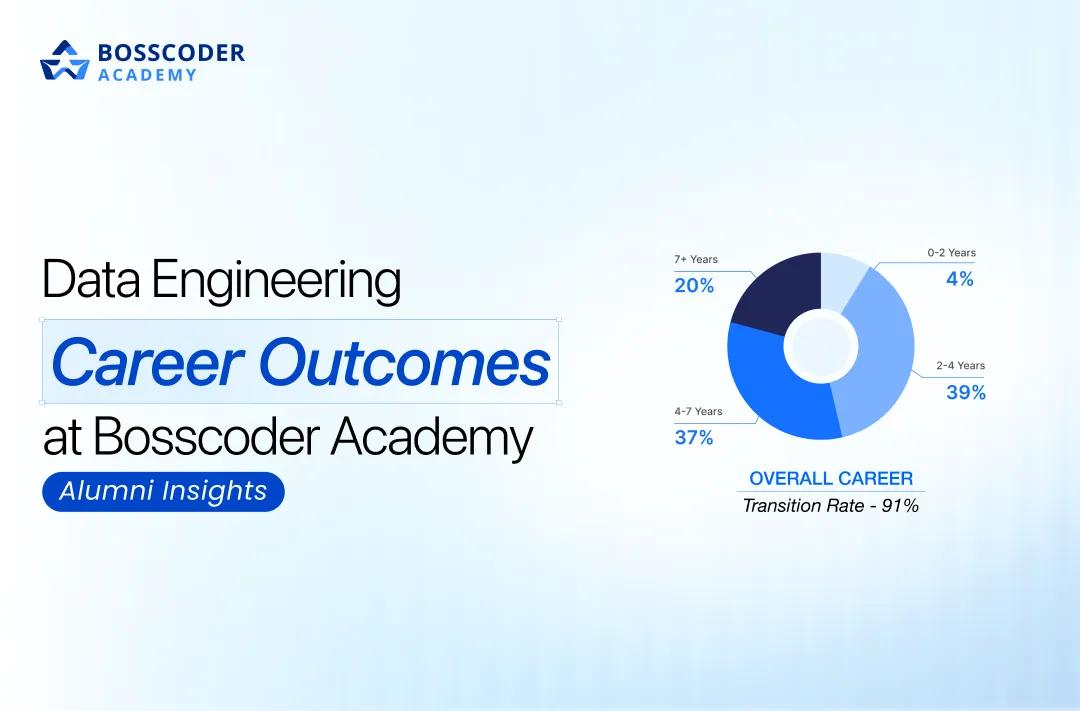
Career Outcomes
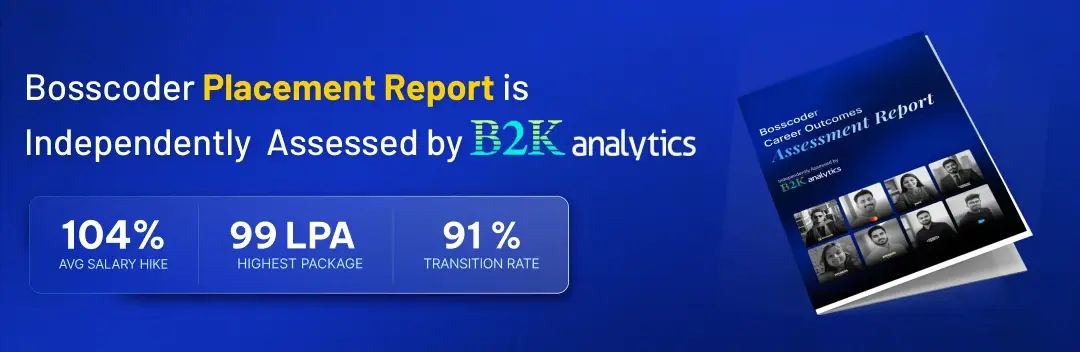
Bosscoder Academy has also released an independently verified Career Outcomes Report.
According to the report:
→ 87% of Data Engineering learners successfully transitioned into Data Science or Data Engineering roles.
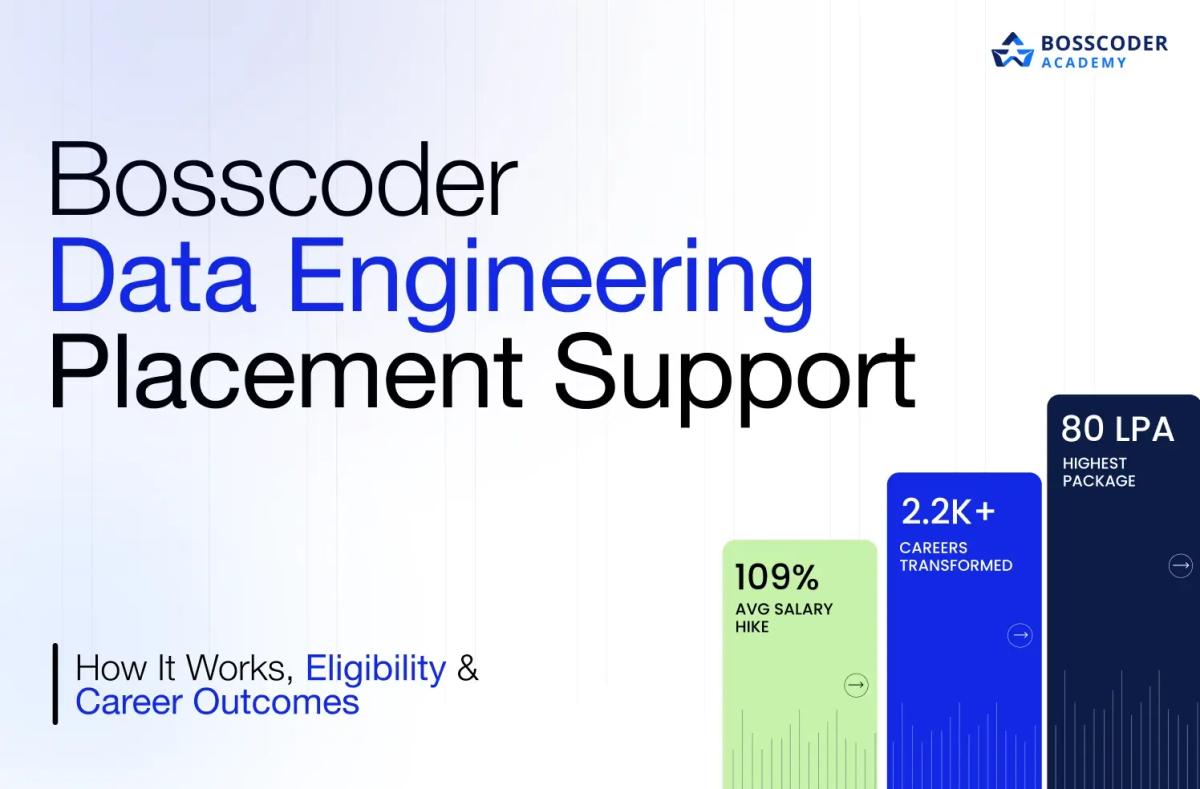
→ Highest reported package in the DS & DE program is ₹80 LPA.
→ Pre-Bosscoder Average CTC: ₹9.6 LPA
→ Post-Bosscoder Average CTC: ₹17.21 LPA
→ Average Salary Hike after Bosscoder is 109%
→ Evaluation was conducted by B2K Analytics, a research firm that has worked with institutions like IIM Ahmedabad, Goa Institute of Management, and MDI Gurgaon, using verified salary and offer data.
It is essential to understand that the Career Outcomes Report clearly states that past outcomes cannot guarantee placement or compensation increases in the future. Placement and compensation are dependent upon the individual’s experience, preparation, skills and market conditions.
Who Should Consider This Program?
The program may fit:
→ Software Engineers
Who want a career change to Data Engineer jobs.
→ Frontend Developers
Interested in working with large-scale data infrastructures.
→ Data Analysts
Wanting to transition to Data Engineer roles focused on data engineering tasks.
→ Early and Mid-Level Professionals
Who need a structured process, rather than trying to find what they need from many different sources of self-learning.
→ Professionals Targeting Product-Based Companies
Who need to prepare for technical interviews that require understanding of Data Engineering concepts and System Design
Final Thoughts
In order to be successful as a Data Engineer, you need more than just knowledge of a couple of tools, you should also know how to work with databases, design data models, and understand cloud platforms, distributed systems and an ever-growing number of AI-enabled data workflows.
The Data Engineer Pathway at Bosscoder Academy combines these topics into a structured program that includes technical skill development through live classes, 1:1 mentorship, working on real-world projects, and Placement support as you pursue your career in Data Engineering.
If you're currently working and looking for a clear framework for transitioning into this field, you'll find that the pathway provides you with everything you need in terms of developing practical skills while still managing your job.
Frequently Asked Questions (FAQs)
Q1. Is Bosscoder Academy's Data Engineering Program worth it for working professionals?
The program is specifically designed for working professionals who wish to move into Data Engineering while working full-time therefore, it has a defined structure added to its curriculum by providing you with a structured outline of the classes as well as 1:1 guidance from an industry expert (a Data Engineer) and practical application through projects during the class.
Q2. What skills are taught in Bosscoder Academy's Data Engineering Program?
The Data Engineering Program will cover various technical skill sets, including SQL, Python, Database Management Systems, Data Warehousing, Data Modeling, ETL Pipelines, Apache Spark, Kafka, Snowflake, Databricks, AWS, Azure, GCP, Data Engineering System Design, cloud technology and much more. In addition to these core technical skills, there are a number of more sub-description-based concepts covered such as Data Structures and Algorithms (DSA) focusing on DSA for a Data Engineer and newer concepts included, such as GenAI (through the use of RAG, Vector Databases and Agentic AI).
Q3. Does Bosscoder Academy's Data Engineering Program include real-world projects?
As part of the program, learners will be working on real-world examples of data engineering projects including but not limited to:
- Building a data pipeline for Tesla vehicle telemetry using the ETL method.
- Building a DBT project for transforming data from airbnb.
- Building a reporting/analytical solution for Netflix and many more.
These types of projects will provide the learner with hands-on experience working on a data engineering project and give them real-world data engineering practices to model workflow.
Q4. What are the career outcomes of Bosscoder Academy's Data Engineering Program?
According to an independent assessment performed by Bosscoder Academy, 87% of people who completed Data Engineering programs have successfully transitioned into Data Engineering fields. In addition, the average cost-to-company after completing from the program was ₹17.21 LPA, the average percentage increase in salary was 109%, and the highest reported salary was ₹80 LPA.