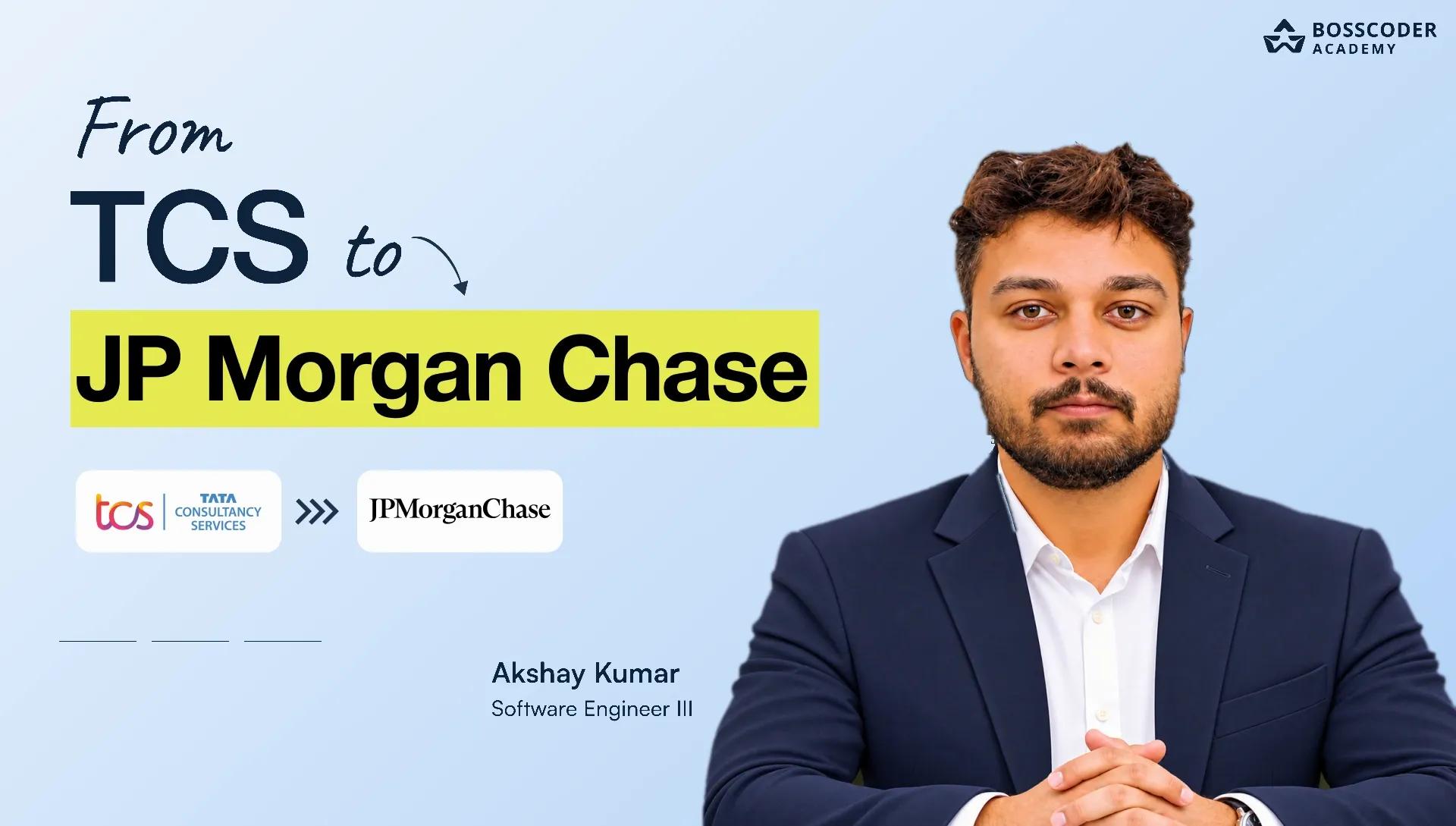
Nine years in tech is a long time. By then, most engineers are comfortable, respected by their teams, and trusted with important work. But comfort and growth are not the same thing, and Akshay knew it. Today, he is a Software Engineer III at JP Morgan Chase, one of the world’s leading financial institutions. This is the story of how a Java engineer from Muzaffarnagar decided to change his trajectory, and what it took.
A Strong Foundation and a Growing Question
Akshay has spent more than nine years in IT, building systems from scratch and developing scalable, robust Java applications. He spent his earlier career at TCS, a service-based organization, where he built deep technical skills across projects.
Over time, though, he wanted something more. He wanted to work closer to the product and get hands-on with the latest technologies that product-based companies typically adopt. Service and product environments are different worlds, and Akshay felt his next chapter belonged in the second one.
“I wasn’t getting much chance to work closely with the product or on the latest tech,” he says. “That is the major reason I decided to move from a service-based to a product-based organization, and to upskill my knowledge and enhance my skills.”
The Bosscoder Upskilling Advantage
Switching after nine years is not a small decision. Product-company interviews test skills that day-to-day project work doesn’t always exercise, especially data structures and algorithms (DSA) and system design.
Akshay chose to prepare deliberately. He enrolled in Bosscoder’s Transformers program for working professionals, designed for engineers who want to move into stronger product roles without pausing their careers.

The Routine That Made the Difference
The change began with one habit: practicing DSA every single day. That daily practice gave Akshay a clear picture of the kinds of questions product companies ask in their interviews, so he was no longer guessing what to prepare.
Daily assignments kept him accountable. Instead of studying in bursts when motivation was high, he stayed consistent, which matters most when you are balancing a full-time job with serious preparation.
On the design side, he went through the high-level design (HLD) recordings to strengthen his system design knowledge. Whenever a question came up, he took it straight to his mentor and discussed it until the concept was clear.
Mentorship That Lasted Beyond the Program
Ask Akshay what stood out most, and he points to Bosscoder Academy mentorship. His mentor guided him through the program, and the relationship didn’t end with the certification. Akshay is still in touch with him today and describes him as cooperative and supportive.
He also values the chance to learn from people who have already reached the positions learners aspire to. Hearing how they got there, and what process they followed, makes the path feel real rather than abstract.
“Everyone needs guidance,” Akshay says. “Mentorship is one of the very good parts of the program, because we get to learn from people who have walked this path before us.”
The Result
The consistency paid off. Akshay made the move to JP Morgan Chase, where he now works as a Software Engineer III. He took nine years of experience, added the interview-ready skills product companies look for, and turned a long-held ambition into a real career step.
Lessons for Engineers Considering a Switch
Akshay’s journey offers a few practical takeaways for experienced engineers:
- Experience alone isn’t enough. Years on the job build strong fundamentals, but product-company interviews still demand focused DSA and system design preparation.
- Consistency beats intensity. Daily practice and assignments build momentum more reliably than occasional marathon sessions.
- Don’t prepare alone. Discussing doubts with a mentor saves time and sharpens your thinking, especially in system design.
- Know why you want to switch. Akshay’s reasons were clear: closer work with the product and exposure to the latest technology. A clear purpose keeps you going when the preparation gets tough.