Modern software systems process millions of operations each second. Companies rely on highly efficient data structures throughout their operations from payment processing via UPI apps to updating their customers regarding their food order and managing their cloud server traffic. Data structures form the backbone of modern software systems, making them some of the most critical aspects of today's software architecture.
One such important data structure is the Queue.
Queues are used heavily in backend system architectures. Software professionals need to understand the application of queues not only for coding interviews but in designing large scale, distributed applications, and real-time systems. Many software engineers build products which require scheduling tasks, handling requests, buffering, and asynchronous processing. All of these use queues internally.
This blog will focus on how queues are used in data structures using practical examples, which should be easily understandable by both professionals and future technology workers.
What is Queue in Data Structure?
A Queue (in data structure) is a type of linear data structure that follows the FIFO (First In First Out) method of processing things.
This means:
→ You will remove the first item added into that structure before removing the others that were put in first.
→ It adds to back of queue
→ It removes from front of queue
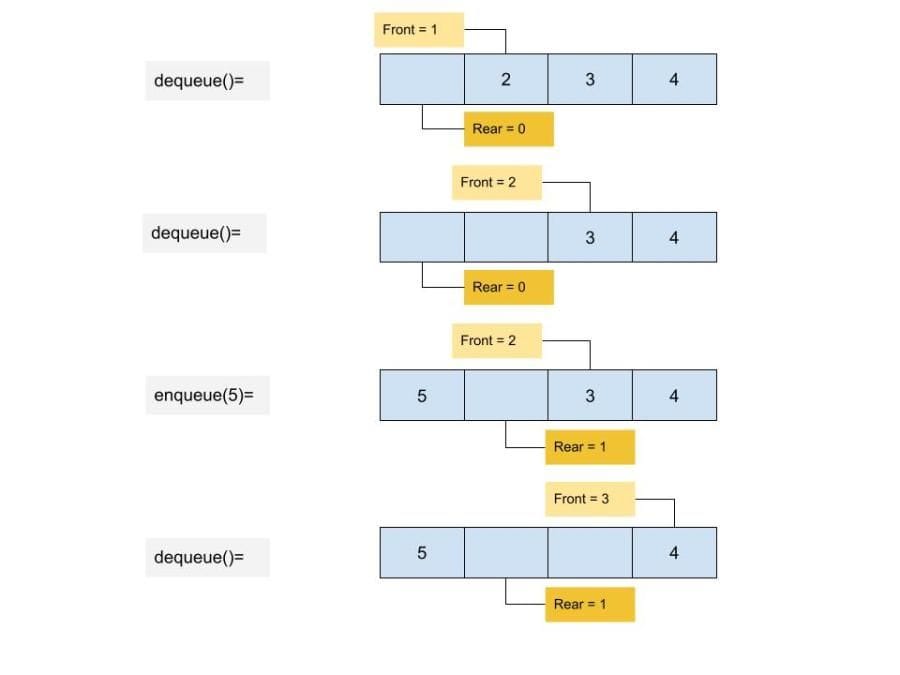
An easy-to-understand example would be standing in line at an airport boarding area or at the subway. You arrive before others and leave before others (FIFO).
Why Queue is Important in Modern Software Systems
Today in the tech industry, applications are becoming highly concurrent and distributed. Systems need to process thousands of requests efficiently without crashing or creating conflicts.
Along with these issues, queues can help in the following:
→ Manage the order of task execution
→ Smoothly handle high volume of requests
→ Reduce the impact of sustained high volume of requests on your server’s resources
→ Improve your application’s ability to scale to at least twice the size
→ Provide more flexibility in processing asynchronously
For these reasons, queues are being heavily used in backend development, cloud computing, operating systems, and system architecture.
Real Applications of Queue in Data Structure
Let us understand where queues are actually used in professional software environments.
1. Request Processing in a Backend Application
One of the biggest examples of a queue is how requests are processed on the backend of large apps like food delivery services, payment processing company, or online retailers all of which receive thousands of requests at the same time.
When there are too many requests to process at the same time, the requests are added to a queue.
Example
When a customer places an order during peak sales:
→ The order request will be added first to the queue
→ The payment processing will be added second to the queue
→ The notification request will be added third to the queue
→ The request for inventory adjustment will be processed last
As you can see, by creating a queue for processing requests, you can help prevent the server from crashing during peak sale events and improve performance.
Use of Modern Queue Technologies like RabbitMQ, Kafka, and AWS SQS are based on queue concepts.
2. CPU Scheduling in Operating Systems
Operating systems use queues to manage multiple running processes. Apps executed on a computer, or the "user level," wait in a process queue for their turn to get some CPU time.
Real Example
Professionally, you may have the following open:
→ VS Code (or any other programming application).
→ Docker
→ Google Meet
→ Google Chrome with 50 tabs
The OS uses a queue to schedule and switch between these jobs, or applications, for you.

Why Should You Know About This As A Professional?
Many product-based companies ask interview questions related to:
- Round Robin CPU Scheduling
- Process Queue Management
- Multi-Level Queues
All three of these subjects will depend on the internal use of a queue.
3. Message Queues in Microservices Architecture
Microservices is an architectural style created out of necessity by large, modern top tech companies.
This architectural style allows for multiple microservices within a single application (service).
Microservices typically communicate via a message queue, allowing each individual service to scale better and have fewer points of failure in their communication process.
Example:
- Payment Microservice
- Order Microservice
- Notification Microservice
- Delivery Microservice
In this example, if one of the microservices goes down, the messages that were sent to that microservice will still be stored in the queue and can still be processed without any loss of message data.
This is the top reason for you, as a professional, to be familiar with queues.
4. BFS in Technical Interviews and Real Systems
BFS is used to search for tree - all events at the same "level" of depth from the top node will be discovered by BFS when parsing through all "level" nodes within a given range of nodes
Queue is most often associated with the BFS algorithm.
Professional Uses Cases:
→ Network routing systems
→ Social media friend suggestions
→ GPS shortest path systems
→ Web crawlers
→ AI path finding systems
BFS flow:
- 1st: Push/dequeue node that is to be searched in memory
- 2nd: (Searching) Discover all adjacent nodes that have not yet been processed during a previous pass through the search/tree structure
- 3rd: Place any new adjacent nodes that are yet to be processed into a processing queue
- 4th: Repeat until you have "exhausted" the search for adjacent nodes.
The BFS approaches mentioned above are very common in coding interviews for many large/high-tech companies, including Amazon, Microsoft, Flipkart, & Adobe.
5. Queue in Cloud Computing Systems
Cloud services often need to execute multiple concurrent/competing tasks in the background constantly.
The cloud uses Queues to efficiently distribute loads to all processing nodes.
Example
When a user calls to upload a file to a cloud storage provider/service; the process will:
- 1st: add it's request to queue for processing
- 2nd: queue the virus checking stage
- 3rd: queue the thumbnail creation stage
- 4th: queue the backup process.
This improves system reliability and performance.
Common Challenges Professionals Face with Queue
Most developers know the fundamentals of queue theory but have difficulties in applying the practical implementation aspects.
Some issues that are frequently encountered include:
| Problem | Common Issue |
|---|---|
| Circular Queue | Pointer confusion |
| BFS Problems | Incorrect traversal logic |
| Message Queues | Duplicate processing |
| Concurrency | Race conditions |
| Overflow Handling | Memory management issues |
All above issues are particularly challenging on scalable backend systems in professional environments.
Why Queue Questions Are Frequently Asked in Interviews
Queues help interviewers assess your:
→ Problem-solving skills
→ Understanding of system flow
→ Knowledge of scheduling concepts
→ Understanding of graph traversal
→ Knowledge of fundamental backend engineering
Common examples of queue interview questions are:
→ Implementing a queue using stacks
→ Implementing a circular queue
→ Sliding window problems
→ Task scheduling
→ BFS traversal questions
Many professionals preparing for jobs in product companies find this hard because they have only learned theoretical material, they are not applying what they know to real life.
Therefore, it is essential to have a structured approach to preparing for data structures and algorithms (DSA).
At Bosscoder Academy, professionals practice solving interview-style DSA questions and participate in system design discussions, mock interviews and hands-on experience with applying the concepts of queues within modern-day software engineering and development.
How Queue Helps in Becoming a Better Software Engineer
Queues have proven to be an important tool for improving interview preparation as well as other areas of work.
Some of the many ways in which queues can enhance your capabilities as a software engineer are:
- Enabling you to design systems that can scale
- Creating asynchronous applications
- Effectively managing heavy traffic
- Enhancing performance of the backend
- Providing a better understanding of distributed systems
As such, queues are one of the most critical foundational data structures for software engineers.
Conclusion
Queue is one of the most commonly utilized data structures in the software engineering/technology sector for real-world applications.
Operating systems, cloud computing, backend development, and microservices architecture all use queues for efficient task management and scalability within their respective systems.
If you are a professional trying to break into the highest levels of product-based companies, understanding how to use queues effectively will be a vital key to both your success at interviews and accomplishing your goals during development.
Learning these concepts with practical implementation and industry-focused problem solving can make a huge difference during interview preparation.
Frequently Asked Questions
Q1. What is the real-life application of queue in data structure?
Queues have real-world applications in various ways, including: CPU scheduling, backend processing of requests, cloud computing, customer service systems, networking, and breadth-first search traversal of graphs.
Q2. Why is queue important for software engineers?
Queues are important to software engineers because they enable them to implement scalable applications, coordinate asynchronous execution of tasks, and efficiently solve coding problems at the level of their job interviews.
Q3. Which top tech companies ask queue interview questions?
Some examples of top tech companies that commonly ask queue-related questions during job interviews include: Amazon, Microsoft, Google, Adobe, Flipkart, and Uber.
Q4. Which technologies use queue in backend systems?
Technologies like RabbitMQ, Apache Kafka, AWS SQS, and Redis Queues are widely used in modern backend systems.