The Operating System is one of the most important subjects for software engineers who are getting ready for interviews at product-based companies. Many top tech companies such as Google, Amazon and Microsoft generally include OS questions in their technical interviews to evaluate how well each candidate understands the inner workings of a system.
While many professionals in the field of coding practice extensively, they neglect studying core computer science concepts when they are preparing for job interviews or changing jobs. Yet, during the technical interviews at many of these companies, it is very common that the interviewers will ask the candidates practical OS questions regarding process management and scheduling, multi threading, memory allocation and management, as well as deadlocks and concurrent processes.
This poses a major obstacle for professionals who want to move into a better tech role since the majority of engineering educational programs and employment experience are based on theoretical concepts or project-based work rather than preparing them for interview-based technical systems knowledge requirements.
An in-depth knowledge and understanding of Operating Systems not only helps in the interview process but also enhances the ability to effectively solve problems, find bugs, construct backend systems and to better design an entire system. Thus, having this knowledge base is particularly important to developers who wish to upskill as well as transition into a product-based company or prepare for the senior software engineering position.
Easy Level OS Interview Questions
Q1. What happens internally when you open a Chrome browser?
When a user launches Chrome on the computer, the operating system creates a new process for Chrome. After that, the files required for Chrome are pulled from the hard drive and loaded into RAM (random access memory) while also allocating the necessary resources such as memory and threads for rendering, networking, and UI handling. The operating system will schedule the appropriate time for the CPU to execute the various tasks associated with running Chrome. This question tests the user's knowledge of processes, memory allocation, and scheduling.
Q2. Why are threads considered lightweight compared to processes?
Threads are lightweight because threads share the same memory and resources that a process uses. Threads can be created with less memory and overhead than processes since there are fewer resources needed to create a thread than to create a process. The overhead for switching between two threads is also less than switching between two processes making multi threaded applications able to conduct concurrent operations more efficiently.
Q3. What happens during a context switch?
A context switch is the process by which the CPU takes the current state of a process including all registers and program counters and places this data back into memory. The operating system will then place the new process state into the CPU and start executing that new process. By allowing multiple processes to share CPU resources, CPUs can effectively share time. However, if excessive amounts of time are dedicated to context switching, then the amount of time spent executing processes is diminished because the time spent switching is greater than the time spent executing the process.
Q4. Why is multitasking possible in modern operating systems?
CPU Scheduling & Context Switching Allow For Fast Changes Between Multiple Processes, This Gives The Appearance Of Multiple Programs Running At The Same Time Even Though Only One Instruction Can Be Executed By A Single CPU Core. The Advancement Of Multi-Core Processors Has Also Assisted In Making Systems More Efficient with regards to Multitasking.
Q5. Why does increasing RAM improve system performance?
When There Is A Larger Amount Of RAM Present, An Operating System Can Keep A Larger Number Of Programs And Data In Memory, Which Reduces The Amount Of Times That The OS Has To Swap Data From RAM To Disk Storage. When There Is No Longer Any Space In Memory, The OS Will Begin To Use Virtual Memory (Which Is Much Slower). Therefore, With An Increase Of RAM Comes Improved Response Times, Along With An Increase In Disk I/O Overhead.
Q6. Why are SSD based systems faster than HDD systems from an OS perspective?
Operating Systems Generally Perform A Large Number Of Read/Write Operations For Booting-Up The System, Paging, Caching & File Access. SSDs Are Much More Efficient Than Hard Disk Drives Because They Provide Lower Latency And Greater Random Access. As A Result, The Time It Takes To Complete An Input/Output (I/O) Operation Has Been Significantly Decreased And Overall Performance Has Improved Significantly.
Q7. What is the difference between concurrency and parallelism?
Concurrency occurs when two or more tasks run in a manner where they are able to progress at the same time, whereas Parallelism occurs when two or more tasks actually run at the same time on different processor cores. A system can provide concurrency with just 1 processor core as long as tasks are scheduled properly; however, to achieve true parallelism, multiple processor cores must be present.
Q8. Why does a system become slow when too many applications are opened?
The reason that a system will slow down as too many applications are opened is due to the cumulative level of resource consumption due to memory allocation, CPU use, and increased context switching overhead as a result of having too many tasks contending for resources. Additionally, if the amount of RAM required by applications deployed on a system exceeds the amount available, the operating system will begin swapping data between system RAM and the disk drive (thrashing). These activities significantly impede the overall system performance and ultimately decrease the responsiveness of applications.
Q9. What happens when you double-click a file?
First the Operating System will determine what type of file it is and what application to use to open it and begin loading the application into memory if it has not already been executed. The system will allocate a process to the file, allocate system memory to that process, and via system calls will open the document. Once the file has been opened, the application will display the contents of the opened document.
Q10. Why are system calls required?
System calls are necessary for applications to access hardware resources since allowing unrestricted access could lead to system crashes or security vulnerabilities. System calls provide an intermediary means of interfacing between kernel and user applications. Examples of these operations are file access or management, memory allocation and management, and process allocation and management.
Q11. Explain the difference between user mode and kernel mode.
User mode is a restricted environment for user applications, whereas kernel mode executes with full access to the computer system. When a user-mode application requests an operation that requires access to the operating system, such as accessing a file or requesting memory, the operating system will switch from user mode to kernel mode in order to process the request.
Q12. Why can one faulty application crash older operating systems?
Older operating systems did not provide adequate protection for processes and memory isolation. An application that caused corruption of shared memory or failure to properly execute a valid operation could affect all other applications on the operating system. More recent operating systems provide protection for memory (protected memory) and address space isolation (virtual memory).
Q13. Why are modern browsers multi-process instead of single-process?
All the tabs, plugins, and rendering engines utilized by modern browsers are organized into separate processes. Because of this organization, it is more stable as the ability for one of the opened tabs to crash will not lead to the crashing of the entire browser. The other benefit created by organizing the tabs, plugins, and rendering engines into separate processes is to improve the security of the application, using techniques such as process isolation and sand boxing.
Q14. Why is Linux preferred for servers?
Linux can provide very efficient resource use by the operating system. It is also very stable with an efficient networking performance. With the concurrent / multitask processing capabilities of the OS makes Linux a very suitable OS for servers, cloud systems and distributed applications.
Q15. What is the role of the scheduler in an operating system?
The scheduler will choose the process/thread that will receive the CPU execution time. The scheduler will attempt to balance the fairness, responsiveness and utilization of the CPU through the use of a scheduling algorithm such as Round Robin Scheduling or Priority Scheduling or Multilevel Queue Scheduling.
Operating System concepts are important for cracking interviews at product-based companies. At Bosscoder Academy, working professionals prepare OS, DSA, and System Design through practical interview-focused learning with 1:1 mentorship.
Medium Level OS Interview Questions
Q16. Explain how deadlock can happen in a real-world system.
Deadlock is the condition where multiple processes are indefinitely waiting for a set of resources that are held by the other processes in that group. For example, if there are two transactions, the first transaction locks table A and waits for table B to complete and the second transaction locks table B and waits to complete table A. Hence, both transactions can wait indefinitely and as a result, both transactions are waiting for each other to release their locks.
Deadlock commonly occurs in databases, distributed systems, and multi threaded applications where multiple processes share resources with each other. To manage deadlocks, operating systems will use the four general techniques of deadlock prevention, deadlock avoidance, deadlock detection and deadlock recovery.
Q17. Why is starvation a problem in priority scheduling?
Starvation happens in priority-based scheduling systems because the processes with the highest priority are always allocated to the CPU before lower-priority processes. Starvation will occur when there are always higher-priority processes that are posted within the system, so no lower-priority processes will ever complete executing.
Starvation reduces fairness in priority-scheduled systems and can indefinitely delay important background-processing tasks. One technique that operating systems implement to resolve starvation is through an aging technique, which increases the priority of all processes that have been waiting for execution until the CPU is given to them.
Q18. What is the difference between paging and segmentation?
Paging divides memory into fixed-length pieces, referred to as pages, and frames. Paging provides an easy way to manage memory since it removes external fragmentation.
It does not take the logical structure of the program into consideration.
Segmentation divides memory into logically divided segments or logical divisions, such as code, stack, and data. Segmentation provides greater logical organization but suffers from external fragmentation.
Most modern operating systems utilize both techniques.
Q19. What causes thrashing in operating systems?
Thrashing results from the operating system using up all available resources by swapping pages between RAM and disk instead of executing processes. This is caused by too many applications trying to access the same limited amount of memory.
As the number of page faults increases, the CPU will perform less work because of constantly needing to wait for disk operations to be performed. This reduction in performance has a negative impact on all applications running on the system.
Q20. Why are mutexes needed in multi-threaded applications?
When multiple threads simultaneously access a shared resource there is a possibility of inconsistent results. A mutex is a synchronization primitive that allows only one thread to enter a critical section at one time.
As an example, if two threads attempt to update the same bank account balance without using a mutex, then it is possible for both threads to succeed with updating the account balance resulting in an incorrect balance.
Utilizing a mutex will guarantee that thread A and thread B will both see a consistent view of the bank account balance and thus cannot have a race condition.
Q21. Explain a race condition using a banking example.
Suppose that two ATM transactions are trying to withdraw money from the same bank account at the same time. Before either thread withdraws money, both threads will read the data from the database for that account (i.e., the account balance). If the database has not been configured to use synchronization, then both threads will have access to the same account balance and both will successfully withdraw money from the account even though the data is inconsistent.
Race conditions can occur any time that multiple concurrent transactions occur without proper synchronization mechanisms.
Q22. What happens during a page fault?
A page fault takes place whenever a process attempts to reference memory pages and those pages are not present in physical memory (RAM). When the operating system detects this, it interrupts the execution of the involved process to determine where to find the referenced page on disk. The disk will be referenced to load the page into RAM, the page table will be updated, and then the execution of the process will resume.
If a page is referenced often as a result of having a large number of pages referenced that were not found in RAM, then this creates a high number of disk I/O operations and negatively affects the performance of the computer system. Efficient memory management is essential for reducing page faults.
Q23. Why are page replacement algorithms important?
RAM can only store a limited number of pages, so the operating system must choose which pages to replace when loading new pages into RAM. Page replacement algorithms help determine which pages should be retained so that page faults will be minimized.
FIFO, LRU, and Optimal Replacement are some of the page replacement algorithms available to help manage memory usage in order to support efficient application execution and reduce the amount of disk accesses that are not necessary.
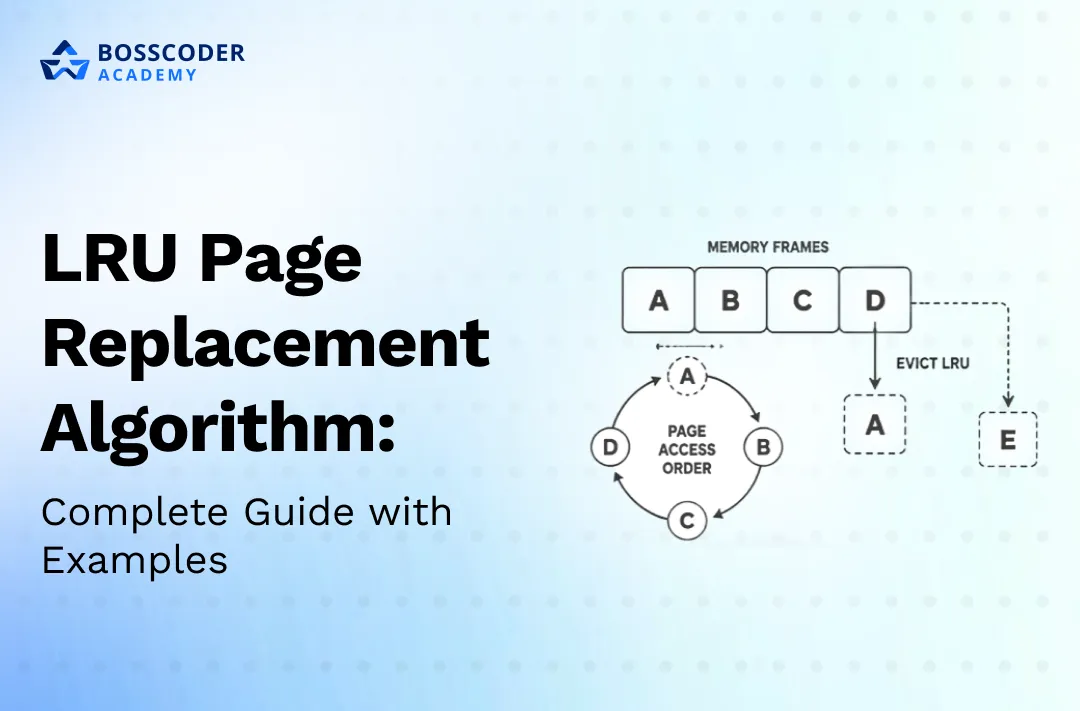
Q24. Why is LRU better than FIFO in many situations?
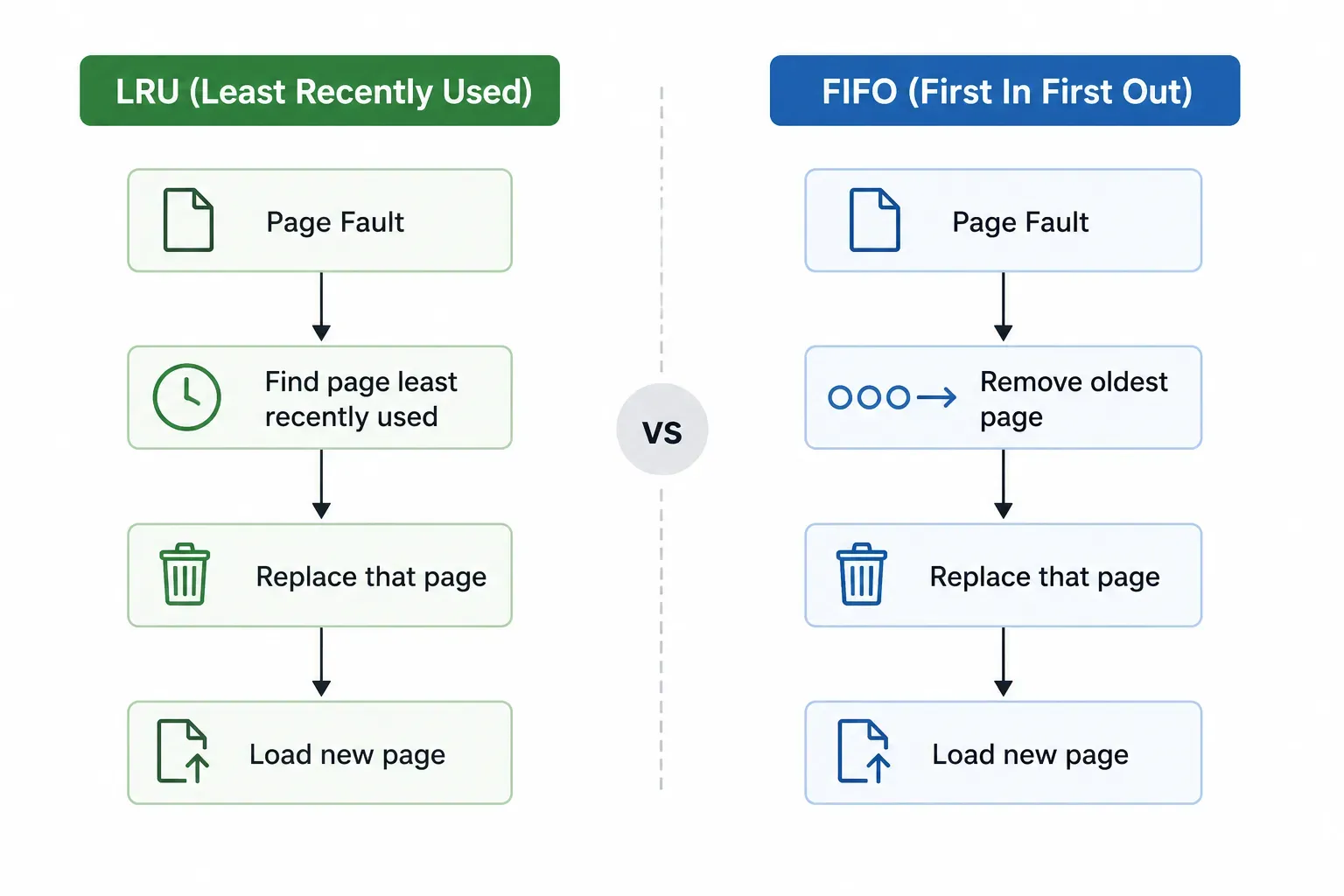
LRU (Least Recently Used) has advantages over FIFO, as it considers the frequency of page usage when evicting pages from memory. FIFO can evict heavily used pages from memory that hold no usefulness to a running process; therefore producing more page faults.
LRU will remove pages that have not been used for the longest time period. Since most frequently used pages have higher probabilities of being used again, LRU usually exhibits a better performance than FIFO based on the lower page fault count.
Q25. Explain the producer-consumer problem.
The producer-consumer problem is a classic example of the production and consumption of data between two processes using a shared buffer. If there isn't proper synchronization between both processes, the producer may write more items into the buffer than it can hold or the consumer may try to read from an empty buffer.
Sharing a resource requires coordinating access to that resource among multiple processes. There are two main types of synchronization mechanisms for this purpose: semaphores and mutexes. Concurrent access to a shared resource and proper synchronization, such as that of the producer-consumer model, are two of the most widely studied topics in the fields of concurrency and synchronization theory.
Q26. What is the purpose of a Process Control Block (PCB)?
The PCB is a data structure that an Operating System keeps for each process, to hold useful information about the process, for example, a process ID, its state, the contents of the registers on the CPU, when the process is scheduled to run, how much memory has been allocated to it, and what files are open.
The Operating System saves and retrieves the information about a process each time there is a context switch using the PCB. The process management function would not be possible without the PCB.
Q27. Why is synchronization difficult in distributed systems?
Applications in distributed systems involve multiple machines communicating with each other over networks, with potential delays and failures of communication. This creates difficulties for ensuring the correct order and consistent view of data across multiple machines since clocks are not perfectly synchronized across machines.
Difficulties are made greater by network failures, message delays and partial failure of components of a distributed system, and so complex, advanced coordination techniques are needed for synchronization in a distributed system.
Q28. Explain Copy-on-Write with fork().
When a parent process makes a child using fork(), the OS creates an initial shared memory page of the parent and child process. Each process has the same pages until either process writes to one of the pages. At that moment, that process will get its own copy of the memory page used, this increases the speed of process creation and significantly decreases the memory that is required.
Q29. What are zombie processes and why are they dangerous?
Zombie processes are processes that have finished executing but have not yet been collected by their parent process, and are still kept in the process table even though they do not execute any longer.
If too many zombie processes exist within the system, they will use up all available resources in the process table and further process creation will be limited. It is very important to ensure that processes are cleaned up correctly.
Q30. Explain the difference between a semaphore and a mutex.
A semaphore is different from a mutex in that a mutex’s primary purpose is to provide mutual exclusion; it only permits one thread’s access to its critical section of code at any given time, and only the thread that acquires the mutex can subsequently release it.
Semaphores can be thought of as counters, representing the number of threads/processes that are allowed to simultaneously access an object. Depending upon the current value of the semaphore counter when a thread attempts to acquire a semaphore, a thread may either be allowed to acquire a semaphore or blocked from doing so while waiting until another thread releases it. Semaphores are typically used for signaling and synchronizing threads.
Medium-level OS questions test practical problem-solving skills in interviews. At Bosscoder Academy, professionals prepare these concepts through interview-focused learning.
Hard Level OS Interview Questions Asked in MAANG
Q31. Design a synchronization solution for the readers-writers problem.
In the readers-writers problem, there are multiple readers and multiple writers who need to access the same shared data. While readers can access the same data concurrently, because they don't change the data, writers need exclusive access to the shared data so that they can maintain consistency of the data.
An effective synchronization mechanism for the readers-writers problem must maintain both fairness (equal access) and concurrency (the number of concurrent users). Reader-preference synchronization mechanisms provide faster reading performance at the expense of possibly starving writers.
Simple Semaphore-Based Logic:
semaphore wrt = 1;
semaphore mutex = 1;
int readcount = 0;

Reader() {
    wait(mutex);
    readcount++;

    if(readcount == 1)
        wait(wrt);

    signal(mutex);

    // Reading happens here

    wait(mutex);
    readcount--;

    if(readcount == 0)
        signal(wrt);

    signal(mutex);
}

Writer() {
    wait(wrt);

    // Writing happens here

    signal(wrt);
}
Writer-preference synchronization mechanisms prevent writer starvation, but at the expense of reduced concurrency. Today, many modern computer systems use a solution that balances both.
Q32. Why do modern operating systems use virtual memory?
Virtual memory allows programs to access a larger logical memory than is physically installed in the computer. Virtual memory also provides a level of process isolation for improved concurrent execution of processes and flexibility in allocating memory.
In order to allow users to access virtual memory addresses, the operating system uses a page table to translate virtual memory addresses into the corresponding physical memory location. In addition to the benefits described above, virtual memory provides an additional security feature by preventing processes from accessing each other’s memory.
Q33. Explain how operating systems avoid deadlocks.
Various techniques have been developed by operating systems to help eliminate deadlock situations.
Deadlock Prevention - This method removes one of the conditions necessary to create a deadlock, such as circular wait.
Deadlock Avoidance - The purpose of this methodology is to allocate resources only if the system will remain in a safe state. The Banker’s Algorithm is a well-known example of this method.
Deadlock Detection - It is also possible to detect when a deadlock has occurred and recover from that state by either terminating processes or releasing resources.
Example Logic:
If Available Resources >= Need of Process
    Allocate Resources
Else
    Wait
The algorithm avoids unsafe allocations before deadlock actually occurs.
Q34. Explain kernel panic in Linux.
When the Linux Kernel finds a non-recoverable error it generates a 'Kernel Panic' message. This occurs from memory access violations, bad device drivers, corrupted Kernel Modules or hardware failures.
A kernel panic stops all operating system functions to prevent data corruption or loss. To analyze the cause of a kernel panic, you would analyze the system log files, crash dump files and/or hardware status indicators.
Q35. Why are interrupts important in operating systems?
Interrupts can be used by hardware devices to signal the CPU that they need attention. This means that the CPU does not have to keep continuously checking the status of these devices. The CPU can perform useful work until interrupted by an interrupt.
Device Generates Interrupt
        ↓
CPU Pauses Current Task
        ↓
Interrupt Handler Executes
        ↓
CPU Resumes Previous Task
An example of this is when the CPU is interrupted by an interrupt when a user enters data from a keyboard or when data has been written to a disk. As a result of the use of interrupts, the CPU's effectiveness, speed and ability to do multiple tasks at once are improved.
Q36. What is priority inversion and how is it solved?
Priority inversion occurs when a high-priority process is blocked (i.e. it cannot be executed) because it must wait for a resource that is being held by a low-priority process. In the meantime, other processes of medium priority can execute and continue to delay the execution of the low-priority process.
In real-time systems, priority inversion can result in the high-priority process being blocked indirectly. Priority inheritance is one solution to priority inversion. This is to temporarily raise the priority of the low-priority process until it has released the needed resource.
Q37. Explain how operating systems handle memory protection.
Operating systems incorporate mechanisms that use hardware-based support for memory protection, such as page tables, virtual memory, and privilege levels. Each running process (program) is assigned a separate series of addresses that are unconnected to others.
When a process attempts to use memory which it does not have permission for, the hardware generates an exception and the operating system terminates or processes the program in a safe manner. As a result, applications are able to prevent one application from corrupting another application's memory.
Q38. What is the difference between monolithic kernel and micro kernel architecture?
Monolithic kernels have a majority of the operating system services (e.g. file systems, device drivers, and memory management) run within kernel mode. This can improve the performance of the operating system because of minimal inter-process communication overhead.
Micro kernels only include the essential services to operate in kernel mode and move all other services to user space. In this case, not only do micro kernels provide improved modularity and encapsulation of servicing, but they provide increased security and fault isolation; however, there is a degradation in performance due to increased communication overhead.
Q39. Why are locks considered expensive in high-concurrency systems?
Locks will block the executing threads from executing until the corresponding shared resource can be accessed. The increased blocking and number of threads trying to access the resource will lead to contention and cause an increased burden on the thread's CPU by incurring a greater amount of time context switching than would have otherwise been required.
Example:
lock();

shared_counter++;

unlock();
Locks impact the performance of multi-threaded applications by limiting the scalability and CPU efficiency when working in high concurrency systems. To overcome these performance impacts, modern systems implement fine-grained locking, lock-free algorithms, or concurrent data structures as performance enhancements.
Q40. Explain how garbage collection affects operating systems and applications.
Garbage collection helps to automatically release any free memory that was allocated to an application in higher-level programming languages (e.g. Java and Go), which makes it simple for developers to manage the memory of their applications. However, as the application has paused execution and uses additional CPU cycles to perform garbage collection, the operating system must support the efficient establishment of memory allocation and freeing to ensure that the application remains responsive during any garbage collection cycles.
Example:
Object obj = new Object();

obj = null;

// Garbage Collector later removes unused object
Q41. How does the operating system isolate processes?
Operating systems provide isolation for processes through the use of virtual memory, separate address spaces, hardware privilege levels, and protected mechanisms for accessing memory.
By using these techniques, one application cannot modify another application's memory or crash the entire machine. Process isolation is one of the primary reasons that modern operating systems offer superior stability and security.
Q42. Why is context switching considered overhead?
The CPU is required to save the state information of the process being switched from and to load the state information of the process being switched to. During this time, there is no computational work done by the application.
Context Switching Flow:
Save Process A State
        ↓
Load Process B State
        ↓
Resume Execution
Frequent switching of context results in a waste of CPU cycles and a decrease in overall throughput. Therefore, systems that are excessively creating threads have decreased performance due to switching overhead.
Q43. Explain demand paging with a real-world example.
The use of demand paging allows an application to load its pages into memory only as they are demanded to avoid the overhead of loading an entire application into memory during the initial application load process and thus improve performance while saving memory.
When using a large integrated development environment (IDE), the essential startup components are loaded first; however, other available features and modules will be loaded as the user uses those features and modules. This results in a faster start-up time and greater memory efficiency.
Demand Paging Flow:
Page Needed?
    ↓
Not in RAM
    ↓
Page Fault Occurs
    ↓
OS Loads Page From Disk
Demand paging is one of the most important concepts in virtual memory management.
Q44. How do operating systems manage file systems internally?
The file system on an operating system is organized using directory structures, including metadata tables, allocation maps, and inodes. Each of those components allows the operating system to maintain a record of the permissions, storage locations, sizes, and ownership of files.
Many modern file systems utilize directories methods as a means of safely recovering data after a crash and maintaining data consistency in the event of an unexpected failure.
File Access Flow:
User Requests File
        ↓
OS Checks Permissions
        ↓
File Metadata Located
        ↓
Disk Blocks Accessed
        ↓
Data Returned
Q45. Why are Operating System fundamentals important for backend engineers?
Backend systems manage concurrent processes, memory, network connectivity, synchronization between processes, caching, and distribution of workloads on a daily basis. Engineers with solid knowledge of Operating System fundamentals have a better understanding of performance bottlenecks and how the system behaves.
This understanding allows backend developers to build scalable applications, optimize their usage of resources, resolve issues once in production, and design reliable distributed systems.
How to Get Ready for MAANG Interviews using Operating System Preparation
→ Concentrate on Handling Real-life Examples Rather Than Just Definitions from Textbooks
→ Deeply Understand Synchronization and Concurrency
→ Practice Scheduling and Memory Management Problems
→ Know Linux Process Management
→ Provide Real-life Examples to Justify Your Answer.
At Bosscoder Academy, Working professionals prepare for Interviews via structured Mentoring on the following Topics Operating Systems, DBMS, System Design, and DSA, with a focus on hands-on Learning rather than on Theoretical Learning.
Conclusion
Operating System questions in MAANG interviews are usually scenario-based rather than purely theoretical. Interviewers expect candidates to understand processes, synchronization, memory management, and concurrency concepts deeply.
Candidates who can explain real-world behavior and system-level thinking generally perform much better in interviews. Strong Operating System fundamentals combined with coding skills can significantly improve interview performance in top product-based companies.
Frequently Asked Questions (FAQs)
Q1. What are the most important Operating System topics for interviews?
The major topics on Operating Systems that are important to be aware of when preparing for interviews are; the difference between a process/thread, deadlock, CPU Scheduling, Memory Management, Synchronization, Paging and Concurrency. Each of these concepts has been a common question asked during software engineering interviews at many top technology companies.
2. Are Operating System questions asked in MAANG interviews?
Yes, companies such as Google, Amazon and Microsoft regularly assess operating systems knowledge & reasoning through common problem solving methodologies & design principles used to achieve high quality software architectures during technical interviews.
Q3. How can I prepare Operating System interview questions effectively?
The best way to prepare is by understanding practical examples instead of only memorizing theory. Practicing real interview questions, concurrency problems, and memory management scenarios can improve interview performance.
Platform like Bosscoder Academy provides professionals with structured 1:1 mentorship to learn Operating Systems, DSA, system design and other core computer science topics.
Q4. Why are Operating Systems important for software engineers?
The knowledge acquired from a computer-science perspective about how processes, memory constructs, threads and system resources operate on their own will assist the software engineer in developing highly scalable applications, debugging any performance-related issues related to their software and accomplishing success across any backend engineering interview process.
Operating Systems help software engineers understand how processes, memory, threads, and system resources work internally. This knowledge is important for building scalable applications, debugging performance issues, and cracking technical interviews.