Which is better: C++ or Java? Which one is more powerful? Should you learn C++ or Java in 2026? Keep reading this post to find out.
Choosing between C++ and Java can be tricky, whether you're just starting out or already have some experience. Both are strong programming languages with different uses. C++ is great for building games, system software, and anything that needs high performance. Java, on the other hand, is widely used for web apps, Android development, and large-scale enterprise software.
In this blog, we’ll break down the key differences between C++ and Java, like speed, syntax, and memory management, so you can decide which one fits your goals best.
What is C++?
C++ is a programming language created in 1985 by Bjarne Stroustrup as an enhanced version of C. It supports both object-oriented and procedural programming, offering speed and control. C++ is widely used in system programming, game development, and high-performance applications like operating systems or software at companies like Microsoft, Google, and NASA.
C++ is platform-independent, meaning programs can run on various devices, from computers to embedded systems. Its low-level memory control makes it a top choice for C++ vs Java for data structures and algorithms, and competitive programming.
Key Features of C++
- Supports multiple programming paradigms
- Allows manual memory management
- Gives access to hardware and system-level operations
- Fast and powerful
- Popular in competitive programming
Popular Use Cases:
- Game development
- System programming
- Real-time simulations
- Embedded systems
What is Java?
Java, developed by James Gosling at Sun Microsystems in 1995, is a high-level, object-oriented programming language. Its “write once, run anywhere” (WORA) feature lets Java code work on any device with a Java Virtual Machine (JVM). Java is popular for enterprise applications, Android development, and web development, powering platforms like eBay, Spotify, and LinkedIn.
Java is simple, secure, and beginner-friendly, with automatic memory management that reduces errors. It’s a strong contender in Java vs C++ for Android development and web development.
Key Features of Java:
- Platform-independent (Write Once, Run Anywhere)
- Automatic memory management with garbage collection
- Secure and robust
- Easy to learn for beginners
- Huge community and open-source tools
Popular Use Cases:
- Android development
- Enterprise applications
- Web development
- Cloud-based software
What's the difference between C++ and Java?
C++ and Java projects share the syntax of the C programming language, but despite this, their ecosystems are completely different. C++ code can be used in C, C++ libraries, and operating system APIs, while Java code is best suited for Java-based libraries.
Furthermore, C++'s low-level design and lack of automated memory management allow it to connect with hardware more efficiently than Java.
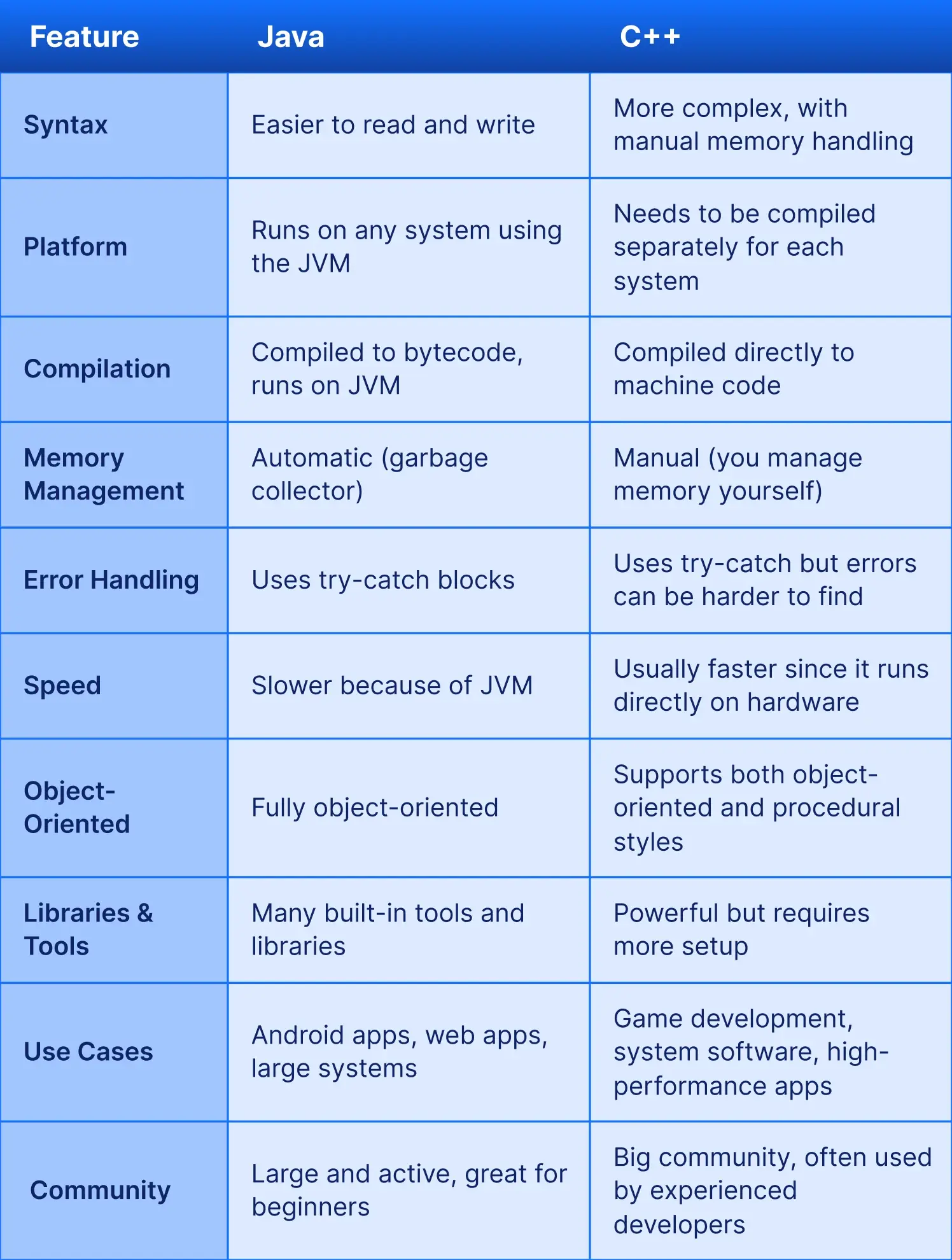
Here's a detailed comparison between C++ and Java:
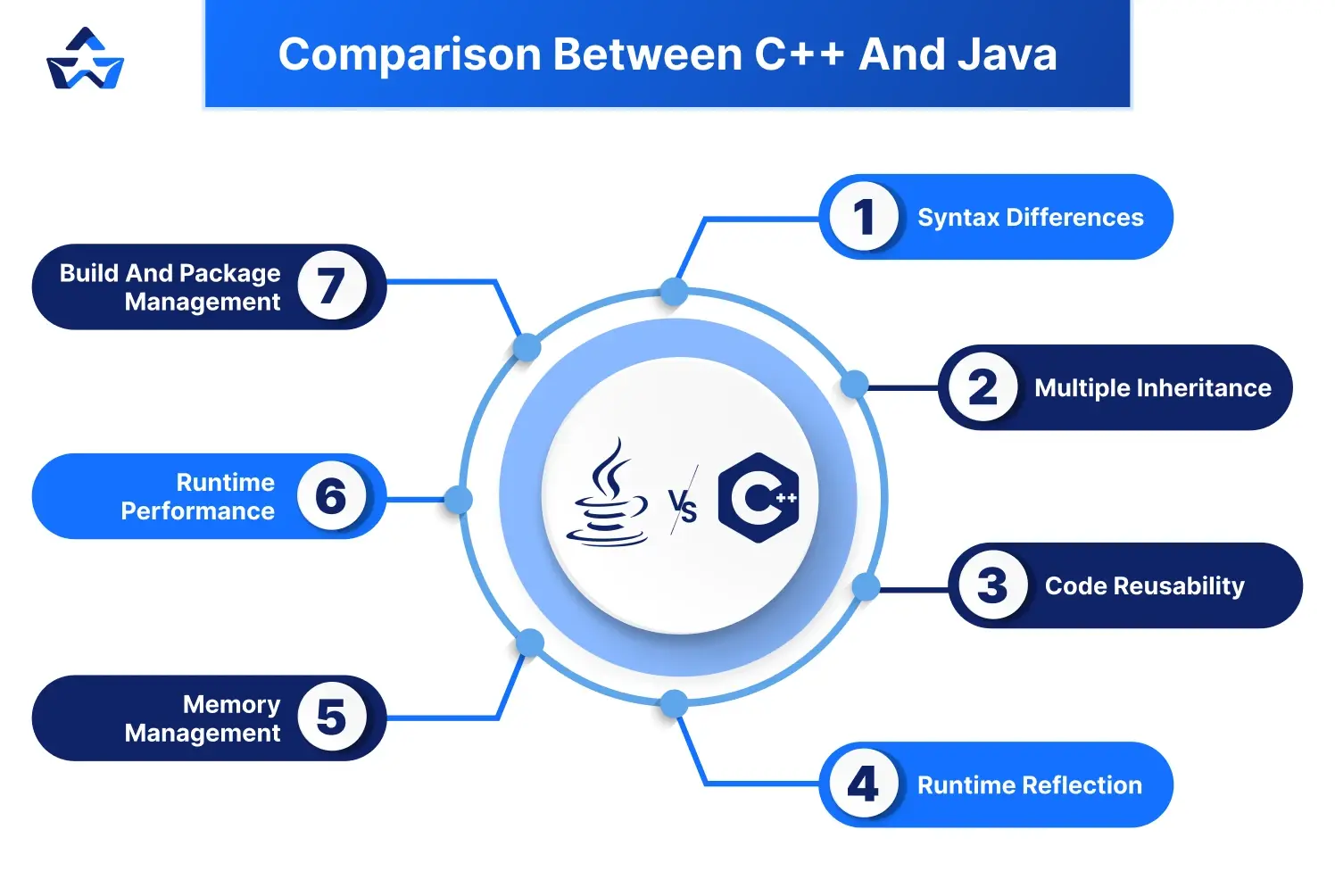
1. C++ vs Java Syntax Differences
C++ and Java share similarities with C, but their syntax differs:
- C++: Allows direct hardware interaction and uses pointers, giving developers more control. This makes C++ vs Java for system programming favor C++.
- Java: Java has simpler syntax without pointers, which makes it easier for beginners. Java’s syntax is designed for C++ vs Java object-oriented programming, focusing on classes and objects.
For C++ vs Java learning curve, Java is more beginner-friendly, while C++ requires understanding complex concepts like pointers.
2. Multiple Inheritance in Java vs C++
In object-oriented programming, multiple inheritance allows a class to inherit features from more than one parent class:
- C++: It supports multiple inheritance, allowing a class to combine features from multiple parents. This is useful for creating specialized languages or improving code safety in C++ vs Java for system programming.
- Java: Does not support multiple inheritance but uses interfaces to achieve similar results, which keeps the code simpler and safer for Java vs C++ for enterprise applications.
C++ offers more flexibility, while Java prioritizes simplicity.
3. C++ and Java: Code Reusability
Both languages allow code reuse through generic classes, but they work differently:
- C++: It uses templates, which are super flexible. They let coders make custom code for different data types. Special features in templates make C++ vs Java for data structures and algorithms stronger with C++.
- Java: Java uses generics, but it removes the specific type information when the code runs. This makes it less flexible than C++. Because of this, you can't do things like create new objects of a generic type or use basic types like int directly with generics.
C++ templates are more versatile, while Java’s generics are simpler but less flexible.
4.Runtime Reflection in Java vs C++
Reflection lets developers inspect code details during runtime:
- Java: Supports reflection, which allows developers to check class details, like available methods or fields, during execution. This is useful for Java vs C++ for web development. It makes your code more flexible, especially when working with frameworks or tools that need to access objects dynamically.
- C++: Offers runtime type information (RTTI), which identifies object types but doesn’t provide detailed class information like Java’s reflection. You get basic type info, but you can’t explore the full structure of a class while the program is running.
Java’s reflection is more powerful, while C++’s RTTI is limited.
5. C++ vs Java Memory Management
Memory management is a key difference in C++ vs Java:
- C++: Uses manual memory management with tools like smart pointers to track and free memory. It supports both heap and stack allocation, making it faster and safer for C++ vs Java for game development. Stack allocation also enables RAII (Resource Allocation Is Initialization).
- Java: Uses automatic memory management called garbage collection, which frees unused memory automatically. This reduces errors and suits Java vs C++ for Android development. You don’t have to worry about deleting memory yourself, Java handles it for you.
C++’s manual approach is faster but riskier, while Java’s garbage collection is safer but slower.
6. Java vs C++: Runtime Performance
In C++ vs Java runtime performance, C++ often outperforms Java:
- C++: Its manual memory management and direct hardware access make it faster for things like competitive programming or tasks where speed really matters. It gives you more control over system resources, which helps in building high-performance applications.
- Java: Runs on the JVM, which adds some overhead but improves performance over time with Just-In-Time (JIT) compilation. It may not match C++ in raw speed, but it's easier to write, maintain, and scale in many use cases.
C++ is better for high-speed tasks, while Java suits most general applications.
7. Build and Package Management
Build and package management handle how code is compiled and connected to external libraries:
- Java: Uses tools like Maven, which simplifies building projects and managing dependencies in IDEs like IntelliJ IDEA. This boosts efficiency in Java vs C++ for enterprise applications.
- C++: Lacks a standard build tool, and some libraries are binary-formatted, adding complexity to C++ vs Java for system programming.
Java’s tools are more streamlined, while C++’s process is less standardized. This means Java projects are usually quicker to set up and easier to manage, especially for beginners.
Which is Better: C++ or Java for Game Development?
In C++ vs Java for game development, C++ shines:
- C++: Powers game engines like Unreal Engine due to its speed and control, perfect for graphics-heavy games. It gives developers more control over hardware, which is key for performance. C++ is the go-to for AAA games that need high-quality graphics and fast performance.
- Java: Used in some games (e.g., Minecraft), but it’s less efficient for high-end gaming. It’s easier to learn, but not the best choice for big, complex games. Java can be useful for simple or mobile games, but it’s not built for heavy graphics processing.
C++ vs Java for Web Development
For C++ vs Java for web development, Java is better. Why read below:
- Java: Frameworks like Spring make it ideal for scalable web apps. It’s widely used in large companies and has strong community support. Java is also more secure and easier to integrate with modern web tools.
- C++: Rarely used for web development due to complexity and lack of web frameworks. It’s more suited for system-level tasks than building websites. Maintaining a web app in C++ would be much harder and slower compared to Java.
Java vs C++ for Android Development
In Java vs C++ for Android development, Java leads:
- Java: Native support in Android Studio and extensive libraries make it perfect for mobile apps. Most Android apps are written in Java because it's easier and faster to develop with. It also works well with modern UI tools and cloud services.
- C++: Used in Android’s Native Development Kit (NDK) for performance-critical tasks, but is less common. It’s helpful when you need more speed, but harder to work with for everyday app development. Most developers only use C++ for specific parts of the app, not the whole project.
C++ vs Java Job Opportunities
Both languages offer strong job opportunities:
- C++: High demand in gaming, finance, and embedded systems for roles like systems programmer. C++ is often used in jobs where speed and hardware control really matter.
- Java: Popular in enterprise software, web, and Android development for roles like backend developer. Java is common in big companies that need stable and scalable applications.
Why Choose Bosscoder Academy?
Ready to dive into coding or level up your skills for a better job? Bosscoder Academy offers beginner-friendly courses in software engineering, guided by top industry pros. Our Transformer Course will teach you how to build apps, websites, and more. Sign up at Bosscoder Academy today to start your journey to an exciting tech career!
Conclusion
Choosing between C++ and Java depends on what you want to do. If you’re into game development, system programming, or competitive programming, go for C++ because it’s fast and powerful. If you want to build Android apps, websites, or big business programs, Java is easier and better. Both have awesome job opportunities, so pick what matches your goals
Frequently Asked Questions
Q1. Is C++ harder to learn than Java?
Answer: Yes, C++ is harder to learn due to manual memory management, pointers, and multiple inheritance. Java is more beginner-friendly with automatic garbage collection and simpler syntax.
Q2. Which is faster: C++ or Java?
Answer: C++ is faster because it allows direct hardware access and manual memory management. Java runs on the JVM which adds overhead, though JIT compilation improves performance over time.
Q3. Which language is better for beginners?
Answer: Java is better for beginners thanks to its simpler syntax, automatic memory management, and "write once, run anywhere" capability that works across different platforms.
Q4. Which language will have better job opportunities in 2026?
Answer: Both offer strong opportunities. C++ jobs dominate in gaming, finance, and embedded systems, while Java remains strong in enterprise software, web, and Android development.
Q5. Which language is better for game development?
Answer: C++ is superior for game development, powering major engines like Unreal Engine due to its speed and hardware control. Java works for simpler games but isn't the industry standard.
Q6. Is C++ still relevant in 2026?
Answer: Absolutely. C++ remains essential for high-performance applications like game development, system programming, embedded systems, and competitive programming.