Data Engineering has become one of the most in-demand careers in technology today. Every time you watch a show on Netflix, book a ride on Uber, order from Amazon, or stream music on Spotify, there are data pipelines working behind the scenes.
As companies generate more data than ever before, they need Data Engineers who can collect, process, store, and manage that data efficiently.
However, one of the biggest challenges for working professionals is understanding what to learn and in what order.
Should you start with SQL?
Do you need Python before Spark?
When should you learn cloud technologies?
This is where a structured curriculum becomes important.
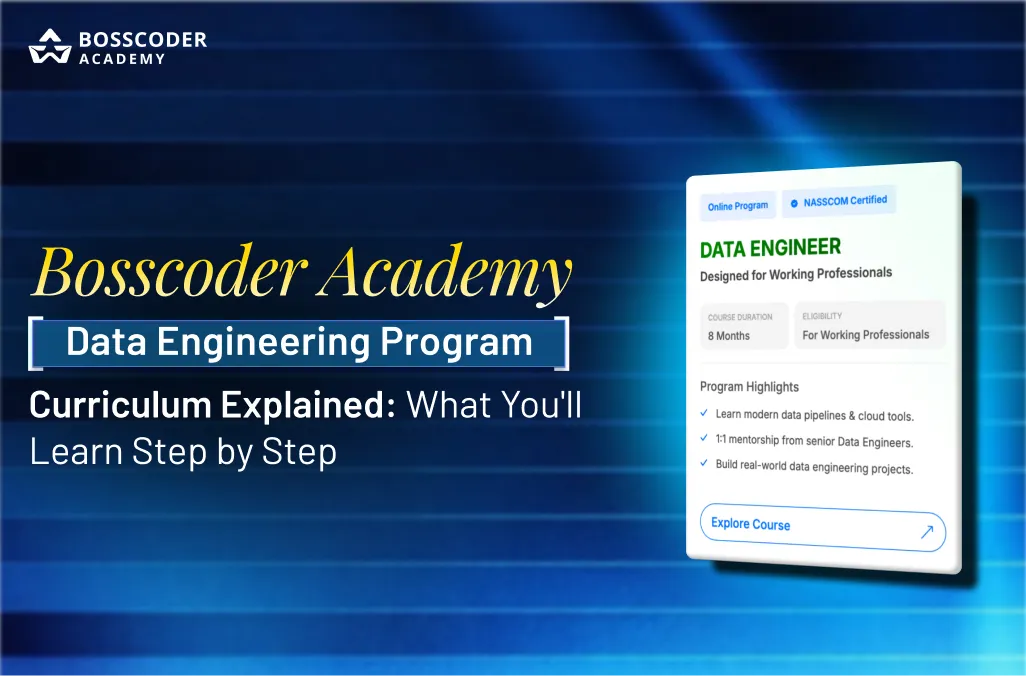
The Bosscoder Academy Data Engineering Program is designed to take learners from fundamentals to advanced concepts through a step-by-step roadmap. Instead of learning random tools from different sources, professionals follow a structured learning path that covers the skills commonly used in modern Data Engineering roles.
Let's understand the complete curriculum in detail.
Why a Structured Data Engineering Roadmap Matters
The Data Engineering ecosystem contains hundreds of tools and technologies. Learning everything is neither possible nor necessary.
What matters is learning the right concepts in the right sequence.
The Bosscoder Academy Data Engineering curriculum is divided into six major modules:
- Programming → Learn SQL and Python, the two most important skills every Data Engineer uses daily.
- Data Engineering Fundamentals → Understand databases, data warehousing, and data modeling concepts.
- Data Engineering Tools → Work with ETL, Big Data, Spark, Kafka, and industry-standard platforms.
- Cloud Technologies → Learn how modern data systems are built and managed on AWS, GCP, and Azure.
- Focused DSA for Data Engineers → Prepare for technical interviews at product-based companies.
- GenAI & Agentic Systems → Understand how AI-powered systems interact with modern data platforms.
Module 1: Programming (10 Weeks)
Strong basics are non-negotiable. That's why curriculum starts with programming because every Data Engineer needs strong foundations in SQL and Python.
SQL
SQL helps Data Engineers query, manage, and analyze data stored in databases.
Topics covered include:
→ Advanced SELECT Statements: Retrieve and filter data efficiently from large databases.
→ Joins: Combine data from multiple tables to answer business questions.
→ Sorting and Grouping: Organize data and create meaningful summaries.
→ Aggregations: Calculate totals, averages, counts, and business metrics.
→ CTEs (Common Table Expressions): Write cleaner and more readable SQL queries.
→ Sub queries: Use one query inside another for advanced analysis.
→ Window Functions: Perform calculations across rows without losing data details.
→ Recursive CTEs: Solve hierarchical and relationship-based problems.
→ Advanced String Functions & Regex: Clean and transform messy data.
Python
Python is widely used for automation, data processing, and building pipelines.
Topics covered include:
→ Python Fundamentals: Build a strong foundation in programming.
→ Functional Programming: Write cleaner and reusable code.
→ Modules, Errors & Exceptions: Handle unexpected issues in applications.
→ OOPs: Organize code using classes and objects.
→ NumPy: Perform efficient numerical computations.
→ Pandas: Work with structured datasets and data transformations.
→ Data Visualization: Present insights through charts and graphs.
→ Stock Market Project: Apply Python concepts on a real-world dataset.
Module 2: Data Engineering Fundamentals (5 Weeks)
Once the programming foundation is complete, learners move into the core concepts of Data Engineering.
Database Management Systems
This section helps learners understand how databases work behind the scenes.
Topics include:
→ RDBMS: Learn traditional relational databases used by businesses.
→ NoSQL Databases: Understand flexible databases used for large-scale applications.
→ Columnar Databases: Explore databases optimized for analytics workloads.
→ Graph Databases: Learn how relationship-based data is stored and queried.
→ ACID Properties: Understand how databases maintain consistency and reliability.
→ Database Architecture: Learn how database systems are structured.
→ ER Modeling: Design relationships between business entities.
→ Normalization & De-normalization: Optimize database performance and storage.
Data Warehousing
Data warehouses are used to store and analyze large amounts of business data.
Topics include:
→ OLTP vs OLAP: Understand operational systems and analytics systems.
→ Data Warehouse Architecture: Learn how enterprise data warehouses are designed.
→ Facts & Dimensions: Understand the foundation of reporting systems.
→ Star Schema: Create efficient reporting models.
→ Snowflake Schema: Build normalized warehouse structures.
→ SCD Type 1, 2 & 3: Track changes in historical business data.
→ DBT: Transform data efficiently within modern data warehouses.
→ Apache Airflow: Automate and schedule data workflows.
→ Indexing & Clustering: Improve query performance.
→ Sharding & Query Optimization: Scale databases for large workloads.
Data Modeling Practice
Learners solve practical business problems by designing data models for:
→ Banking Systems: Model customers, accounts, and transactions.
→ Cab Booking Platforms: Design systems similar to ride-sharing applications.
→ E-commerce Platforms: Structure products, orders, and customer data.
→ Netflix-like Systems: Understand streaming platform data architecture.
→ Learning Management Systems: Design educational platform databases.
→ Healthcare Systems: Model patient, doctor, and medical records data.
Module 3: Data Engineering Tools (6 Weeks)
This module introduces learners to tools commonly used by Data Engineers in production environments.
ETL & Data Integration Tools
→ DBT: Transform raw data into analysis-ready datasets.
→ Apache Airflow: Schedule and manage data workflows.
→ Fivetran: Automate data ingestion from multiple sources.
Big Data Fundamentals
→ Snowflake: Learn one of the most popular cloud data warehouses.
→ Google BigQuery: Analyze massive datasets using serverless infrastructure.
→ Databricks: Build modern data processing pipelines.
→ HDFS: Store large-scale distributed data efficiently.
Real-Time & Distributed Processing
→ Apache Spark: Process large datasets quickly across distributed systems.
→ Apache Kafka: Handle real-time data streams and events.
System Design for Data Engineering
→ Batch vs Streaming: Understand different data processing approaches.
→ Lambda & Kappa Architecture: Learn common big data architectures.
→ Ingest → Process → Store → Serve: Understand the complete data lifecycle.
→ Netflix/Uber-style Pipelines: Learn how large-scale systems are designed.
→ Scalability & Fault Tolerance: Build systems that remain reliable at scale.
Module 4: Cloud Technologies (5 Weeks)
Most modern Data Engineering workloads run on cloud platforms. This module helps learners understand cloud-based data infrastructure.
AWS
→ Amazon S3: Store data securely in the cloud.
→ Amazon RDS & Aurora: Manage cloud-based databases.
→ AWS Glue: Build ETL pipelines.
→ Data Migration Services: Move data across systems.
→ EC2: Run applications and workloads on virtual servers.
→ Lambda: Execute code without managing servers.
→ IAM: Control access and permissions.
→ CloudWatch & CloudTrail: Monitor and track cloud activities.
Google Cloud Platform
→ BigQuery: Analyze large datasets efficiently.
→ Cloud Storage: Store structured and unstructured data.
→ Data flow: Process streaming and batch data.
→ Dataproc: Run Spark and Hadoop workloads.
Microsoft Azure
→ Azure Synapse Analytics: Analyze enterprise-scale data.
→ Azure Data Lake Storage: Store large volumes of structured and unstructured data.
→ Azure Data Factory: Build data integration pipelines.
→ Azure Databricks: Run large-scale data processing workloads.
DevOps for Data Engineering
→ CI/CD Pipelines: Automate deployment processes.
→ Terraform: Manage infrastructure through code.
→ Docker: Package applications consistently.
→ Kubernetes: Deploy and manage containers at scale.
Important Add-ons
Few advanced modules are included as important add-ons to help learners stay aligned with evolving industry trends and emerging technologies.
Focused DSA for Data Engineers (8 Weeks)
Many product-based companies evaluate problem-solving skills during interviews.
This module focuses on the DSA topics most relevant for Data Engineering roles:
- Arrays: Solve data manipulation problems efficiently.
- Strings: Handle text-processing challenges.
- Binary Search: Optimize search operations.
- Recursion & Backtracking: Solve complex algorithmic problems.
- Hashing: Improve lookup and retrieval performance.
- Stacks & Queues: Understand important data structures.
- Linked Lists & Trees: Build strong problem-solving foundations.
- Dynamic Programming: Solve optimization problems efficiently.
- Graphs: Model and solve network-based problems.
- Time & Space Complexity: Evaluate algorithm performance.
GenAI & Agentic Systems (4 Weeks)
AI is becoming an important part of modern data platforms. This module introduces learners to Generative AI and Agentic Systems.
→ LLM Basics: Understand how large language models work.
→ Prompt Engineering: Learn how to interact effectively with AI systems.
→ Structured Outputs: Generate reliable machine-readable responses.
→ Embeddings & Vector Databases: Power semantic search and AI applications.
→ RAG Systems: Connect AI models with external knowledge.
→ Agentic Systems: Build AI workflows that can perform tasks autonomously.
How This Curriculum Differs From Random Online Courses
Many Data Engineering courses focus only on a few tools.
You might learn Spark from one course, Kafka from another, and AWS from somewhere else.
The result is often fragmented knowledge.
The Bosscoder Academy Data Engineering Program follows a structured Data Engineering roadmap where every topic builds upon the previous one.
→ Programming first so learners understand data manipulation.
→ Fundamentals next to build database and warehousing knowledge.
→ Tools afterward to apply concepts in real systems.
→ Cloud technologies to understand production environments.
→ DSA preparation for interviews.
→ GenAI skills for future-ready Data Engineering careers.
This makes the learning journey more practical and easier to follow for working professionals.
Industry Projects Included in the Program
Learners also work on projects inspired by real companies:
- ETL Pipeline for Tesla Vehicle Telemetry
- Data Transformation for Airbnb Bookings
- Real-Time Streaming Analytic for Netflix
- Spotify Music Analytic
- Processing Ride Data for Uber
- Market Analytics on Stocks for Goldman Sachs
- Predicting Customer Churn for Amazon Prime
- Dashboard to discover Sales Analytics for Walmart
All of these projects allow learners to create their portfolio while applying concepts in practical business situations.
Who Should Join This Program?
This curriculum is suitable for:
→ Software Engineers looking to move into Data Engineering.
→ Data Analysts wanting to build technical data skills.
→ Frontend Developers interested in large-scale data systems.
→ Working professionals targeting product-based companies.
→ Engineers looking for a structured Data Engineering learning path.
→ Professionals wanting hands-on experience with modern data tools.
Final Thoughts
The biggest challenge in learning Data Engineering is not finding resources—it is knowing what to learn and in what order.
The Bosscoder Academy Data Engineering Program solves this problem through a structured curriculum that covers SQL, Python, databases, data warehousing, ETL tools, cloud technologies, system design, DSA, and modern AI systems.
By the end of the program, learners gain:
→ Practical experience with the use of SQL and Python (i.e., processing data).
→ Real life experience using Airflow, DBT, Spark, Kafka and Snowflake through the various labs in this program.
→ Familiarity with cloud services such as AWS, GCP and Azure.
→ An understanding of how to design systems from an engineering perspective.
→ Preparation for interviews including practice on DSA topics and
→ Exposure to GenAI and Agentic Systems.
For working professionals aiming to transition into Data Engineering roles at product-based companies, to develop the desired skill sets in a logical manner that aligns with industry best practices.
Frequently Asked Questions (FAQs)
Q1. What topics are covered in the Bosscoder Academy Data Engineering Program curriculum?
Topics in the Bosscoder Academy Data Engineer Program include:
- SQL
- Python
- Database Management Systems (DBMS)
- Data Warehouse
- ETL Pipelines
- Apache Spark
- Kafka
- Airflow
- DBT
- Snowflake
- Cloud platforms, including AWS, GCP, and Azure
- System Design.
- Data Structures and Algorithms
- GenAI.
The curriculum structure of the programme goes from fundamentals to advanced Data Engineering Concepts.
Q2. Is the Bosscoder Academy Data Engineering Program suitable for beginners?
The Bosscoder Academy Data Engineer programme starts at an introductory level by covering topics such as SQL and Pascal before advancing to topics like Data Warehousing, Spark, Kafka, Cloud Technologies, and System Design.
This approach to learning will help all types of professionals, especially those who have experience in software development, data analysis, and/or those who are currently working but want to move into the field of data engineering, begin their journey in Data Engineering.
Q3: Does the Bosscoder Academy Data Engineering Program include real-world projects?
Yes, learners will work on a variety of industry-inspired projects, including:
- Real-Time Streaming Analytic for Netflix
- Spotify Music Analytic
- Processing Ride Data for Uber
- Market Analytics on Stocks for Goldman Sachs
By completing these types of projects, learners will apply what they have learned and develop portfolios for future job interviews.
Q4. What tools and technologies will I learn in the Bosscoder Academy Data Engineering Program?
The program includes hands-on training in SQL, Python, Apache Spark, Kafka, Airflow, DBT, Snowflake, Databricks, BigQuery, AWS, Azure, GCP, Docker, Kubernetes, and Terraform. Learners also gain exposure to modern topics such as Generative AI, Vector Databases, RAG, and Agentic AI systems.